Pachysandra terminalis
Siebold. & Zucc.
Japanese spurge
(c) Algirdas, some rights reserved (CC BY-SA)

(c) Carl Lewis, some rights reserved (CC BY)

(c) Carl Lewis, some rights reserved (CC BY)
What to Eat
Edible parts: Fruit
The fruit can be eaten raw or cooked and is sweet and juicy. The ovoid fruits are 5–6mm long. Fruit is not usually produced in cultivation, possibly because both male and female plants are required and most people grow only one.
Where to Find It
A temperate plant. It grows in moist deciduous woods in valleys and low mountains to 2000 metres. It can grow in shade. It needs moist well drained soil. It does not do well in full sun, dry soils or in windy locations. It can stand frost. Melbourne Botanical gardens. It suits hardiness zones 5-10.
Asia, Australia, Canada, China, Japan*, Korea, North America, Slovenia,
How to Identify
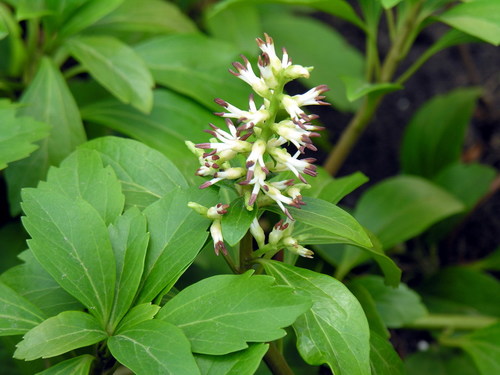
A small evergreen shrub 20 cm high. It spreads to 50 cm across. Leaves are glossy dark green. They are clustered at the tips of the short stems. The upper half of the leaves are often toothed. Plants are separately male and female so both are required for fruit production. The flowers are small and greenish or white and without petals. The flowers have a pleasant sweet smell.
How to Grow
Plants can be grown from seed. It an also be grown from cuttings of half ripe wood. These should be 4-7 cm long and with a node attached. Plants are most easily grown by dividing the clump in spring.
Propagation: Sow seed in a cold frame as soon as it is ripe if possible, otherwise in late winter. Prick out seedlings into individual pots when large enough to handle and grow on in a shady part of the greenhouse or cold frame. Plant out in early summer of the following year. Cuttings of half-ripe wood, 4–7cm long taken at a node, can be taken June to August in a shady position in a frame. Division in spring is very easy — larger divisions can go directly into permanent positions, while smaller ones are better potted up and grown on in light shade in a cold frame until well established, then planted out in late spring or early summer.
Medicinal Uses
None known.
Other Uses
A very useful ground cover plant for shady positions, spreading by means of underground runners. It is a vigorous grower but not overly invasive, and grows well in the shade of shrubs.
Wikipedia
Source ↗Pachysandra terminalis, the Japanese pachysandra, carpet box or Japanese spurge, is a species of flowering plant in the boxwood family Buxaceae, native to Japan, Korea and China and introduced to eastern North America. It is a slow-growing, spreading evergreen perennial growing to 10 cm (4 in) tall by 60 cm (24 in) broad, with alternate, simple, glossy leaves, and creeping stems. The leaves may yellow in direct sunlight or in winter. When growing in a spreading mass of many plants, a dense cover is formed. The flowers are white, borne above the foliage. In temperate Northern Hemisphere sites they appear late in the month of March and throughout the month of April. The plant is very cold hardy. The specific epithet terminalis means "ending", and refers to the clusters of leaves which appear at the end of the short stems.
Notes
There are 4 Pachysandra species.
Names & Synonyms
Japonska pahisandra
References (9)
- Abh. Math.-Phys. Cl. Koenigl. Bayer. Akad. Wiss. 4(2):142. 1845
- Cundall, P., (ed.), 2004, Gardening Australia: flora: the gardener's bible. ABC Books. p 972
- Heywood, V.H., Brummitt, R.K., Culham, A., and Seberg, O. 2007, Flowering Plant Families of the World. Royal Botanical Gardens, Kew. p 75
- Hibbert, M., 2002, The Aussie Plant Finder 2002, Florilegium. p 217
- http://www.botanic-gardens-ljubljana.com/en/plants
- Joyce, D., 1998, The Garden Plant Selector. Ryland, Peters and Small. p 151
- Lord, E.E., & Willis, J.H., 1999, Shrubs and Trees for Australian gardens. Lothian. p 249
- Plants for a Future database, The Field, Penpol, Lostwithiel, Cornwall, PL22 0NG, UK. http://www.scs.leeds.ac.uk/pfaf/
- Ryan, S., 2008, Dicksonia. Rare Plants Manual. Hyland House. p 108


