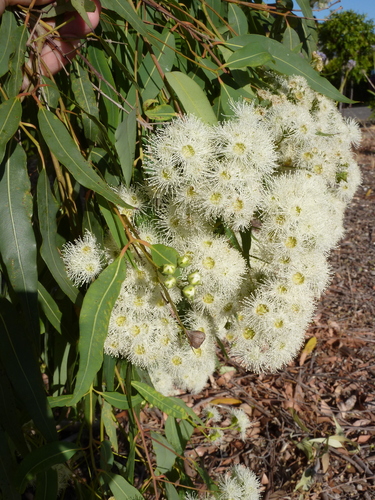
Eugenia capensis
(Eckl. & Zeyh.) Harv. ex Sond.
Dune myrtle, Myrtle apple
(c) magdastlucia, some rights reserved (CC BY-NC), uploaded by magdastlucia
(c) Sharon Louw, some rights reserved (CC BY-NC), uploaded by Sharon Louw

(c) Tony Rebelo, some rights reserved (CC BY-SA), uploaded by Tony Rebelo
What to Eat
Edible parts: Fruit
The flesh of the small dark blue to black fruits is eaten occasionally.
Where to Find It
A tropical plant. It suits warm sandy areas. It occurs in South Africa on dunes. It can be associated with mangrove swamps. It suits hardiness zones 9-12.
Africa, Australia, Central Africa, Congo, East Africa, Eswatini, Kenya, Malawi, Mozambique, South Africa, Southern Africa, Swaziland, Tanzania, Zambia, Zimbabwe,
How to Identify
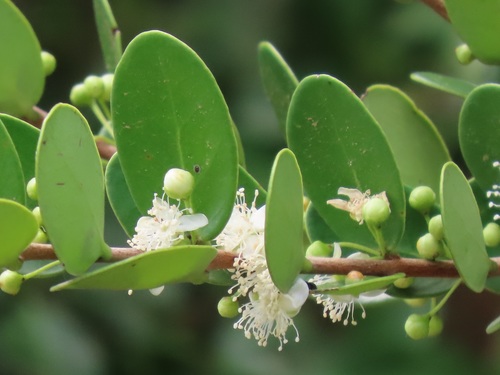
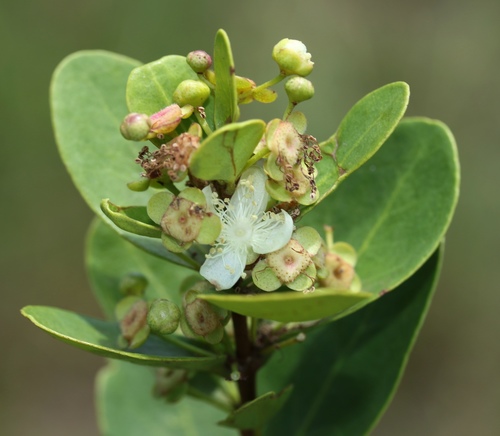
A low shrub. It can grow to 7 m tall. It is evergreen and with many branches. The bark is grey or brown. The leaves and small and leathery. The twigs are short, flattened and angled. The leaves are thick and oval and mostly opposite each other along the twigs. They are 1.3-3.8 cm long. The edges of the leaves are thickened and rolled inwards. The edges are smooth. The midrib and veins are easy to see underneath the leaf. The leaves and shoots have dense whitish hairs. The leaves have short leaf stalks. The flowers are small and white. The flowers occur either in the angles where leaves join or on old wood. The fruit is about 0.8 cm long and slightly oval. The ends of the flower remain to form a crown like section on the fruit. The fruit are dark blue to black. They have a large stone. The fruit are edible. There are several subspecies.
Nutrition Score: 48/100
| Part | Moisture | kJ | kcal | Protein | Vit A | Vit C | Iron | Zinc |
|---|---|---|---|---|---|---|---|---|
| Fruit | 68.6 | 496 | 119 | 0.9 | — | 107 | 1.7 | 0.1 |
| Fruit | 81.8 | 360 | 86 | 2.8 | — | — | — | — |
How to Grow
Propagation: Seed - best sown as soon as it is ripe.
Other Uses
The white wood is hard and heavy. It is used for making small items such as poles and spoons. The wood is used for fuel and for making charcoal.
Wikipedia
Source ↗Eugenia capensis, the dune myrtle, is a species of plant in the family Myrtaceae, which is native to East and southern Africa.
Notes
There are about 550 Eugenia species. They are mostly in tropical and subtropical South America.
Names & Synonyms
Inhlele, Mkaaga, Tshitawatawane, Ukelenkele