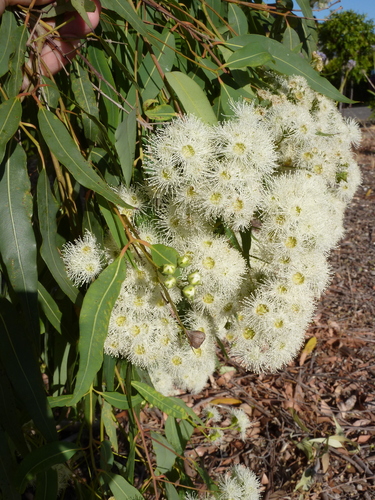
Eugenia capensis subsp. natalitia
(Sond.) F. White
Natal myrtle, Natal eugenia, Forest myrtle

Royal Botanic Gardens, Kew

Royal Botanic Gardens, Kew

Royal Botanic Gardens, Kew
What to Eat
Edible parts: Fruit
The round fruits with edible flesh are eaten.
Where to Find It
It occurs in South Africa mostly on dunes and in coastal areas. It can occur on the edges of forests. In Brisbane Botanical Gardens.
Africa, Australia, East Africa, Eswatini, Mozambique, South Africa, Southern Africa, Swaziland, Zimbabwe,
How to Identify
A shrub or tree which can reach 8 m tall. It has spreading branches. The trunk is smooth and cream coloured. The leaves are dark green and leathery. The leaves have a sweet smell. The young leaves are soft and light pink. The leaves are shiny and grow opposite one another along the branch. The leaves are a duller green underneath. They are 2.5-8 cm long and 1.3-3.8 cm wide. They are oval in shape but taper towards each end. The edge of the leaf does not have teeth but it is often rolled inwards and wavy. The midrib is easily visible and is sunken on the top of the leaf and raised under the leaf. The side veins are indistinct. The leaf stalk is grooved along its length. The flowers are white and fluffy. They are on slender stalks either near the leaves or on old wood. The fruit is round and 0.8-1.3 cm across. At the end of the fruit the flower continues like a crown. The fruit has a large round stone. The fruit flesh is edible.
How to Grow
It can be grown as a hedge.
Wikipedia
Source ↗Eugenia capensis, the dune myrtle, is a species of plant in the family Myrtaceae, which is native to East and southern Africa.
Production
In the southern hemisphere flowering is about October to December.
Notes
There are about 550 Eugenia species. They are mostly in tropical and subtropical South America.
Names & Synonyms
Bosmirt, Ijobe, Inchitsamuti, Lijobe, Lijoye, Mutulumembe, Tinkelenkele, Tshitawatawane, Tshitulumembe
References (8)
- Long, C., 2005, Swaziland's Flora - siSwati names and Uses http://www.sntc.org.sz/flora/ (As Eugenia natalitia)
- Magwede, K., van Wyk, B.-E., & van Wyk, A. E., 2019, An inventory of Vhavenḓa useful plants. South African Journal of Botany 122 (2019) 57–89 (As Eugenia natalitia)
- Palmer, E and Pitman, N., 1972, Trees of Southern Africa. Vol. 3. A.A. Balkema, Cape Town p 1669 (As Eugenia natalitia)
- Peters, C. R., O'Brien, E. M., and Drummond, R.B., 1992, Edible Wild plants of Sub-saharan Africa. Kew. p 154 (As Eugenia natalitia)
- Ruiters-Welcome, A. K., 2019, Food plants of southern Africa. Ph.D. thesis. Univ. of Johannesburg p 81 (As Eugenia natalitia)
- Schmidt, E., Lotter, M., & McCleland, W., 2007, Trees and shrubs of Mpumalanga and Kruger National Park. Jacana Media p 476 (As Eugenia natalitia)
- Swaziland's Flora Database http://www.sntc.org.sz/flora (As Eugenia natalitia)
- Welcome, A. K. & Van Wyk, B.-E., 2019, An inventory and analysis of the food plants of southern Africa. South African Journal of Botany 122 (2019) 136–179 (As Eugenia natalitia)