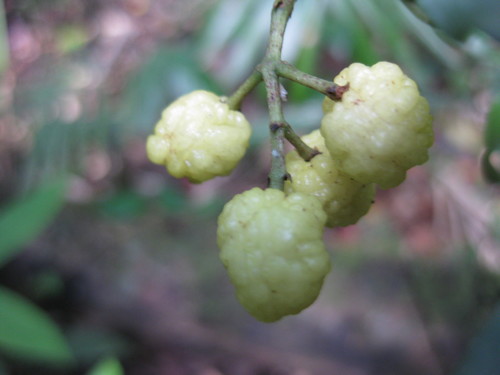
Evodia sp.

wikimedia · cc0
Wikimedia Commons - National Museum of Natural History
Wikimedia Commons - National Museum of Natural History

wikimedia · cc0
Wikimedia Commons - Philipp Franz von Siebold and Joseph Gerhard Zuccarini
Wikimedia Commons - Philipp Franz von Siebold and Joseph Gerhard Zuccarini
What to Eat
Edible parts: Leaves
The leaves are used as a flavouring.
Known Hazards
Where to Find It
A tropical plant. It grows wild over a widespread area.
Pacific, Papua New Guinea, PNG,
Countries: Australia, Fiji, Micronesia, Kiribati, Marshall Islands, Nauru, New Zealand, Papua New Guinea, Palau, Solomon Islands, Tonga, Tuvalu, Vanuatu, Samoa
How to Identify
Euodia sp. probably hortensis Forst. Sometimes also spelt Evodia. A shrub up to 5 m tall. The leaf shape varies and the leaves have a smell. It has small white flowers which occur in large clusters. The fruit is small about 5 mm long.
How to Grow
Plants grow from seeds.
Notes
NB Often used as medicine. There are about 150 Euodia species.
References (3)
- Altschul, S.V.R., 1973, Drugs and Foods from Little-known Plants. Notes in Harvard University Herbaria. Harvard Univ. Press. Massachusetts. no. 1895G
- French, B.R., 1986, Food Plants of Papua New Guinea, A Compendium. Asia Pacific Science Foundation p 346
- Powell, J.M., Ethnobotany. In Paijmans, K., 1976, New Guinea Vegetation. Australian National University Press. p 110