Euonymus oxyphyllus
Miq.
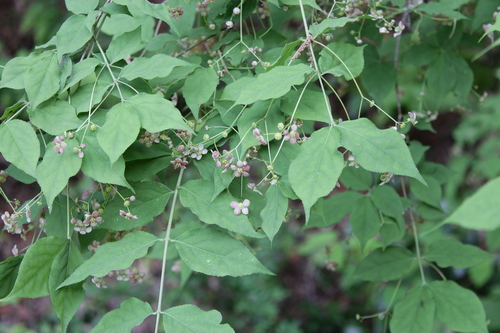
(c) harum.koh, some rights reserved (CC BY-SA), uploaded by harum.koh
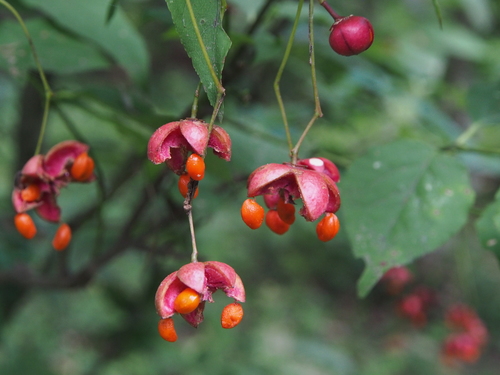
(c) Keita Watanabe, some rights reserved (CC BY-NC), uploaded by Keita Watanabe

(c) MP Zhou, some rights reserved (CC BY-NC), uploaded by MP Zhou
What to Eat
Edible parts: Leaves, Caution
Young leaves can be eaten after boiling. Some caution is advised given the possible toxicity associated with this genus.
Known Hazards
Where to Find It
It is a temperate plant. In China it grows between sea level to 2,300 m above sea level. It suits hardiness zones 5-9.
Asia, China, Japan, Korea, Taiwan,
How to Identify
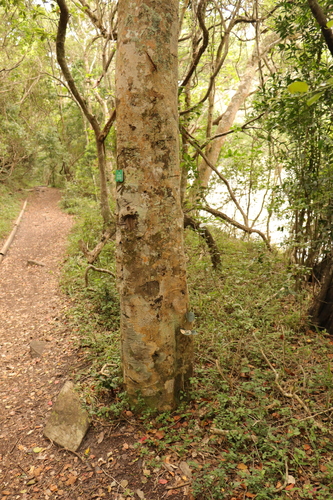
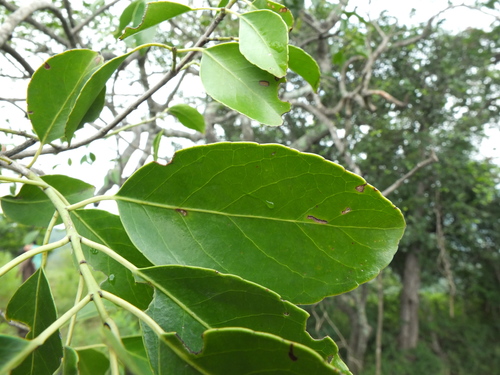
A deciduous tree. It grows 6 m high. It is often only 2.4 m high and 2.4 m wide. The leaves are dull green and oval. The tips are pointed and there are teeth along the edge which are turned inwards. The leaves turn purple-red in autumn. The flowers are greenish-brown. The fruit is dark red and round. They have 4 or 5 ribs. The seeds are bright red.
How to Grow
Thriving in almost any soil, including chalk, it is particularly suited to dry shaded areas. Prefers a well-drained loamy soil. A very ornamental plant, it is hardy to about -25°c. A slow growing plant, though it makes a large shrub in time.
Propagation: Seed is best sown as soon as it is ripe in a cold frame. Stored seed requires 3 months of cold stratification and should be sown as early in the year as possible; seed can take 18 months to germinate. When seedlings are large enough to handle, prick them out into individual pots and grow on in the greenhouse for at least their first winter. Plant out into permanent positions in late spring or early summer, after the last expected frosts. Cuttings of half-ripe wood, 5–7cm long, taken at a node or with a heel, root very easily in July or August in a frame.
Medicinal Uses
The plant is used in gynaecological applications.
Other Uses
The wood is hard, elastic, and very fine-grained. It is used for stamps, printing blocks, and mosaics.
Wikipedia
Source ↗Euonymus oxyphyllus, the Korean spindle tree, is a species of flowering plant in the family Celastraceae, native to central and eastern China (including Taiwan), Manchuria, Korea, Japan and the Kurils. It is a shrub or small tree typically reaching 2.5 m (8 ft). The Royal Horticultural Society considers it to be a good tree for smaller gardens, especially for its colorful Autumn foliage and fruits.
Notes
There are about 175 Euonymus species.
References (3)
- Ann. Mus. Bot. Lugduno-Batavum 2:86. 1865
- Etherington, K., & Imwold, D., (Eds), 2001, Botanica's Trees & Shrubs. The illustrated A-Z of over 8500 trees and shrubs. Random House, Australia. p 314
- Plants for a Future database, The Field, Penpol, Lostwithiel, Cornwall, PL22 0NG, UK. http://www.scs.leeds.ac.uk/pfaf/