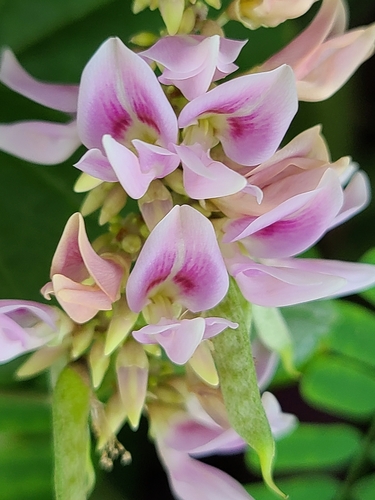
Psoralea orbicularis
Lindl.
Roundleaf Leather Root

Arizona State University Vascular Plant Herbarium (ASU-Plants)

FSC - Fresno State Herbarium (FSC-)
What to Eat
Edible parts: Leaves
Leaves - cooked.
Known Hazards
Where to Find It
South-western N. America.
NORTHERN AMERICA: United States (California), Mexico (Baja California (Norte) (north))
How to Identify
Psoralea orbicularis is a PERENNIAL growing to 0.1 m (0ft 4in) by 0.6 m (2ft). See above for USDA hardiness. It is hardy to UK zone 6. The species is hermaphrodite (has both male and female organs) and is pollinated by Insects. It can fix Nitrogen. Suitable for: light (sandy), medium (loamy) and heavy (clay) soils and prefers well-drained soil. Suitable pH: mildly acid, neutral and basic (mildly alkaline) soils. It cannot grow in the shade. It prefers dry or moist soil.
How to Grow
Succeeds in an ordinary garden soil. We have very little information on this species but it is growing at Kew in the system beds and seems to be thriving there. Plants are very intolerant of root disturbance, they are best planted out into their permanent positions whilst still small. This species has a symbiotic relationship with certain soil bacteria, these bacteria form nodules on the roots and fix atmospheric nitrogen. Some of this nitrogen is utilized by the growing plant but some can also be used by other plants growing nearby.
Propagation: Pre-soak the seed for 24 hours in warm water and then sow in early to mid spring in a greenhouse. Either sow the seed in individual pots or pot up the young seedlings as soon as possible in order to avoid root disturbance. Grow them on in the pots until planting out in their final positions. It is usually impossible to transplant this species without fatal damage to the root. Division in spring. With great care since the plant resents root disturbance. It is virtually impossible to divide this species successfully.
Medicinal Uses
Blood purifier FebrifugeA decoction of the root used as a blood purifier and in the treatment of fevers.
Other Uses
Soil stabilization. The plant is a good soil stabilizer in its natural environment.