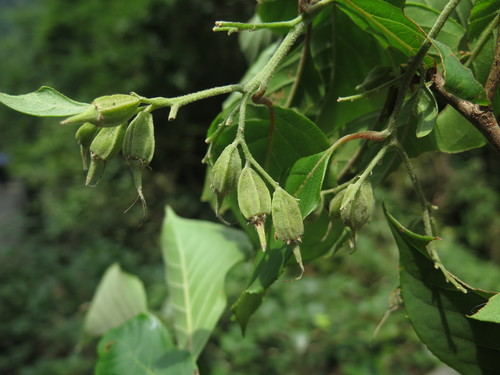
Pterostyrax corymbosa
Siebold.&Zucc.
Epaulette Tree

Guanning Liu

rodan_

rhinolin
What to Eat
Edible parts: Leaves
Leaves - cooked. A famine food, it is only used when all else fails.
Where to Find It
E. Asia - China, Japan.
Coming Soon
How to Identify
Pterostyrax corymbosa is a deciduous Tree growing to 12 m (39ft 4in) at a fast rate. See above for USDA hardiness. It is hardy to UK zone 6. It is in flower from June to July. The species is hermaphrodite (has both male and female organs). Suitable for: light (sandy), medium (loamy) and heavy (clay) soils. Suitable pH: mildly acid and neutral soils and can grow in very acid soils. It can grow in semi-shade (light woodland) or no shade. It prefers moist soil.
How to Grow
Requires a good loamy soil and a sunny position. Requires a deep acid soil in sun or semi-shade. A fast-growing tree. Often confused with P. hispida. Flowers are most abundantly produced on wood that was well-ripened the previous summer. Plants in this genus are notably resistant to honey fungus.
Propagation: Seed - best sown as soon as it is ripe in a cold frame. Stored seed requires 3 months cold stratification at 5°c. Prick out the seedlings into individual pots when they are large enough to handle and grow them on in the greenhouse or cold frame for their first winter. Plant them out in the late spring or early summer of the following year. Cuttings of half-ripe wood, July/August in a frame. Layering.
Names & Synonyms
More from Styracaceae