Citrus lucida
(Scheff.) Mabb.
Wood apple

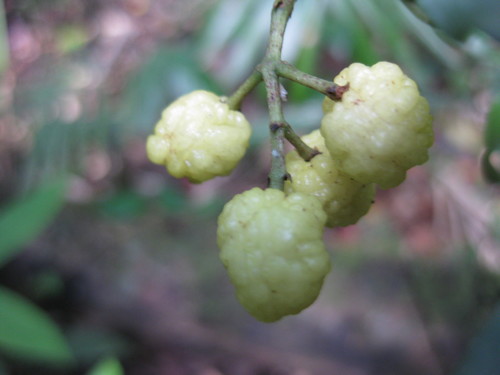
(c) Alexey P. Seregin, some rights reserved (CC BY-NC), uploaded by Alexey P. Seregin
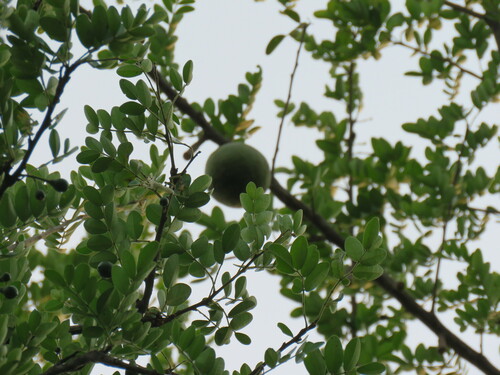
(c) Wangworn Sankamethawee, some rights reserved (CC BY-NC)

(c) fahmmp, some rights reserved (CC BY-NC)
What to Eat
Edible parts: Leaves, Fruit
In Cambodia and Java, Feroniella lucida is occasionally cultivated as a fruit tree. The pulp of the raw fruits is eaten as a vegetable. The pericarp is used medicinally. The pulp is used as a sour ingredient in Cambodian and Thai cooking. Feroniella lucida can be grown as an indoor bonsai. One of the phytochemicals the plant contains is lichexanthone.
Where to Find It
A tropical plant. It grows in dense forests and secondary undergrowth. It is also cultivated.
Asia, Bangladesh, Cambodia, India, Indochina, Indonesia, SE Asia, Sri Lanka, Thailand,
How to Identify
A small tree. It grows 6-15 m tall. It may or may not have thorns. These thorns can be 8 cm long on the branches. The leaves are alternate and 8 cm long. They are compound with a single leaflet at the end. There are 3-4 pairs of leaflets. These are oval and finely irregular along the edge. They have a rough surface and are shiny on the upper surface. They are covered with cottony hairs underneath. The leaflets are 1.5-3.5 cm long by 1-1.5 cm wide. The leaf stalk is hairy. The flowers can be in the axils of leaves or at the ends of branches. Flowers have 5 petals. The fruit is rounded with a hard outer cover. It is green with white flesh. There are many seeds inside.
Names & Synonyms
Kawista-krikil, Krasang, Krasang si Phle, Ma sang, Som kaek
References (14)
- Arora, R. K., 2014, Diversity in Underutilized Plant Species - An Asia-Pacific Perspective. Bioversity International. p 70 (As Feroniella lucida)
- Bull. Soc. Bot. France 59:781. 1912
- Burkill, I.H., 1966, A Dictionary of the Economic Products of the Malay Peninsula. Ministry of Agriculture and Cooperatives, Kuala Lumpur, Malaysia. Vol 1 (A-H) p 1015
- Chatterjee, A. S., 1997, Fruit Trees in Cambodian Home Gardens. Trainers' training manual. Home garden series No.3 p 54
- Jacquat, C., 1990, Plants from the Markets of Thailand. D.K. Book House p 73
- Khumgratok, S., Edible Plants in Cultural Forests of Northeastern Thailand. Mahasarakham University Thailand.
- Lembaga Biologi Nasional, 1977, Buah-Buahan, Balai Pustaka, Jakarta. p 58
- Martin, F. W., et al, 1987, Perennial Edible Fruits of the Tropics. USDA Handbook 642 p 74 (Also as Feroniella oblata)
- Martin, M.A., 1971, Introduction L'Ethnobotanique du Cambodge. Centre National de la Recherche Scientifique. Paris.
- Perera, A. H. and Rajapakse, R. M. N., 1991, A baseline study of Kandyan Forest Gardens of Sri Lanka: Structure, composition and utilization. Forest Ecology and Management, 45:269-280
- Phon, P., 2000, Plants used in Cambodia. © Pauline Dy Phon, Phnom Penh, Cambodia. p 297
- Solomon, C., 2001, Encyclopedia of Asian Food. New Holland. p 409
- Srichaiwong, P., et al, 2014, A Study of the Biodiversity of Natural Food Production to Support Community Upstream of Chi Basin, Thailand. Asian Social Science 10 (2): (As Feroniella lucida)
- World Checklist of Useful Plant Species 2020. Royal Botanic Gardens, Kew