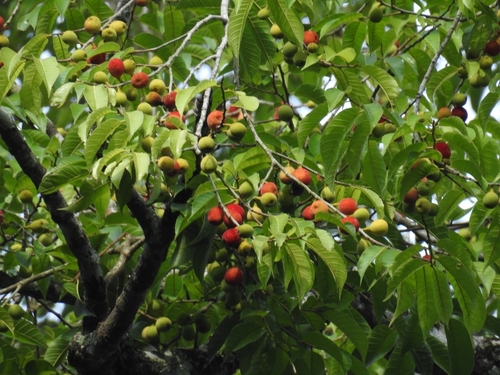
Ficus awkeotsang
Makino
Chinese jello, Love jade seed
MoraceaeSeeds/Nuts
iNaturalist · cc-by-nc
(c) Chen Shu, some rights reserved (CC BY-NC)
(c) Chen Shu, some rights reserved (CC BY-NC)

iNaturalist · cc-by-nc
(c) Chen Shu, some rights reserved (CC BY-NC)
(c) Chen Shu, some rights reserved (CC BY-NC)

iNaturalist · cc-by-nc
(c) 梁士明, some rights reserved (CC BY-NC)
(c) 梁士明, some rights reserved (CC BY-NC)
What to Eat
Edible parts: Seeds - gelatin
Gelatin is purified from the seeds and used to make a popular drink.
Where to Find It
A tropical plant.
Asia, China, Taiwan,
Countries: United Arab Emirates, Afghanistan, Armenia, Azerbaijan, Bangladesh, Bahrain, Brunei, Bhutan, China, Georgia, Indonesia, Israel, India, Iraq, Iran, Jordan, Japan, Kyrgyzstan, Cambodia, North Korea, South Korea, Kuwait, Kazakhstan, Laos, Lebanon, Sri Lanka, Myanmar, Mongolia, Maldives, Malaysia, Nepal, Oman, Philippines, Pakistan, Qatar, Saudi Arabia, Singapore, Syria, Thailand, Tajikistan, Timor-Leste, Turkmenistan, Turkey, Taiwan, Uzbekistan, Vietnam, Yemen
How to Identify
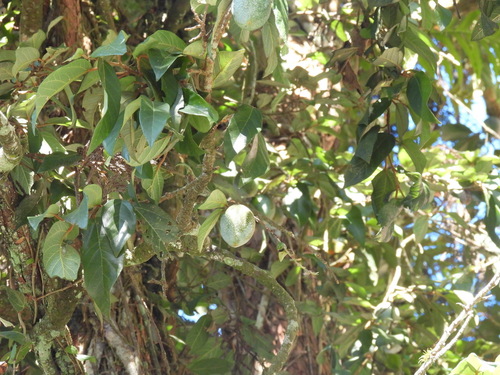
A fig. It is a creeping evergreen vine. It trails on tree trunks and over rocks. The small branches are reddish-brown. The leaves are broadly sword shaped and 6-15 cm long and 4-6 cm wide. They are hairy underneath. The figs are oblong and black and 6-10 in a group are 5 cm long by 3-5 cm wide.
Notes
There are about 800-1000 Ficus species. They are mostly in the tropics. There are 120 Ficus species in tropical America.
Names & Synonyms
Ficus pumila L. var. awkeotsang (Makino) Corner
References (1)
- Hu, Shiu-ying, 2005, Food Plants of China. The Chinese University Press. p 357