Ficus benghalensis
L.
Banyan Tree, Indian Banyan
(c) Kate Turner, some rights reserved (CC BY-NC), uploaded by Kate Turner

(c) margaretlane, some rights reserved (CC BY-NC)

(c) 106611639464075912591, some rights reserved (CC BY-NC-SA), uploaded by 106611639464075912591
What to Eat
Edible parts: Fruit, Leaves, Stems
The ripe figs are eaten raw or cooked as a vegetable, or dried; they are sweet and especially popular with children. Young leaves are eaten as a vegetable and can serve as a famine food, as can young shoots.
Where to Find It
A tropical plant. In Nepal it grows up to 1400 m altitude. They are common over the plains of India. The grow wild in the sub-Himalayan forests. It is a tropical plant. It can tolerate frost. It can grow in arid places. It is moderately salt tolerant. It suits hardiness zones 11-12.
Africa, Andamans, Asia, Australia, Bangladesh, Bhutan, British Indian Ocean Terr., BIOT, East Africa, Egypt, Fiji, Hawaii, Himalayas, India, Indochina, Indonesia, Kiribati, Laos, Malaysia, Maldives, Mauritius, Myanmar, Nauru, Nepal, North Africa, Northeastern India, Pacific, Pakistan, SE Asia, Sikkim, Singapore, Sri Lanka, St Helena, Thailand, United Arab Emirates, UAE, USA, Zimbabwe,
How to Identify
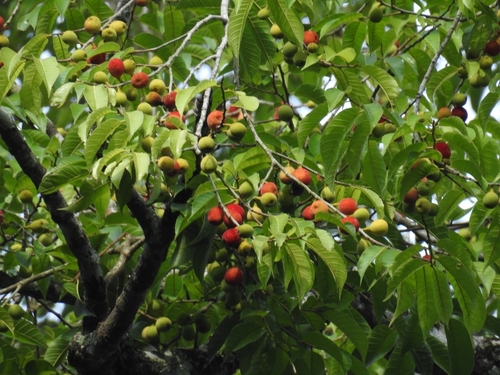
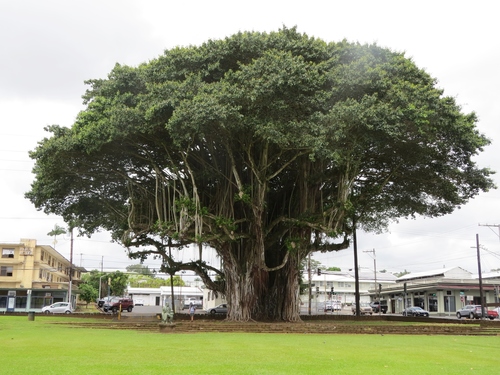
A fig. It is an evergreen tree. It grows to about 35 m high. It has a spreading canopy. The branches have many aerial roots. They are like thick columns. They grow down from the spreading branches. These support the widely spreading crown. One tree can be 60 m wide. The bark is pale grey. The leaves are alternate and stalked. They are 10-20 cm long by 5-12.5 cm wide. They are oval and rounded at the base. They are deep green above and paler underneath. They are also hairy underneath. They are thick and leathery. The flowers are very small and inside the fig. The figs grow between the upper part of the leaf stalk and stem. The figs are round and scarlet when ripe.
Nutrition Score: 44/100
| Part | Moisture | kJ | kcal | Protein | Vit A | Vit C | Iron | Zinc |
|---|---|---|---|---|---|---|---|---|
| Fruit | 13 | — | — | 8.1 | — | 156.6 | 4.1 | — |
How to Grow
Plants can be grown from seeds or cuttings. Young branches should be used for cuttings. Cuttings root easily. One famous tree in Calcutta covers 1.6 ha.
Propagation: Seed - germinates best at a temperature around 20°c. Air layering. Tip cuttings around 4 - 12cm long, taken from lateral branches.
Medicinal Uses
Traditional uses indicate medicinal applications, though specific uses are not detailed in the data.
Other Uses
The aerial roots are used for temporary binding materials. The bark and leaves contain tannins. The latex obtained from all parts of the plant can be used to produce an inferior quality rubber. The wood is light in weight, water-resistant. A low-quality wood, it is not suitable for general use, but it might be employed for secondary cabinet work, such as the linings of drawers and cabinets. It is used locally for poles, cart yokes, furniture and to line wells. This species can be a very noxious weed in the forest, occupying a large amount of space to the exclusion of more useful species. Further, it is very destructive to any walls or buildings it grows near to and is extremely difficult to eradicate.
Wikipedia
Source ↗Ficus benghalensis, Ficus indica, or Ficus audrey commonly known as the banyan, banyan fig, audrey fig and Indian banyan, is a tree native to the Indian subcontinent. Specimens in India are among the largest trees in the world by canopy coverage. It is also known as a "strangler fig" because like many other trees in the genus Ficus it starts out as epiphyte, that is, leaning on another tree that it ends up enveloping.
Production
In India fruit are available June to September.
Other Information
The figs are eaten especially by children. The buds and leaves are sold in markets. It is cultivated.
Notes
There are about 800-1000 Ficus species. They are mostly in the tropics. There are 120 Ficus species in tropical America. This tree is sacred to Hindus.
Names & Synonyms
Aal, Al, Ala, Alada, Alam, Ala-maram, Alamarum, Ara banyan, Bad, Bahupada, Bar, Bara, Bargad, Bargat, Barh, Barnang, Bat, Beringin bulu, Bor, Bot, Cheri hanthor, Khanayo, Khongnangbot, Kirigas, Kraang, Mara, Marri, Ngisa, Nika, Ni-khrot, Peddamarri, Peraal, Pyi-nyaung, Sai, Sami, Torong khongnang, Vad, Vada, Vadla, Vadlo, Vata, Vatam, Vati, Vor, Wad, War, Wora, Zoroo