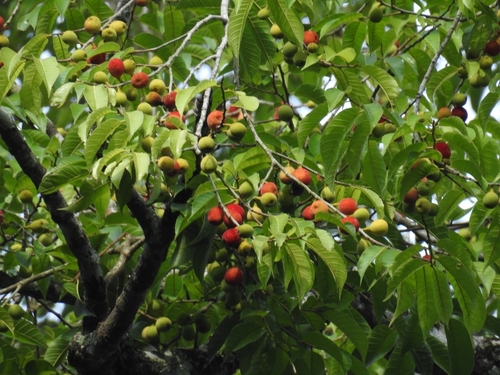
Ficus benjamina
L.
Benjamin’s fig, Weeping fig
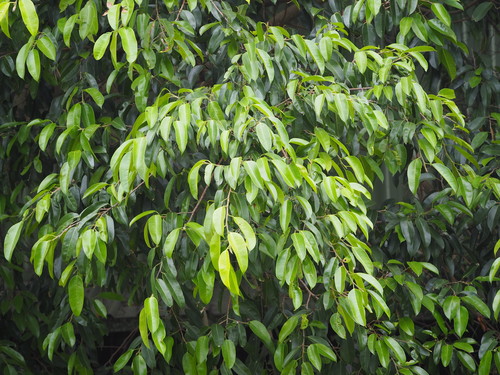
no rights reserved, uploaded by 葉子
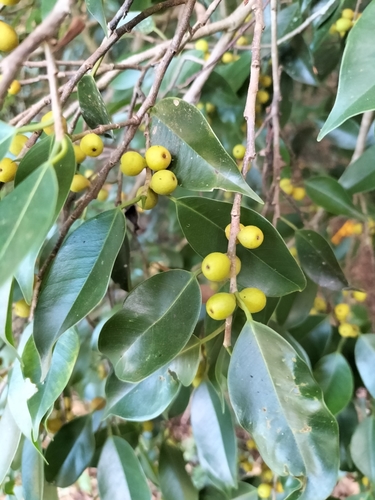
(c) Matthew Borella, some rights reserved (CC BY), uploaded by Matthew Borella
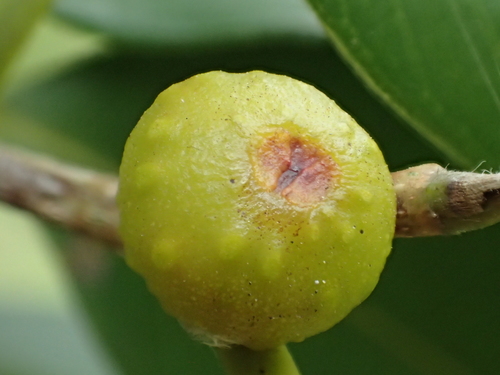
no rights reserved, uploaded by 葉子
What to Eat
Edible parts: Fruit, Leaves
The fruit and leaves are eaten.
Known Hazards
Where to Find It
It is a tropical plant. It can grow in subtropical and warm temperate regions. It does best in rich, moist soil. It needs a protected sunny position. It is damaged by drought and frost. It can survive light frost. They need a minimum temperature above 15°C. It grows naturally in moist coastal monsoon vine forests. In China it grows in mixed forests between 500-600 m altitude in S China. It requires humidity and light. It grows below 700 m altitude in Vietnam. It grows on the edge of secondary forest. In XTBG Yunnan. It suits hardiness zones 10-12. Hobart Botanical Gardens.
Africa, Asia, Australia, Bangladesh, Bhutan, Cambodia, China, Dominican Republic, East Africa, East Timor, Fiji, Haiti, Hawaii, Himalayas, India, Indochina, Indonesia, Laos, Malaysia, Maldives, Myanmar, Nepal, North America, Northeastern India, Pacific, Pakistan, Papua New Guinea, PNG, Philippines, Puerto Rico, Rotuma, SE Asia, Sikkim, Singapore, Solomon Islands, South America, Sri Lanka, Taiwan, Tasmania, Thailand, Timor-Leste, USA, Vietnam, West Indies, Zimbabwe,
How to Identify
A fig. It is an evergreen tree. It grows to 12-30 m high and spreads to 4-15 m across. The stem is erect and slender. It has irregular flanges along it. The trunk can be 30-50 cm across. The branches can hang over and the leaves hang down. The plant can produce aerial roots from the largest branches. The bark is smooth and pale grey. The leaves are simple, green and glossy. They are darker on top. The are leathery and oval and taper towards the tip. Leaves are 5-13 cm long and 2-4.5 cm wide. The leaf stalk is 1 cm long. The flowers are very small. There are separate male and female flowers enclosed in a receptacle or fig. The fruit are dark red and small round figs. They are 1 cm across. They are produced in pairs. Some varieties occur based on the size of the figs.
How to Grow
Plants can be grown by cuttings, suckering or layering. Plants can be grown from seed,
Propagation: Seed - Semi-ripe cuttings.
Medicinal Uses
The bark of the root, the root itself, and the leaves are boiled in oil and applied on wounds and bruises. The juice of the bark (latex?) has a reputation in the Philippines for curing liver diseases. The pounded leaves and bark are applied as a poultice in the treatment of rheumatic headaches.
Other Uses
The inner bark is a source of fibre. The strips of bast of this species are salmon-buff; some are soft and pliable, others hard and stiff. Rope made from the bast possesses a fair degree of tenacity. With a tensile strength of 480 kilos per square centimeter. Wetting reduced the strength only 2%. The bark contains about 4.2% tannins. A latex can be obtained from all parts of the plant. It contains 30% caoutchouc, along with 59% resin. The wood is of low quality, but is used for temporary constructions, mouldings, interior work, cladding, drawers, small domestic articles, fruit crates etc. The wood is used for fuel. The tree provides a dense shade and has an aggressive root system, usually shading out plants underneath. The tree is planted as a pioneer species in northern Thailand in reforestation projects to restore native woodland - it is planted in degraded woodland and open areas in a mix with various other species that all have the ability to grow fast; produce dense, weed-suppressing crowns; and attract seed-dispersing wildlife, particularly birds and bats. The tree responds well to trimming and can be grown as a hedge. However, the aggressive rooting system makes it unsuitable for growing near buildings, drains etc., and it would also compete for nutrients with other plants growing nearby.
Wikipedia
Source ↗Ficus benjamina, commonly known as weeping fig, benjamin fig or ficus tree and often sold in stores as just ficus, is a species of flowering plant in the family Moraceae, native to Asia and Australia. It is the official tree of Bangkok. The species is also naturalized in the West Indies and in the states of Florida and Arizona in the United States. Its small fruit are favored by some birds. Ficus trees have proved to have environmental benefits in urban areas, such as acting as biomonitors. The species is also associated with some allergens.
Production
It is moderately fast growing. In Australia plants fruit from August to October.
Notes
There are about 800-1000 Ficus species. They are mostly in the tropics. There are 120 Ficus species in tropical America.
Names & Synonyms
Balete, Beringin, Charingin, Chilubor, Chhrey kreum, Chui ye rong, Co hay, Faiy kudhi nika, Jawi-jawi, Jejawi, Kabra, Kyet-kadut, Niakhusi, Nyaung-lun, Nyaung-thabye, Pakur, Pimpri, Pukar, Putra-juvi, Sai yol, Sai-yoi-bai-laem, Sami, Si, The Waringin, Waringin, Weringin
References (53)
- Ambasta, S.P. (Ed.), 2000, The Useful Plants of India. CSIR India. p 221
- Argent, G et al, nd, Manual of the Larger and More important non Dipterocarp Trees of Central Kalimantan Indonesia. Volume 2 Forest Research Institute, Samarinda, Indonesia. p 439
- Barwick, M., 2004, Tropical and Subtropical Trees. A Worldwide Encyclopedic Guide. Thames and Hudson p 182
- Bodkin, F., 1991, Encyclopedia Botanica. Cornstalk publishing, p 472
- Brickell, C. (Ed.), 1999, The Royal Horticultural Society A-Z Encyclopedia of Garden Plants. Convent Garden Books. p 438
- Brock, J., 1993, Native Plants of Northern Australia, Reed. p 186
- Burkill, I.H., 1966, A Dictionary of the Economic Products of the Malay Peninsula. Ministry of Agriculture and Cooperatives, Kuala Lumpur, Malaysia. Vol 1 (A-H) p 1021
- Cengel, D. J. & Dany, C., (Eds), 2016, Integrating Forest Biodiversity Resource Management and Sustainable Community Livelihood Development in the Preah Vihear Protected Forest. International Tropical Timber Organization p 120
- Chase, P. & Singh, O. P., 2016, Bioresources of Nagaland: A Case of Wild 4 Edible Fruits in Khonoma Village Forest. in J. Purkayastha (ed.), Bioprospecting of Indigenous Bioresources of North-East India. p 50
- Cooper W & Cooper W T, 1994, Fruits of the Rain Forest. RD Press p 128
- Cooper, W. and Cooper, W., 2004, Fruits of the Australian Tropical Rainforest. Nokomis Editions, Victoria, Australia. p 322
- Cundall, P., (ed.), 2004, Gardening Australia: flora: the gardener's bible. ABC Books. p 602
- Dharani, N., 2002, Field Guide to common Trees & Shrubs of East Africa. Struik. p 107
- Elliot, W.R., & Jones, D.L., 1992, Encyclopedia of Australian Plants suitable for cultivation. Vol 4. Lothian. p 281
- Engel, D.H., & Phummai, S., 2000, A Field Guide to Tropical Plants of Asia. Timber Press. p 103
- Etherington, K., & Imwold, D., (Eds), 2001, Botanica's Trees & Shrubs. The illustrated A-Z of over 8500 trees and shrubs. Random House, Australia. p 326
- Flora of Australia, Volume 3, Hamamelidales to Casuarinales, Australian Government Publishing Service, Canberra (1989) p 37
- Flora of Pakistan. www.eFloras.org
- Forest Inventory and Planning Institute, 1996, Vietnam Forest Trees. Agriculture Publishing House p 553 (As Ficus retusa var. nitida)
- French, B.R., 2010, Food Plants of Solomon Islands. A Compendium. Food Plants International Inc. p 75
- Friday, J. B., 2005, Forestry and Agroforestry Trees of East Timor. http://www.ctahr.hawaii.edu/forestry/data/Timor/Timor trees.html
- Greig, D., 1996, Flowering Natives for Home Gardens. Angus & Robertson. p 181
- Hall, N. et al, 1972, The Use of Trees and Shrubs in the Dry Country of Australia, AGPS, Canberra. p 202
- Hearne, D.A., & Rance, S.J., 1975, Trees for Darwin and Northern Australia. AGPS, Canberra p 69, Pl 19
- Hibbert, M., 2002, The Aussie Plant Finder 2002, Florilegium. p 101
- Hussey, B.M.J., Keighery, G.J., Cousens, R.D., Dodd, J., Lloyd, S.G., 1997, Western Weeds. A guide to the weeds of Western Australia. Plant Protection Society of Western Australia. p 182
- Jackes, B.R., 2001, Plants of the Tropics. Rainforest to Heath. An Identification Guide. James Cook University. p 66
- Jones, D.L. & Gray, B., 1977, Australian Climbing Plants. Reed. p 102
- Jones D, L, 1986, Ornamental Rainforest Plants in Australia, Reed Books, p 218
- Krishen P., 2006, Trees of Delhi, A Field Guide. DK Books. p 99
- Lazarides, M. & Hince, B., 1993, Handbook of Economic Plants of Australia, CSIRO. p 114
- Lord, E.E., & Willis, J.H., 1999, Shrubs and Trees for Australian gardens. Lothian. p 55
- Martin, M.A., 1971, Introduction L'Ethnobotanique du Cambodge. Centre National de la Recherche Scientifique. Paris.
- Molyneux, B. and Forrester, S., 1997, The Austraflora A-Z of Australian Plants. Reed. p 95
- McMakin, P.D., 2000, Flowering Plants of Thailand. A Field Guide. White Lotus. p 55
- Nakahara, K. et al, 2002, Antimutagenicity of Some Edible Thai Plants, and a Biocative Carbazole Alkaloid, Mahanine, Isolated from Micromelum minutum. Journal of Agricultural and Food Chemistry. 50: 4796-4892
- Pasha, M. K. & Uddin, S. B., 2019, Minor Edible Fruits of Bangladesh. Bangladesh J. Plant Taxon. 26(2): 299–313
- Peekel, P.G., 1984, (Translation E.E.Henty), Flora of the Bismarck Archipelago for Naturalists, Division of Botany, Lae, PNG. p 139, 143
- Plants of Haiti Smithsonian Institute http://botany.si.edu/antilles/West Indies
- Purseglove, J.W., 1968, Tropical Crops Dicotyledons, Longmans. p 389
- Schuler, S., (Ed.), 1977, Simon & Schuster's Guide to Trees. Simon & Schuster. No. 113
- Selvam, V., 2007, Trees and shrubs of the Maldives. RAP Publication No. 2007/12 p 92
- Smith, A.C., 1981, Flora Vitiensis Nova, Lawaii, Kuai, Hawaii, Volume 2 p 175
- Sujanapal, P., & Sankaran, K. V., 2016, Common Plants of Maldives. FAO & Kerala FRI, p 133
- Sukarya, D. G., (Ed.) 2013, 3,500 Plant Species of the Botanic Gardens of Indonesia. LIPI p 281
- Sundriyal, M., et al, 1998, Wild edibles and other useful plants from the Sikkim Himalaya, India. Oecologia Montana 7:43-54
- Sundriyal, M., et al, 2004, Dietary Use of Wild Plant Resources in the Sikkim Himalaya, India. Economic Botany 58(4) pp 626-638
- Sundriyal, M. & Sundriyal, R. C., 2004, Structure, Phenology, Fruit Yield, and Future Prospects of some Prominent Wild Edible Plant Species of the Sikkim Himalaya, India. Journal of Ethnobiology 24(1): 113-138
- Swaminathan, M.S., and Kochnar, S.L., 2007, An Atlas of major Flowering Trees in India. Macmillan. p 263
- Townsend, K., 1994, Across the Top. Gardening with Australian Plants in the tropics. Society for Growing Australian Plants, Townsville Branch Inc. p 211
- World Checklist of Useful Plant Species 2020. Royal Botanic Gardens, Kew
- Young, J., (Ed.), 2001, Botanica's Pocket Trees and Shrubs. Random House. p 383
- www.eFloras.org Flora of China