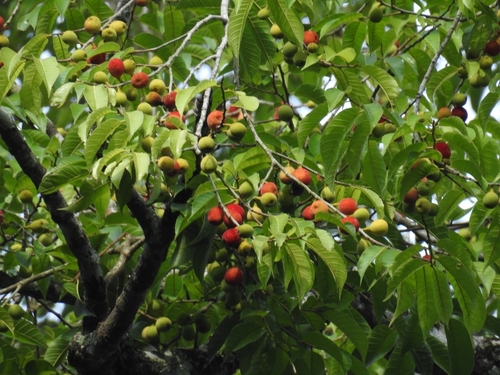
Ficus callosa
Willd.
Hard skin fig

(c) Abu Hamas, some rights reserved (CC BY-SA), uploaded by Abu Hamas

(c) Shiwalee Samant, some rights reserved (CC BY-NC)
What to Eat
Edible parts: Leaves, Leaves - flavouring, Fruit
The leaves are mixed with rice as a flavoring, cooked and eaten alone, or cooked with tomato. The fruit are also cooked and eaten.
Where to Find It
A tropical plant. They occur in the Philippines from Isabela, Bataan, Camarines, Mindoro, Palawan, Cebu and Mindanao Provinces. In China it grows on the edges of forests and is also cultivated between 600-800 m in S China. In XTBG Yunnan.
Asia, China, India, Indochina, Indonesia, Malaysia, Myanmar, Pacific, Philippines, SE Asia, Singapore, Sri Lanka, Thailand, Vietnam,
How to Identify
A fig. It is a large tree. It grows 25-35 m tall. The trunk is 25-35 cm across. The bark is hard and grey. The leafy growths at the base of the leaves are oval, hairy and 1-1.8 cm long. The leaf stalk is 3-9 cm long. The leaves are a dark green and smooth and shiny on the top surface. They are pale green underneath. They have a blunt point and are rounded at the base. The leaves are 15-30 cm long by 7-20 cm wide. They are leathery. The fruit are borne in the upper leaf axils. They are often in pairs. They are 2 to 3 cm across. They are pale green but become yellow when mature.
How to Grow
Plants can be grown by seeds.
Other Uses
The fibrous bark is used for making cloth. The yellow-grey wood has numerous darker coloured lines or streaks. It is very light in weight yet relatively strong. The fine wood is often used for making furniture, and is also used for boxes, ply etc. It is a possible substitute for Indian balsa (Sterculia spp.).
Wikipedia
Source ↗Ficus callosa is a species of tree in the family Moraceae native to India, southern China, Indo-China and Malesia. In Vietnam it may be called đa chai or đa gùa.
Other Information
Leaves are sold in local markets.
Notes
There are about 800-1000 Ficus species. They are mostly in the tropics. There are 120 Ficus species in tropical America. The wood is used for furniture.
Names & Synonyms
Callose-leafed fig, Kalukoi, Palelang, Paleng, Pohon ara pangsar, Shiny-leafed fig, Wo ni qie, Ying bi rong
References (9)
- Ambasta, S.P. (Ed.), 2000, The Useful Plants of India. CSIR India. p 221
- Brown, Philippines.
- Fu, Yongneng, et al, 2003, Relocating Plants from Swidden Fallows to Gardens in Southwestern China. Economic Botany, 57(3): 389-402
- Mem. Acad. Roy. Sci. Hist. (Berlin) 1798:102. 1798
- Monsalud, M.R., Tongacan, A.L., Lopez, F.R., & Lagrimas, M.Q., 1966, Edible Wild Plants in Philippine Forests. Philippine Journal of Science. p 500
- Shi, Y. et al, 2014, An ethnobotanical study of the less known wild edible figs (genus Ficus) native to Xishuangbanna Southwest China. Journal of Ethnobiology and Ethnomedicine. 10:68
- Sukarya, D. G., (Ed.) 2013, 3,500 Plant Species of the Botanic Gardens of Indonesia. LIPI p 281
- www.eFloras.org Flora of China
- Xu, You-Kai, et al, 2004, Wild Vegetable Resources and Market Survey in Xishuangbanna, Southwest China. Economic Botany. 58(4): 647-667.