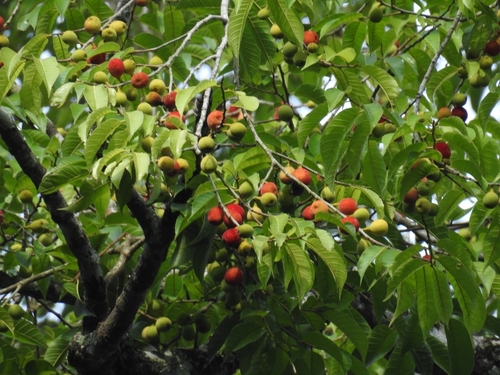
Ficus congesta
Roxb.
Red leaf fig, Cluster fig

(c) ryanthughes, some rights reserved (CC BY-NC)
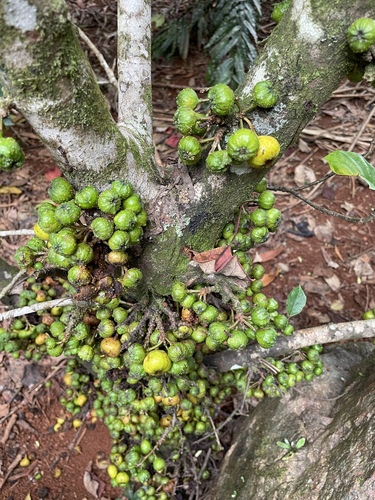
(c) Rene, some rights reserved (CC BY-NC)
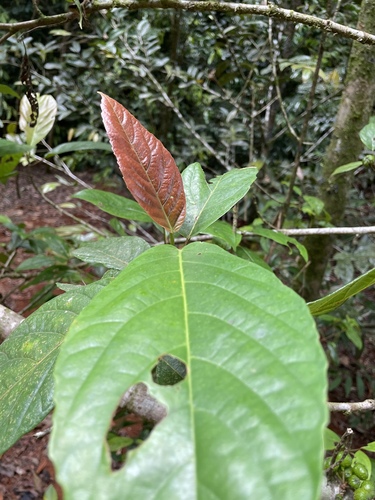
(c) Rene, some rights reserved (CC BY-NC)
What to Eat
Edible parts: Fruit
The edible fruit can be eaten fresh.
Where to Find It
It is a tropical plant. They grow naturally in rainforest in Queensland and the Northern Territory in Australia. It is often along the edges of streams. It grows from sea level to 1030 m altitude. In Townsville Anderson BG.
Asia, Australia*, China, India, Indonesia, New Guinea, Pacific, SE Asia,
How to Identify
A fig. It is a small tree. It grows 6-12 m high and spreads 4-10 m wide. The trunk is short. It can have several stems. The bark is grey and smooth. The leaves are simple and 12-25 cm long. They are sandpapery on both sides. There are also hairs on both sides. New leaves are red. The fruit are about 25 mm across and round. The fruit can occur singly, in the axils of leaves or on branches or stems or on runners along the ground. The fruit are edible.
How to Grow
It can be grown from seed or by aerial layers of cuttings.
Notes
There are about 800-1000 Ficus species. They are mostly in the tropics. There are 120 Ficus species in tropical America.
Names & Synonyms
References (10)
- Beasley, J., 2011, Plants of Tropical North Queensland - the compact guide. Footloose publications. p 96
- Cooper W & Cooper W T, 1994, Fruits of the Rain Forest. RD Press p 128
- Cooper, W. and Cooper, W., 2004, Fruits of the Australian Tropical Rainforest. Nokomis Editions, Victoria, Australia. p 323
- Elliot, W.R., & Jones, D.L., 1992, Encyclopedia of Australian Plants suitable for cultivation. Vol 4. Lothian. p 282
- Fl. ind. ed. 1832, 3:560. 1832
- Flora of Australia, Volume 3, Hamamelidales to Casuarinales, Australian Government Publishing Service, Canberra (1989) p 65
- Jackes, B.R., 2001, Plants of the Tropics. Rainforest to Heath. An Identification Guide. James Cook University. p 66
- Melzer, R. & Plumb, J., 2011, Plants of Capricornia. Belgamba, Rockhampton. p 203
- Townsend, K., 1994, Across the Top. Gardening with Australian Plants in the tropics. Society for Growing Australian Plants, Townsville Branch Inc. p 211
- World Checklist of Useful Plant Species 2020. Royal Botanic Gardens, Kew