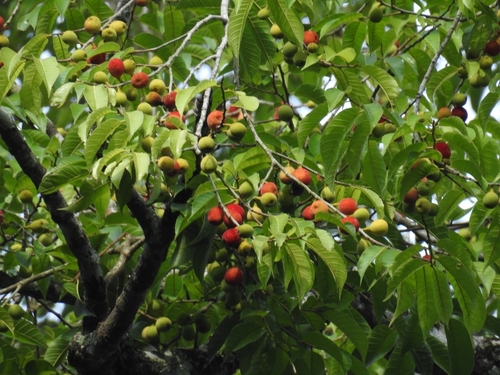
Ficus destruens
F. Muell. ex C. White
Drupe fig, Red fig, Rusty Fig
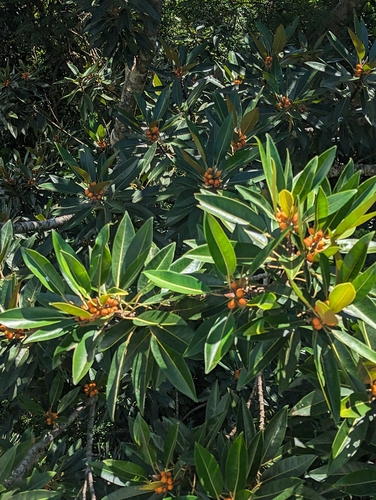
(c) Christopher Mitchell, some rights reserved (CC BY-NC), uploaded by Christopher Mitchell
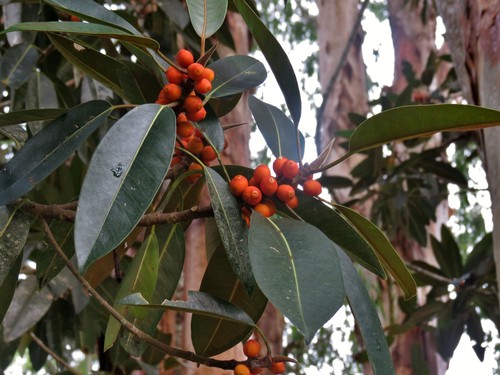
(c) Graham Bell, some rights reserved (CC BY-NC), uploaded by Graham Bell

(c) Nemo's great uncle, some rights reserved (CC BY-NC-SA)
What to Eat
Edible parts: Fruit
The fruit are edible and eaten fresh.
Where to Find It
A tropical plant. They grow naturally in rainforests in Queensland in Australia. It grows from sea level to 1200 m altitude. In Townsville palmetum. It suits hardiness zones 10-12.
Australia*, SE Asia, Singapore,
How to Identify
A fig. It is a tree up to 30 m high. It often occurs as a strangler. It has a rounded or spreading bushy crown. It can spread 15-30 m wide. Young branches are covered with rusty hairs. The leaves are simple and 9-25 cm long by 8-10 cm wide. The leaves are leathery and blunt. There are rusty hairs underneath the leaf. The leaves are crowded towards the ends of branches. The leaf stalks are 8-10 cm long. The fruit are 10-17 mm across. They occur singly or in pairs in the axils of leaves. The surface of the fruit is covered with small rusty hairs. The fruit are edible.
Nutrition Score: 36/100
| Part | Moisture | kJ | kcal | Protein | Vit A | Vit C | Iron | Zinc |
|---|---|---|---|---|---|---|---|---|
| Fruit | 60.8 | 657 | 157 | 2.8 | — | — | — | — |
How to Grow
Plants can be grown from seed or from aerial layers. It can be grown from cuttings.
Wikipedia
Source ↗Ficus destruens is a hemiepiphytic fig that is endemic to the wet tropical rainforests of northeastern Queensland, Australia.
Notes
There are about 800-1000 Ficus species. They are mostly in the tropics. There are 120 Ficus species in tropical America.
Names & Synonyms
Boonjee fig, Strangler Fig
References (12)
- Beasley, J., 2011, Plants of Tropical North Queensland - the compact guide. Footloose publications. p 96
- Cooper W & Cooper W T, 1994, Fruits of the Rain Forest. RD Press p 130
- Cooper, W. and Cooper, W., 2004, Fruits of the Australian Tropical Rainforest. Nokomis Editions, Victoria, Australia. p 324
- Cundall, P., (ed.), 2004, Gardening Australia: flora: the gardener's bible. ABC Books. p 602
- Elliot, W.R., & Jones, D.L., 1992, Encyclopedia of Australian Plants suitable for cultivation. Vol 4. Lothian. p 282
- Etherington, K., & Imwold, D., (Eds), 2001, Botanica's Trees & Shrubs. The illustrated A-Z of over 8500 trees and shrubs. Random House, Australia. p 327
- Flora of Australia, Volume 3, Hamamelidales to Casuarinales, Australian Government Publishing Service, Canberra (1989) p 42
- Jackes, B.R., 2001, Plants of the Tropics. Rainforest to Heath. An Identification Guide. James Cook University. p 66
- Nicholson, N & H., 1996, Australian Rainforest Plants 2, Terania Rainforest Publishing. NSW. p 29
- Ratcliffe D & P., 1987, Australian Native Plants for Indoors. Little Hills press. p 89
- Townsend, K., 1994, Across the Top. Gardening with Australian Plants in the tropics. Society for Growing Australian Plants, Townsville Branch Inc. p 212
- White, C., 1933, Contributions Arnold Arboretum, 4:16