Ficus drupacea
Thunb.
Brown-woolly fig, Hairy Fig, Drupe Fig, Red Fig
(c) Dinesh Valke, some rights reserved (CC BY-SA)
(c) Shiwalee Samant, some rights reserved (CC BY-NC), uploaded by Shiwalee Samant
(c) Shiwalee Samant, some rights reserved (CC BY-NC), uploaded by Shiwalee Samant
What to Eat
Edible parts: Fruit
The ripe fruit are eaten fresh. The fruit have been used for making jelly and wine.
Where to Find It
It is a tropical plant. It grows naturally in the rainforest. In China it grows in mountain forests and along streams between 100-1500 m altitude in S China. In XTBG Yunnan.
Asia, Australia, Bangladesh, Bhutan, China, East Timor, Hawaii, Himalayas, India, Indochina, Indonesia, Laos, Malaysia, Myanmar, Nepal, Northeastern India, Pacific, Papua New Guinea, PNG, Philippines, Puerto Rico, SE Asia, Sikkim, Solomon Islands, Sri Lanka, Thailand, Timor-Leste, Torres Strait, USA, Vietnam, West Indies,
How to Identify
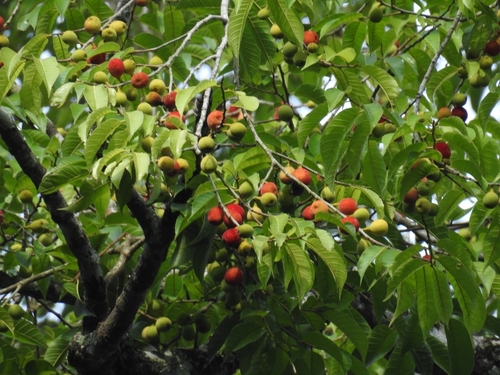
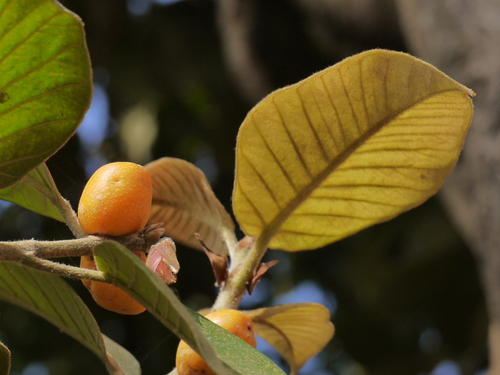
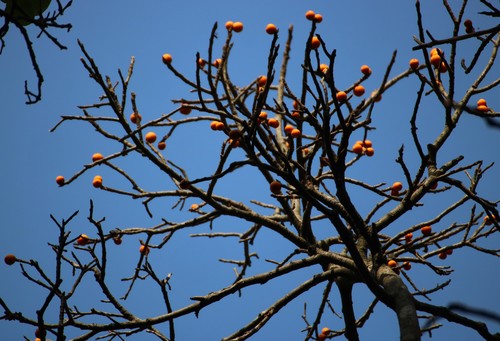
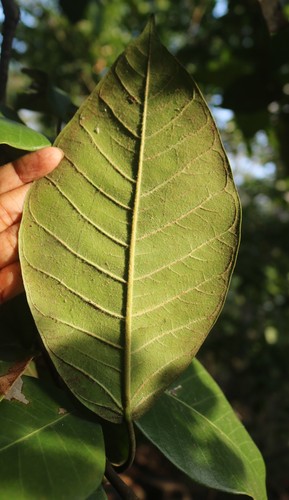
A fig. It is a small to medium sized tree. It grows 10-15 m high. It has a spreading bushy crown. It has strangling roots but not aerial roots. There are prop roots near the base. The trunk is short and irregular. The bark is grey and smooth. The young shoots have dense rusty coloured hairs. The leaf stalk is 2.5-3 cm long. The leaves are simple and 8-18 cm long by 4-9 cm wide. They are oval but narrow abruptly at each end. They are dark green and leathery. Underneath they are more yellowish brown. Young leaves have rusty hairs while mature leaves are smooth. The fig or receptacle is 1.5-2 cm across. They are round and in the axils of leaves on young shoots. They occur either singly or in pairs. They ripen from orange to dark red. They are edible. There are some varieties described based on the hairiness of the leaves.
How to Grow
Plants can be grown from seed or by using aerial layering.
Medicinal Uses
The roots are an effective vulnerary when powdered and applied to wounds.
Other Uses
A fibre is obtained from the bark. A weak rope can be made from it.
Wikipedia
Source ↗Ficus drupacea, also known as the brown-woolly fig or Mysore fig, is a tropical tree native to Southeast Asia and Northeast Australia (it has been introduced into the New World tropics, including Puerto Rico). It is a strangler fig; it begins its life cycle as an epiphyte on a larger tree, which it eventually engulfs. Its distinctive features include dense, woolly pubescence, bright yellow to red fleshy fruit, and grayish white bark. It can reach heights of 10–30 meters (33–98 ft). Its fruit are eaten by pigeons, and it is pollinated by Eupristina belgaumensis. It occurs in environments ranging from sea-level beachfront environments to montane forests, up to 1,000 metres (3,300 feet).
Notes
There are about 800-1000 Ficus species. They are mostly in the tropics. There are 120 Ficus species in tropical America.
Names & Synonyms
Akar piangu antan, Balete, Bhurvar, Bulu timun, Goni, Haimi, Kabai, Kiara gambir, Kiara wunuk, Krang-baikhon, Lungkhon, Nonok, Payapa, Sagaing, Taninthayi, Zhen guo rong
References (19)
- Cooper W & Cooper W T, 1994, Fruits of the Rain Forest. RD Press p 130
- Cooper, W. and Cooper, W., 2004, Fruits of the Australian Tropical Rainforest. Nokomis Editions, Victoria, Australia. p 324
- Cowie, I, 2006, A Survey of Flora and vegetation of the proposed Jaco-Tutuala-Lore National Park. Timor-Lests (East Timor) www.territorystories.nt/gov.au p 51
- Elliot, W.R., & Jones, D.L., 1992, Encyclopedia of Australian Plants suitable for cultivation. Vol 4. Lothian. p 284
- Flora of Australia, Volume 3, Hamamelidales to Casuarinales, Australian Government Publishing Service, Canberra (1989) p 36
- Flora of China.
- French, B.R., 2010, Food Plants of Solomon Islands. A Compendium. Food Plants International Inc. p 78
- Habitat Management Profile – Saibai Island. Appendix C. Preliminary List of Useful Plants for Saibai Island. p 116
- http://www.ntbg.org/plants/plant details.php (As Ficus mysorensis)
- Jackes, B.R., 2001, Plants of the Tropics. Rainforest to Heath. An Identification Guide. James Cook University. p 66
- Krishen P., 2006, Trees of Delhi, A Field Guide. DK Books. p 50 (Ficus drupacea var. pubescens)
- Little, E. L., et al, 1974, Trees of Puerto Rico and the Virgin Islands. USDA Handbook 449. Forestry Service. p 126
- PROSEA (Plant Resources of South East Asia) handbook, Volume 2, 1991, Edible fruits and nuts.
- Staples, G.W. and Herbst, D.R., 2005, A tropical Garden Flora. Bishop Museum Press, Honolulu, Hawaii. p 411
- Sukarya, D. G., (Ed.) 2013, 3,500 Plant Species of the Botanic Gardens of Indonesia. LIPI p 282
- Swaminathan, M.S., and Kochnar, S.L., 2007, An Atlas of major Flowering Trees in India. Macmillan. p 263 (Ficus drupacea var. pubescens)
- Thunb. Ficus 6, 11. 1786
- Townsend, K., 1994, Across the Top. Gardening with Australian Plants in the tropics. Society for Growing Australian Plants, Townsville Branch Inc. p 212
- World Checklist of Useful Plant Species 2020. Royal Botanic Gardens, Kew