Ficus elastica
Roxb. ex Hornem.
India Rubber Tree, Rubber plant

(c) Yoav Daniel Bar-Ness, some rights reserved (CC BY)
(c) M Nur Yahya, some rights reserved (CC BY-NC)

(c) Subhadra Devi, some rights reserved (CC BY)
What to Eat
Edible parts: Leaves, Fruit, Vegetable
Young leaves are eaten as a vegetable. The very young leaf tips, harvested before the leaves have expanded, can be eaten as a salad.
Where to Find It
A tropical plant. It does best in rich, moist soil. It suits a protected sunny position. It is damaged by drought and frost. It is salt tolerant. They need a temperature above 15°C. It grows up to 1,200 m altitude in NE India. In China it grows in Yunnan. It suits hardiness zones 11-12.
Africa, Antigua and Barbuda, Asia, Australia, Bhutan, China, Dominican Republic, East Africa, East Timor, Ethiopia, Guam, Haiti, Hawaii, Himalayas, India, Indochina, Indonesia, Korea, Laos, Malaysia, Maldives, Marquesas, Mozambique, Myanmar, Nauru, Nepal, North America, Northeastern India, Pacific, Papua New Guinea, PNG, Philippines, Sao Tome and Principe, SE Asia, Sikkim, Singapore, Slovenia, Tasmania, Thailand, Timor-Leste, USA, Vietnam, West Africa, West Indies, Zimbabwe,
How to Identify
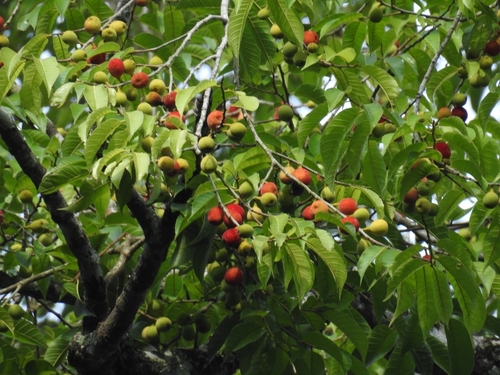
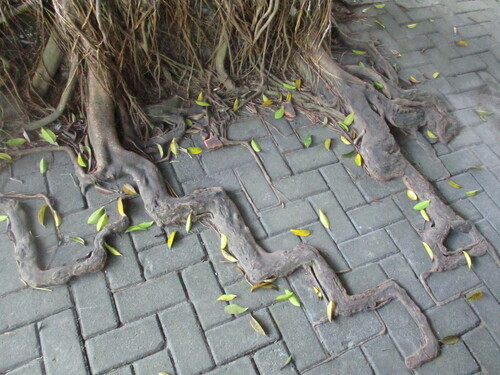
A fig. It is an evergreen tree. It grows to 30-60 m high and spreads to 10-60 m across. The trunk can be 25-40 cm across. The stem is erect and stout. It can have buttresses. The bark is pale grey and smooth. It can grow on other plants when young. The tree has a rounded crown. It produces aerial roots which hang down and later become prop roots. It also has an aggressive root system. The leafy growth at the base of a leaf is red and 10 cm long. It leaves an easy to see scar. The leaves are green and glossy. Often new leaves have a red flush. They are oblong and 30-45 cm long. They are leathery and have prominent veins. On fruiting branches of mature trees the leaves are smaller. The fruit are greenish-yellow figs. These are 1 cm long and grow from the axils where leaves fall. Often they occur in pairs.
How to Grow
It grows best in areas where annual daytime temperatures are within the range 20 - 30?c, but can tolerate 10 - 36°c. It can be killed by temperatures of -1°c or lower. It prefers a mean annual rainfall in the range 600 - 1,000mm, but tolerates 300 - 2,800mm. Prefers a sunny position. Succeeds in most well-drained soils of moderate fertility. Prefers a pH in the range 5.5 - 7.5, tolerating 5 - 8.3. Ficus elastica seedlings develop root nodules containing 95% water, which act as a water reservoir. This most probably helps the seedlings to survive the initial epiphytic phase. During this phase the plant sends down thin aerial roots which only thicken after they have reached the ground. Young specimens in Java are reported to be epiphytic. The root system of Ficus elastica is shallow and dense, making mixed plantation or intercropping systems impossible. Roots may spread over a distance of 40 metres, as reported for India. The yield of individual trees in plantations of Ficus elastica can vary very widely, the highest attains 30 times more than the lowest. The yield of the first harvest is directly influenced by the circumference of the tree and the horizontal length of the incision. A tree of 1.8 metres in diameter yielded 15 kg rubber; the average yields in three consecutive years of 50 wild trees measuring 34 metres tall and 5.7 m in diameter (aerial roots included) were 4, 1.9 and 0.4 kg/tree respectively. The average annual yield of 55 trees in Bogor Botanical Gardens tapped four times at the age of 8 to 17 years is only 41 g/tree. It has been reported that the first yield of a tapped aerial root with a diameter of 15 cm yielded 9.3 kg of rubber, but this exceptionally high yield was never confirmed by other measurements. The symbiotic relation of Ficus spp. With specialized wasps is well-known. Figs can only be pollinated by female agaonid wasps (Hymenoptera, Chalcidoidea, Agaonidae). These wasps are highly species-specific; the fig-wasp associated with Ficus elastica is Blastophaga clavigera, known from India. In Ficus elastica the wasps arrive when female flowers are receptive. They enter the fig via the osteole, a bract-covered apical pore. Once inside they pollinate the female flowers and deposit their eggs in the ovaries. As style length varies greatly within these figs and because the wasp can only reach the ovary of short-styled flowers, only some of the flowers obtain an egg, while in others the seed develops. Male and female wasps emerge after a few weeks, and mate within the fig. The females then emerge from the fig and, in so doing pick up pollen from the newly mature anthers of male flowers. Figs on a single tree mature at the same time, while different trees of the same species flower out of synchrony, thus inducing cross- pollination. The symbiotic relation of Ficus spp. With specialized wasps is well-known. Figs can only be pollinated by female agaonid wasps (Hymenoptera, Chalcidoidea, Agaonidae). These wasps are highly species-specific; the fig-wasp associated with Ficus elastica is Blastophaga clavigera, known from India. In Ficus elastica the wasps arrive when female flowers are receptive. They enter the fig via the osteole, a bract-covered apical pore. Once inside they pollinate the female flowers and deposit their eggs in the ovaries. As style length varies greatly within these figs and because the wasp can only reach the ovary of short-styled flowers, only some of the flowers obtain an egg, while in others the seed develops. Male and female wasps emerge after a few weeks, and mate within the fig. The females then emerge from the fig and, in so doing pick up pollen from the newly mature anthers of male flowers. Figs on a single tree mature at the same time, while different trees of the same species flower out of synchrony, thus inducing cross- pollination.
Propagation: Seed viability is 20–50% and does not appear to decrease over the first three months of storage. Clean seeds from the surrounding pulp before sowing under shade; the first seedlings emerge about two weeks later. Seeds from bird or bat droppings are reported to germinate more readily. Once the first two pairs of leaves have developed, prick out seedlings into trays under shade, then transfer to beds at 25–40cm spacing when several centimetres tall, gradually removing shade until they are in full sunlight. Seedlings can be planted in the field when 35–40cm tall, typically after about one year due to slow initial growth. In India, it was common practice to plant out at 3 metres tall. For vegetative propagation, select high-yielding mother trees, as individual latex yield varies considerably. Branches cut at a slant can be planted directly, provided the wood is not too young; new cuttings need support to prevent wind-rock root damage. Air layering is also very successful, with layers ready to sever from the mother plant after just 40 days.
Medicinal Uses
A decoction of the aerial rootlets is used as a vulnerary. The latex has been successfully used to treat five cases of trichuriasis.
Other Uses
A latex obtained from the bark of the stem and larger branches can be used for all applications of natural rubber, including tyres, car and machine components, and consumer products such as footwear, sports goods, toys, and gloves. Traditionally, the latex is used to line split-rattan baskets to make them watertight. The rubber from this plant contains 4–20% resin, which hardens over time and reduces elasticity. It has relatively short polyisoprene chains of low molecular weight (78,000) and is soluble in cajeput oil (Melaleuca cajuputi). It is hypoallergenic to individuals sensitive to proteins in Hevea brasiliensis rubber. Latex is collected by tapping the stem and larger branches — and sometimes root bark — preferably in high humidity, as dry conditions cause it to coagulate too quickly and rain reduces rubber content. Incisions are made with a knife or gouge, with V-shaped gouges producing horizontal cuts up to 5cm wide and about 20cm long, spaced roughly 40cm apart on opposite sides of the tree. A herringbone tapping system uses a central vertical channel fed by grooves at 45°, with fibres punctured every 2–3cm; this produces better-quality fluid latex than the scrap collected from horizontal cuts. Latex drips from horizontal incisions for about 2–3 minutes and is collected on mats or leaves; the coagulated material is gathered 2–3 days later. A well-developed planted tree can first be tapped after 6–7 years, with yield and rubber content increasing with tree age and girth. Consecutive tappings show a marked decrease in yield; trials with 55 trees in Bogor across four harvests at intervals of 2, 3, and 4 years yielded 238g, 67g, 70g, and 320g per tree respectively, suggesting a four-year recovery period for laticifers. The scrap is sorted and cleaned by hand; the latex resists coagulation by heat, acids, or alkalis, and must instead be beaten, kneaded, and treated with alcohol to yield a superior product that does not become sticky with age. Ammonia and tannin have also been used as coagulants in Peninsular Malaysia. The latex showed toxicity to juveniles of the nematode Meloidogyne javanica. The fibrous bark has been used to make clothes and ropes. The wood is of poor quality but is occasionally used for boards, posts, boats, and fuel.
Wikipedia
Source ↗Ficus elastica, the rubber fig, rubber bush, rubber tree, rubber plant, or Indian rubber bush, Indian rubber tree, or rambung is a species of flowering plant in the family Moraceae, native to eastern parts of South and Southeast Asia. It has become naturalized in Sri Lanka, the West Indies, and the US state of Florida. Its common names reflect its historical use as a source of rubber within its native range, but it is not used in the modern commercial-scale production of natural rubber.
Production
It is fast growing.
Other Information
It is cultivated.
Notes
Latex can be extracted for making rubber. There are about 800-1000 Ficus species. They are mostly in the tropics. There are 120 Ficus species in tropical America.
Names & Synonyms
Ara rambong, Attah bar, Balete, Bor, Bunoh setaroh, Da bup do, Ganoi, Indian caoutchouc tree, Kanoi, Karet kebo, Labar, Moih-krat, Nyaung-kyetpaung, Pohon karet kebo, Pokok getah rambong, Rabarugas, Rambong, Sangri, Sherak, Yaang-india, Yin du rong
References (39)
- Ambasta, S.P. (Ed.), 2000, The Useful Plants of India. CSIR India. p 222
- Balkrishna, A., et al, 2022, Indigenous Uses of Plants among Forest-dependent Communities of Seijosa, Arunachal Pradesh. International Journal of Economic Plants 2022, 9(1):064-080
- Barwick, M., 2004, Tropical and Subtropical Trees. A Worldwide Encyclopedic Guide. Thames and Hudson p 185
- Bodkin, F., 1991, Encyclopedia Botanica. Cornstalk publishing, p 472
- Brickell, C. (Ed.), 1999, The Royal Horticultural Society A-Z Encyclopedia of Garden Plants. Convent Garden Books. p 439
- Burkill, H. M., 1985, The useful plants of west tropical Africa, Vol. 4. Kew.
- Burkill, I.H., 1966, A Dictionary of the Economic Products of the Malay Peninsula. Ministry of Agriculture and Cooperatives, Kuala Lumpur, Malaysia. Vol 1 (A-H) p 1025
- Cundall, P., (ed.), 2004, Gardening Australia: flora: the gardener's bible. ABC Books. p 603
- Dharani, N., 2002, Field Guide to common Trees & Shrubs of East Africa. Struik. p 108
- Engel, D.H., & Phummai, S., 2000, A Field Guide to Tropical Plants of Asia. Timber Press. p 82
- Etherington, K., & Imwold, D., (Eds), 2001, Botanica's Trees & Shrubs. The illustrated A-Z of over 8500 trees and shrubs. Random House, Australia. p 327
- Flora of Pakistan. www.eFloras.org
- Friday, J. B., 2005, Forestry and Agroforestry Trees of East Timor. http://www.ctahr.hawaii.edu/forestry/data/Timor/Timor trees.html
- Gangwar, A. K. & Ramakrishnan, P. S., 1990, Ethnobotanical Notes on Some Tribes of Arunachal Pradesh, Northeastern India. Economic Botany, Vol. 44, No. 1 pp. 94-105
- Grubben, G. J. H. and Denton, O. A. (eds), 2004, Plant Resources of Tropical Africa 2. Vegetables. PROTA, Wageningen, Netherlands. p 561
- Hearne, D.A., & Rance, S.J., 1975, Trees for Darwin and Northern Australia. AGPS, Canberra p 69
- Hibbert, M., 2002, The Aussie Plant Finder 2002, Florilegium. p 102
- Hort. bot. hafn. suppl. 7. 1819
- Krishen P., 2006, Trees of Delhi, A Field Guide. DK Books. p 52
- Lord, E.E., & Willis, J.H., 1999, Shrubs and Trees for Australian gardens. Lothian. p 55
- Lugod, G.C. and de Padua L.S., 1979, Wild Food Plants in the Philippines. Vol. 1. Univ. of Philippines Los Banos. p 54
- Martin, F.W. & Ruberte, R.M., 1979, Edible Leaves of the Tropics. Antillian College Press, Mayaguez, Puerto Rico. p 91, 206
- Murtem, G. & Chaudhrey, P., 2016, An ethnobotanical note on wild edible plants of Upper Eastern Himalaya, India. Brazilian Journal of Biological Sciences, 2016, v. 3, no. 5, p. 63-81
- Ochse, J.J. et al, 1931, Vegetables of the Dutch East Indies. Asher reprint. p 494
- Peekel, P.G., 1984, (Translation E.E.Henty), Flora of the Bismarck Archipelago for Naturalists, Division of Botany, Lae, PNG. p 137, 138
- Plants of Haiti Smithsonian Institute http://botany.si.edu/antilles/West Indies
- Purseglove, J.W., 1968, Tropical Crops Dicotyledons, Longmans. p 388
- Sahni, K.C., 2000, The Book of Indian Trees. Bombay Natural History Society. Oxford. p 158
- Selvam, V., 2007, Trees and shrubs of the Maldives. RAP Publication No. 2007/12 p 94
- Sharma, G., et al, 2016, Agrobiodiversity in the Sikkim Himalaya. International Centre for Integrated Mountain Development, ICIMOD Working Paper 2016/5 p 20
- Staples, G.W. and Herbst, D.R., 2005, A tropical Garden Flora. Bishop Museum Press, Honolulu, Hawaii. p 409 (Drawing)
- Sujanapal, P., & Sankaran, K. V., 2016, Common Plants of Maldives. FAO & Kerala FRI, p 134
- Sukarya, D. G., (Ed.) 2013, 3,500 Plant Species of the Botanic Gardens of Indonesia. LIPI p 283
- Sundriyal, M. & Sundriyal, R. C., 2004, Structure, Phenology, Fruit Yield, and Future Prospects of some Prominent Wild Edible Plant Species of the Sikkim Himalaya, India. Journal of Ethnobiology 24(1): 113-138
- Swaminathan, M.S., and Kochnar, S.L., 2007, An Atlas of major Flowering Trees in India. Macmillan. p 255
- Terra, G.J.A., 1973, Tropical Vegetables. Communication 54e Royal Tropical Institute, Amsterdam, p 46
- World Checklist of Useful Plant Species 2020. Royal Botanic Gardens, Kew
- Young, J., (Ed.), 2001, Botanica's Pocket Trees and Shrubs. Random House. p 385
- Zeven, A. C. & de West, J. M. J., 1982, Dictionary of cultivated plants and their regions of diversity. Wageningen. p 76