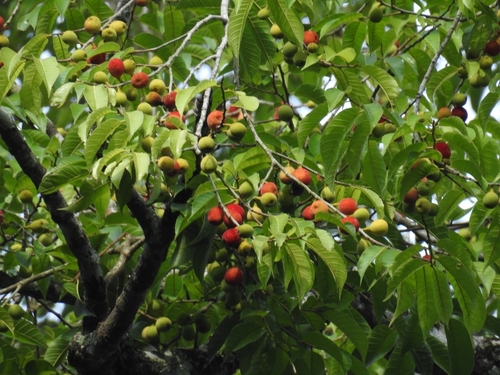
Ficus grossularioides
Burm.f.
White-leafed fig, Kebak
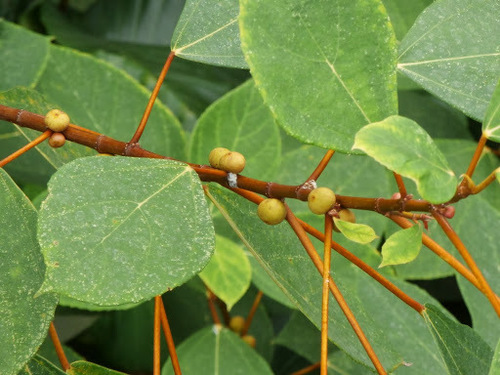
(c) 106611639464075912591, some rights reserved (CC BY-NC-SA), uploaded by 106611639464075912591
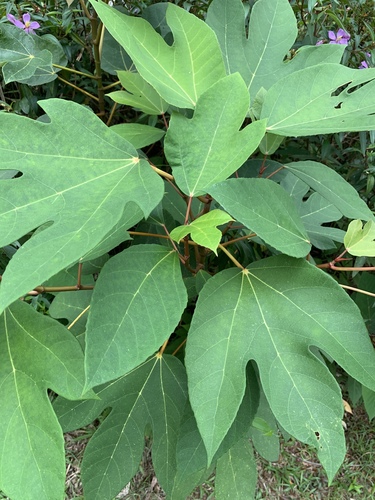
(c) Pizzas fear me, some rights reserved (CC BY-NC), uploaded by Pizzas fear me
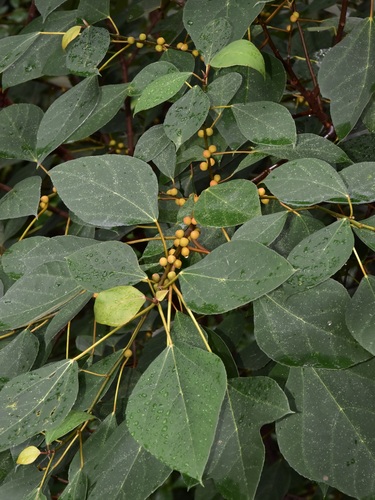
(c) Nasser Halaweh, some rights reserved (CC BY), uploaded by Nasser Halaweh
What to Eat
Edible parts: Fruit, Leaves
The ripe fruit are edible, and the young leaves are cooked as a vegetable.
Where to Find It
A tropical plant. It can be on open forest and swamp forest. It grows up to 400 m above sea level. It is often along rivers and streams and is usually on sandy soils.
Asia, Brunei, India, Indochina, Indonesia, Malaysia, New Guinea, SE Asia, Thailand,
How to Identify
A fig. It is a shrub or small tree. It grows 7 m tall. The trunk can be 15-35 cm across. The stem has white sap. The leave are alternate and simple or with 3-7 lobes. Leaves smooth on bottom, rough on top. They are pale and hairy underneath. Fruit orange when ripe. Fruit edible when ripe. They are 11 cm across. They grow on the twigs.
How to Grow
Usually found wild in sandy soils. Fig trees have a unique form of fertilization, each species relying on a single, highly specialized species of wasp that is itself totaly dependant upon that fig species in order to breed. The trees produce three types of flower; male, a long-styled female and a short-styled female flower, often called the gall flower. All three types of flower are contained within the structure we usually think of as the fruit. The female fig wasp enters a fig and lays its eggs on the short styled female flowers while pollinating the long styled female flowers. Wingless male fig wasps emerge first, inseminate the emerging females and then bore exit tunnels out of the fig for the winged females. Females emerge, collect pollen from the male flowers and fly off in search of figs whose female flowers are receptive. In order to support a population of its pollinator, individuals of a Ficus spp. must flower asynchronously. A population must exceed a critical minimum size to ensure that at any time of the year at least some plants have overlap of emmission and reception of fig wasps. Without this temporal overlap the short-lived pollinator wasps will go locally extinct.
Medicinal Uses
The species is not usually cultivated as it is a commonly found plant and all products from it are collected from wild plants, traditional medicine uses latex against scorpion stings and leaf extract (decoction) is used against kidney complaints. Young shoots are reported to be edible and can be eaten raw.
Other Uses
The wod is used for temporary construction, mouldings, interior work, fruit crates. The wood is used for fuel.
Wikipedia
Source ↗Ficus grossularioides, the white-leaved fig, is a species of flowering plant that belongs to Moraceae, the fig or mulberry family, it is native to Southeast Asia.
Notes
There are about 800-1000 Ficus species. They are mostly in the tropics. There are 120 Ficus species in tropical America.
Names & Synonyms
Akar semelit dadeh, Ara perak, Hamberang lalaki, Kebak berang, Kebak, Kelumpong ayer, Kelumpong jantan, Kupan, Lengkan, Modang susu, Sepedej jantan, Seuhang
References (11)
- Bijdr. 477. 1825 (As Ficus alba)
- Burkill, I.H., 1966, A Dictionary of the Economic Products of the Malay Peninsula. Ministry of Agriculture and Cooperatives, Kuala Lumpur, Malaysia. Vol 1 (A-H) p 1019 (As Ficus alba)
- Chai, P. P. K. (Ed), et al, 2000, A checklist of Flora, Fauna, Food and Medicinal Plants. Lanjak Entimau Wildlife Sanctuary, Sarawak. Forestry Malaysia & ITTO. p 169
- Fl. indica 227. 1768
- Mohd, N. G. et al, 2014, A Preliminary Flora Survey in Gunung Kajang, Pulau Tioman, Pahang Darul Makmur, Malaysia. Malays. Appl. Biol. 43(2): 17-23
- MacKinnon, K., 1981, The Ecology of Kalimantan. p 712
- Martin, F.W. & Ruberte, R.M., 1979, Edible Leaves of the Tropics. Antillian College Press, Mayaguez, Puerto Rico. p 91, 206 (As Ficus alba)
- Ochse, J.J. et al, 1931, Vegetables of the Dutch East Indies. Asher reprint. p 492 (As Ficus alba)
- Slik, F., www.asianplant.net
- Terra, G.J.A., 1973, Tropical Vegetables. Communication 54e Royal Tropical Institute, Amsterdam, p 46 (As Ficus alba)
- World Checklist of Useful Plant Species 2020. Royal Botanic Gardens, Kew