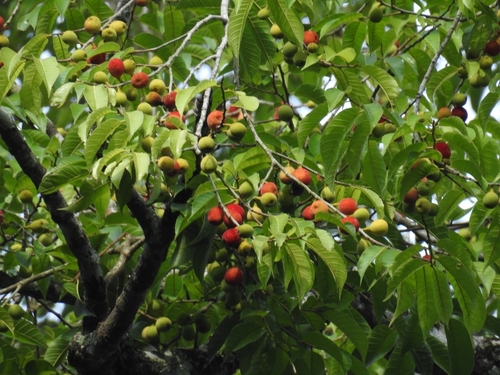
Ficus itoana
Diels

wikimedia · cc-by
Wikimedia Commons - Arthur Chapman
Wikimedia Commons - Arthur Chapman

gbif · cc0
President and Fellows of Harvard College
President and Fellows of Harvard College

gbif · cc0
President and Fellows of Harvard College
President and Fellows of Harvard College
What to Eat
Edible parts: Fruit, Leaves
Both the young leaves and fruit are eaten.
Where to Find It
A tropical plant.
Pacific, Papua New Guinea, PNG,
Countries: Australia, Fiji, Micronesia, Kiribati, Marshall Islands, Nauru, New Zealand, Papua New Guinea, Palau, Solomon Islands, Tonga, Tuvalu, Vanuatu, Samoa
How to Identify
A fig. It is a tree with small buttresses. The bark is thin. The leaves are green on the top surface with white veins and underneath the leaf is light dull green. The leaf is 29 cm long by 12 cm wide. The leaf stalk is 7 cm long. There are 8 to 10 pairs of side veins. The fruit are bright green and turn red. They are pear shaped with small bracts near the base. The fruit are produced on the stem below the leaves on a thick, rough twig. The fruit are 2 cm across.
Notes
There are about 800-1000 Ficus species. They are mostly in the tropics. There are 120 Ficus species in tropical America.
References (5)
- Borrell, O.W., 1989, An Annotated Checklist of the Flora of Kairiru Island, New Guinea. Marcellin College, Victoria Australia. p 106, 201
- Plants of Papua New Guinea LAE herbarium record
- Powell, J.M., Ethnobotany. In Paijmans, K., 1976, New Guinea Vegetation. Australian National University Press. p 110
- Walter, A. & Sam C., 2002, Fruits of Oceania. ACIAR Monograph No. 85. Canberra. p 279
- World Checklist of Useful Plant Species 2020. Royal Botanic Gardens, Kew