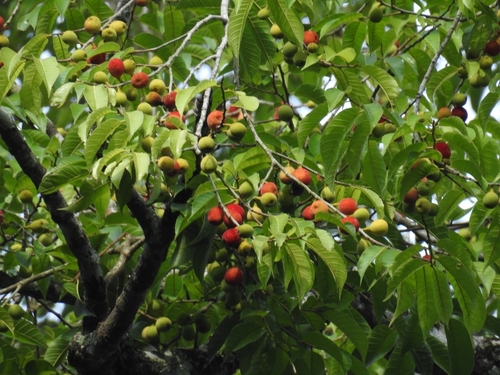
Ficus leucotricha
(Miq.) Miq.
Large-leaf Rock fig, Hairy-fruited rock fig

Wikimedia Commons - Mary Emily Eaton

Wikimedia Commons - Mary Emily Eaton (1873-1961)Daniel Schweich for the filtred image.
What to Eat
Edible parts: Fruit
The figs are eaten.
Where to Find It
It is a tropical plant. It grows on sandstone outcrops.
Australia*,
How to Identify
A fig. It is a medium sized shrub. It grows 3-6 m high and spreads 1-3 m wide. It has aerial roots. The trunk is slender. The bark is smooth and pale grey. Plants loose their leaves in the dry season. The young shoots are hairy. The leaves are alternate. They are 5-13 cm long by 4-9 cm wide. The fruit or figs are 1-3 cm across. They are round and occur singly or in pairs in the axils of leaves. There are some varieties of this species.
How to Grow
Plants can be grown from seed, cuttings or aerial layering.
Notes
There are about 800-1000 Ficus species. They are mostly in the tropics. There are 120 Ficus species in tropical America.
Names & Synonyms
Guray, Gurir, Koorie
References (8)
- Bindon, P., 1996, Useful Bush Plants. Western Australian Museum. p 141
- Elliot, W.R., & Jones, D.L., 1992, Encyclopedia of Australian Plants suitable for cultivation. Vol 4. Lothian. p 285
- Flora of Australia, Volume 3, Hamamelidales to Casuarinales, Australian Government Publishing Service, Canberra (1989) p 43
- Kenneally, K.E., Edinger, D. C., and Willing T., 1996, Broome and Beyond, Plants and People of the Dampier Peninsula, Kimberley, Western Australia. Department of Conservation and Land Management. p 138
- Lazarides, M. & Hince, B., 1993, Handbook of Economic Plants of Australia, CSIRO. p 114
- Paczkowska, G . & Chapman, A.R., 2000, The Western Australian Flora. A Descriptive Calatogue. Western Australian Herbarium. p 331
- Smith, M & Kalotas, A. C., 1985, Bardi Plants: An Annotated List of Plants and Their Use by the Bardi Aborigines of Dampierland, in North-western Australia. Rec. West Aust. Mus. 1985, 12(3): 317-359
- Wheeler, J.R.(ed.), 1992, Flora of the Kimberley Region. CALM, Western Australian Herbarium, p 80