Ficus microcarpa
L.f.
Small-fruited Fig, Laurel fig, Curtain fig
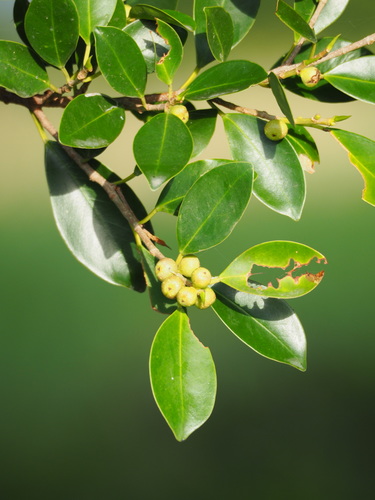
no rights reserved, uploaded by 葉子
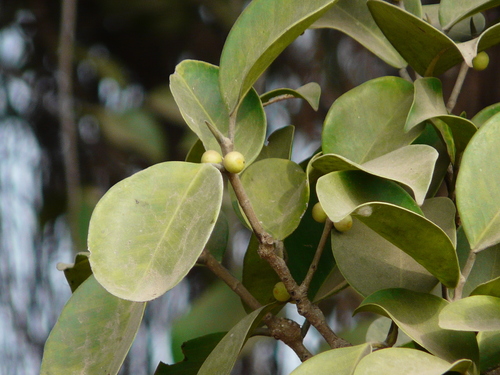
(c) Dinesh Valke, some rights reserved (CC BY-SA)

(c) Dinesh Valke, some rights reserved (CC BY-SA)
What to Eat
Edible parts: Fruit, Aerial root - tea
The small figs are eaten fresh. The aerial roots can be brewed into tea.
Known Hazards
Where to Find It
It grows in tropical and subtropical climates. It grows in light to medium soils. It does best in an open sunny position. It is drought resistant but damaged by frost. They need a temperature above 13°C. It is often in coastal rainforests. It suits humid locations. It suits hardiness zones 10-12. In XTBG Yunnan.
Africa, Andamans, Asia, Australia, Bangladesh, Bhutan, China, Christmas Island, Cyprus, Dominican Republic, East Timor, Egypt, Haiti, Hawaii, Himalayas, India, Indochina, Indonesia, Iraq, Japan, Laos, Malaysia, Mediterranean, Mexico, Micronesia, Middle East, Myanmar, Nepal, New Caledonia, North Africa, North America, Northeastern India, Pacific, Pakistan, Palau, Papua New Guinea, PNG, SE Asia, Sikkim, Sri Lanka, St Helena, Taiwan, Thailand, Timor-Leste, USA, Vanuatu, Vietnam, West Indies,
How to Identify
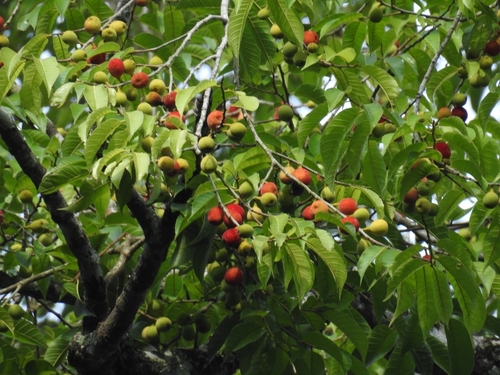
A fig. It is an evergreen tree. It grows 15-25 m tall and spreads to 5 m across. The trunk can be 50 cm wide. The stem is erect and has buttresses. There are aerial roots. The bark is light grey and smooth. The branches are low and it has an open crown. It has a curtain of strangling roots. The leaves are dark green and shiny above and light green underneath. They are oval and pointed. They are 6-12 cm long by 2-7 cm wide. The leaf stalks are 0.5-1.5 cm long. The figs are rosy red or purple and round. They are produced singly or in pairs and are 1.2 cm across. They do not have fruit stalks. The fruit are edible. This plant varies considerably and 3 different varieties are known.
How to Grow
Plants are grown by tip cuttings. They can also be grown from seed or by aerial layering.
Propagation: Seed - germinates best at a temperature around 20°c. Air layering. Tip cuttings around 4 - 12cm long, taken from lateral branches.
Medicinal Uses
The root, bark and leaf latex are used medicinally to treat wounds, headache and toothache. The bark and leaf latex is taken internally to treat colic and liver trouble. Patients with fever or headache perspire in the steam of boiling young leaves.
Other Uses
A fibre from the bark is made into cloth. The latex is used for caulking boats and waterproofing. The wood, including the aerial roots, is used locally in light construction, tool making etc. The wood is used for fuel. Grown as a shade tree for coffee plantations. The tree is planted as a pioneer species in northern Thailand in reforestation projects to restore native woodland - it is planted in degraded woodland and open areas in a mix with various other species that all have the ability to grow fast; produce dense, weed-suppressing crowns; and attract seed-dispersing wildlife, particularly birds and bats.
Wikipedia
Source ↗Ficus microcarpa, also known as Chinese banyan, Hill's weeping fig, small-fruited fig, Malayan banyan, Indian laurel, or curtain fig, is a species of banyan tree in the family Moraceae. Its native range is from India to China and Japan, through Southeast Asia and the western Pacific to the state of Queensland in Australia, and it has been introduced to parts of the Americas and the Mediterranean. It was first described in 1782, and is a culturally significant plant in a number of Asian countries.
Production
In Australia trees fruit from January to August.
Other Information
It is sold in local markets in China. It is cultivated.
Notes
There are about 800-1000 Ficus species. They are mostly in the tropics. There are 120 Ficus species in tropical America. It can be invasive.
Names & Synonyms
Chikhan, Chinese banyan, Cuban laurel, Glossy-leaf fig, Indian laurel fig, Malay banyan, Nandan, Rong shu, Rong tree, Usba
References (31)
- Abdel-Hameed, E. S., 2009, Total phenolic contents and free radical scavenging activity of certain Egyptian Ficus species leaf samples. Food Chemistry 114: 1271-1277
- Bodkin, F., 1991, Encyclopedia Botanica. Cornstalk publishing, p 473
- Brickell, C. (Ed.), 1999, The Royal Horticultural Society A-Z Encyclopedia of Garden Plants. Convent Garden Books. p 439
- Cooper W & Cooper W T, 1994, Fruits of the Rain Forest. RD Press p 130
- Cooper, W. and Cooper, W., 2004, Fruits of the Australian Tropical Rainforest. Nokomis Editions, Victoria, Australia. p 325
- Cowie, I, 2006, A Survey of Flora and vegetation of the proposed Jaco-Tutuala-Lore National Park. Timor-Lests (East Timor) www.territorystories.nt/gov.au p 51
- Cundall, P., (ed.), 2004, Gardening Australia: flora: the gardener's bible. ABC Books. p 603
- Elliot, W.R., & Jones, D.L., 1992, Encyclopedia of Australian Plants suitable for cultivation. Vol 4. Lothian. p 287
- Etherington, K., & Imwold, D., (Eds), 2001, Botanica's Trees & Shrubs. The illustrated A-Z of over 8500 trees and shrubs. Random House, Australia. p 328
- Flora of Australia, Volume 3, Hamamelidales to Casuarinales, Australian Government Publishing Service, Canberra (1989) p 38
- Flora of China @ efloras.org Volume 5
- Flora of Pakistan. www.eFloras.org
- Hardwick, G., 2001, Economically Useful Plants for Northern Australia: Master Species List. Crusader eBooks.
- Hearne, D.A., & Rance, S.J., 1975, Trees for Darwin and Northern Australia. AGPS, Canberra p 70
- Hibbert, M., 2002, The Aussie Plant Finder 2002, Florilegium. p 102
- http://cypruswildflowers.com
- Jackes, B.R., 2001, Plants of the Tropics. Rainforest to Heath. An Identification Guide. James Cook University. p 66
- Krishen P., 2006, Trees of Delhi, A Field Guide. DK Books. p 54
- Lebot, V. & Sam, C., Green desert or ‘all you can eat’? How diverse and edible was the flora of Vanuatu before human introductions?. Terra australis 52 p 408
- Li, D. et al, 2017, Ethnobotanical survey of herbal tea plants from the traditional markets in Chaoshan, China. Journal of Ethnopharmacology. 205 (2017) 195-206
- Lord, E.E., & Willis, J.H., 1999, Shrubs and Trees for Australian gardens. Lothian. p 16
- Marinelli, J. (Ed), 2004, Plant. DK. p 455
- Melzer, R. & Plumb, J., 2011, Plants of Capricornia. Belgamba, Rockhampton. p 206
- Plants of Haiti Smithsonian Institute http://botany.si.edu/antilles/West Indies
- Suppl. pl. 442. 1782 ("1781")
- Townsend, K., 1994, Across the Top. Gardening with Australian Plants in the tropics. Society for Growing Australian Plants, Townsville Branch Inc. p 213
- Valder, P., 1999, The Garden Plants of China. Florilegium. p 285
- Williams, J.B., Harden, G.J., and McDonald, W.J.F., 1984, Trees and shrubs in rainforests of New South Wales and Southern Queensland. Univ. of New England, Armidale. p 66
- World Checklist of Useful Plant Species 2020. Royal Botanic Gardens, Kew
- www.eFloras.org. Flora of China
- Young, J., (Ed.), 2001, Botanica's Pocket Trees and Shrubs. Random House. p