Ficus montana
Burm.f.
Oak-leaved fig

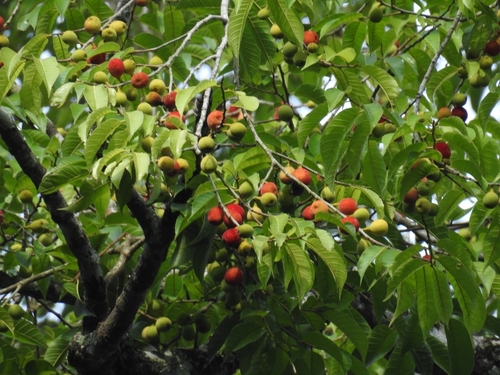
(c) Abu Hamas, some rights reserved (CC BY-SA), uploaded by Abu Hamas

(c) Ananda Virgiana Prima Dewi, some rights reserved (CC BY-NC), uploaded by Ananda Virgiana Prima Dewi
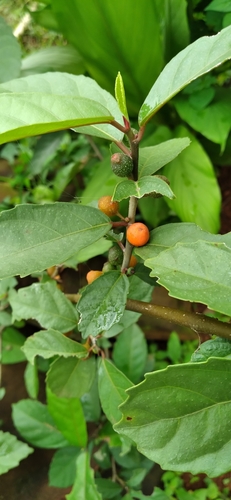
(c) wuddanmisbahuddin, some rights reserved (CC BY-NC), uploaded by wuddanmisbahuddin
What to Eat
Edible parts: Fruit, Leaves
The very young leaves are eaten raw in salads. The fruit are sweetish and eaten, especially by children.
Where to Find It
A tropical plant. It grows in gullies and hard soils and in forests up to 1,300 m above sea level. It is usually near streams.
Asia, Hawaii, India, Indochina, Indonesia, Malaysia, Myanmar, Pacific, SE Asia, Thailand, USA,
How to Identify
A fig. It is a shrub. It grows 2 m long. The branches often lie along the ground. The leaves are oval and have 2-8 lobes along the stalk. The leaves are 5-15 cm long. They have a rough sandpapery surface underneath. The figs are in the axils of leaves. They are on stalks 5 cm long. The figs are about 1 cm across. The become red when ripe.
How to Grow
Plants can be grown from seeds or cuttings.
Medicinal Uses
The roots, in combination with other ingredients, are used in the treatment of syphilis. The leaves are smoked together with opium.
Wikipedia
Source ↗Ficus montana (common name, oakleaf fig) is a species of subtropical climbing fig plant. Leaves are 3 to 5 inches long. The leaves are shaped like oak leaves which gives its common name. It is grown as a houseplant, in offices and in shopping malls. It is slow growing. It is often confused with the tiny F. pumila quercifolia, which is a vining species that creeps on the surface of soil. The Latin specific epithet montana refers to mountains or coming from mountains.
Other Information
The fruit are eaten mainly by children.
Notes
There are about 800-1000 Ficus species. They are mostly in the tropics. There are 120 Ficus species in tropical America.
Names & Synonyms
Amis mata, Amis panon, Duea din, Kesinan, Maduea hin, Perijeh, Periyeh, Perlasan, Ujah-ujahan, Uyah-uyahan
References (11)
- Burkill, I.H., 1966, A Dictionary of the Economic Products of the Malay Peninsula. Ministry of Agriculture and Cooperatives, Kuala Lumpur, Malaysia. Vol 1 (A-H) p 1029 (As Ficus quercifolia)
- Fl. indica 226. 1768 and Fl. Ind. 3:534. 1832 (As Ficus quercifolia)
- Martin, F.W. & Ruberte, R.M., 1979, Edible Leaves of the Tropics. Antillian College Press, Mayaguez, Puerto Rico. p 206 (As Ficus quercifolia)
- Milow, P., et al, 2013, Malaysian species of plants with edible fruits or seeds and their evaluation. International Journal of Fruit Science. 14:1, 1-27
- Ochse, J.J. et al, 1931, Vegetables of the Dutch East Indies. Asher reprint. p 503 (As Ficus quercifolia)
- PROSEA (Plant Resources of South East Asia) handbook, Volume 2, 1991, Edible fruits and nuts.
- Soepadmo, E. and Saw, L. G., 2000, Tree Flora of Sabah and Sarawak. Forestry Malaysia. Volume Three. p 290
- Staples, G.W. and Herbst, D.R., 2005, A tropical Garden Flora. Bishop Museum Press, Honolulu, Hawaii. p 411
- Sukarya, D. G., (Ed.) 2013, 3,500 Plant Species of the Botanic Gardens of Indonesia. LIPI p 928
- Terra, G.J.A., 1973, Tropical Vegetables. Communication 54e Royal Tropical Institute, Amsterdam, p 46 (As Ficus quercifolia)
- World Checklist of Useful Plant Species 2020. Royal Botanic Gardens, Kew