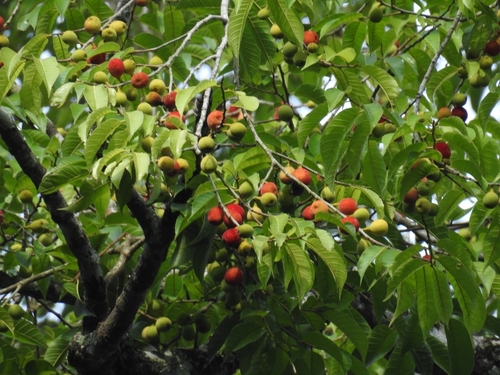
Ficus obpyramidata
Miq.
Soft fig, Common river fig

President and Fellows of Harvard College

President and Fellows of Harvard College

President and Fellows of Harvard College
What to Eat
Edible parts: Fruit
The fruit is eaten and occasionally sold in markets.
Where to Find It
A tropical plant. It occurs in rainforest in Malaysia mostly near water. It grows along stream banks and up to 1,300 m above sea level.
Asia, Indochina, Malaysia, Myanmar, SE Asia, Thailand,
How to Identify
A fig. It is a small tree up to about 7 m high. It has an upright stem and a large canopy of leaves. The leaves are 7-35 cm long by 4-18 cm wide. The fruit are borne on the stem and branches. They are pear shaped to round and 5-7.5 cm wide. When young the fruit are greenish-brown but turn orange-brown when ripe.
Nutrition Score: 59/100
| Part | Moisture | kJ | kcal | Protein | Vit A | Vit C | Iron | Zinc |
|---|---|---|---|---|---|---|---|---|
| Fruit | 50.9 | 722 | 176 | 6.3 | — | — | 83 | 26 |
How to Grow
Plants can be grown from seed.
Other Information
It is not popular. The fruit are occasionally sold in markets.
Notes
There are about 800-1000 Ficus species. They are mostly in the tropics. There are 120 Ficus species in tropical America.
Names & Synonyms
Ara Lempong, Engkunoh, Kelempong
References (8)
- Burkill, I.H., 1966, A Dictionary of the Economic Products of the Malay Peninsula. Ministry of Agriculture and Cooperatives, Kuala Lumpur, Malaysia. Vol 1 (A-H) p 1028
- Chin, H.F., & Yong, H.S., 1996, Malaysian Fruits in Colour. Tropical press, Kuala Lumpur p 78
- Corner,
- Milow, P., et al, 2013, Malaysian species of plants with edible fruits or seeds and their evaluation. International Journal of Fruit Science. 14:1, 1-27
- PROSEA (Plant Resources of South East Asia) handbook, Volume 2, 1991, Edible fruits and nuts.
- Siong, K. H., 2003, Indigenous Fruits of Sarawak. Forest Department Sarawak. p 104
- Soepadmo, E. and Saw, L. G., 2000, Tree Flora of Sabah and Sarawak. Forestry Malaysia. Volume Three. p 291
- World Checklist of Useful Plant Species 2020. Royal Botanic Gardens, Kew