Ficus polita
Vahl
Wild rubber fig
(c) mamy_andriamahay, some rights reserved (CC BY-NC), uploaded by mamy_andriamahay
(c) magdastlucia, some rights reserved (CC BY-NC)

(c) magdastlucia, some rights reserved (CC BY-NC), uploaded by magdastlucia
What to Eat
Edible parts: Leaves, Fruit
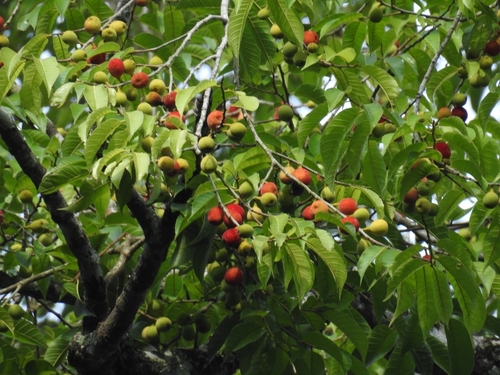
Leaves - cooked. The leaves are occasionally used as a vegetable. The green to purple, globose fruits are 20 - 40mm in diameter. This report does not say that they are edible, though many species in this genus do produce edible fruit.
Where to Find It
A tropical plant. It grows in evergreen forest, coastal forest and dune forest. It grows up to 1,500 m above sea level.
Africa, Angola, Benin, Burkina Faso, Cameroon, Central Africa, Central African Republic, CAR, Congo DR, Congo R,Côte d'Ivoire, East Africa, Eswatini, Gabon, Ghana, Guinea, Guinée, Guinea-Bissau, Ivory Coast, Kenya, Madagascar, Malawi, Mozambique, Nigeria, Senegal, Sierra Leone, South Africa, Southern Africa, Swaziland, Tanzania, Uganda, West Africa, Zambia, Zimbabwe,
How to Identify
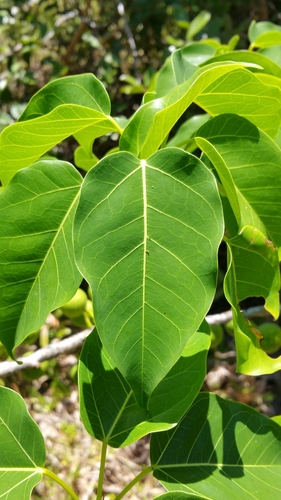
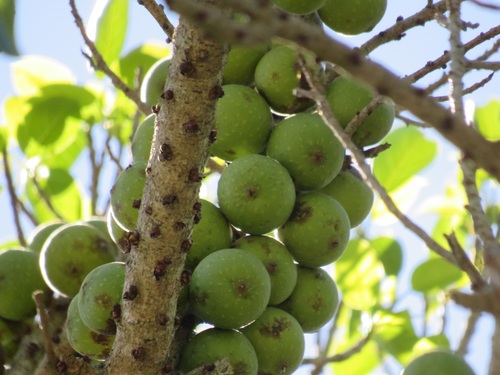
A strangler fig that becomes a large tree. It grows 10-16 m tall. The bark is light brown. It flakes in small sections. The leaves are broadly oval. They are 6-15 cm long by 4-10 cm wide. They are dark green and glossy above and paler underneath. The tip narrows to a point. The base is rounded. The figs are 1.5-3 cm across. They normally occur in pairs. They can be on the branches or the trunk. They are green and warty.
How to Grow
The wasp pollinator is Courtella bekiliensis.
Propagation: Seed - Cuttings
Other Uses
The tree is sometimes used as a boundary marker and for live fences.
Wikipedia
Source ↗Ficus polita, the heart-leaved fig, is a species of fig that is native to forests of tropical Africa,
Notes
There are about 800-1000 Ficus species. They are mostly in the tropics. There are 120 Ficus species in tropical America.
Names & Synonyms
Arafaja, Blohunyi, Bupoco, Durumi, Figuerinha, Lithahi, Rita
References (16)
- Abbiw, D.K., 1990, Useful Plants of Ghana. West African uses of wild and cultivated plants. Intermediate Technology Publications and the Royal Botanic Gardens, Kew. p 47
- Achigan-Dako, E, et al (Eds), 2009, Catalogue of Traditional Vegetables in Benin. International Foundation for Science.
- Dalziel, J. M., 1937, The Useful plants of west tropical Africa. Crown Agents for the Colonies London.
- Gilbert, T., et al, 2017, Diversity and local transformation of indigenous edible fruits in sahelian domain of Cameroon. Journal of Animal & Plant Sciences Vol. 26 (2): 5289-5300
- Jardin, C., 1970, List of Foods Used In Africa, FAO Nutrition Information Document Series No 2.p 78, 137 (Also as Ficus megapoda)
- Long, C., 2005, Swaziland's Flora - siSwati names and Uses http://www.sntc.org.sz/flora/
- Martin, F.W. & Ruberte, R.M., 1979, Edible Leaves of the Tropics. Antillian College Press, Mayaguez, Puerto Rico. p 206
- Moksia, F., et al, 2019, Diversity and Socio-Economic Value of Wild Edible Plants in the Mounts Mandara Region, Cameroon. International Journal of Sciences. Vol. 8:10
- MORTIMORE,
- Palgrave, K.C., 1996, Trees of Southern Africa. Struik Publishers. p 113
- Peters, C. R., O'Brien, E. M., and Drummond, R.B., 1992, Edible Wild plants of Sub-saharan Africa. Kew. p 150
- Swaziland's Flora Database http://www.sntc.org.sz/flora
- Terra, G.J.A., 1973, Tropical Vegetables. Communication 54e Royal Tropical Institute, Amsterdam, p 46
- Vivien, J., & Faure, J.J., 1996, Fruitiers Sauvages d'Afrique. Especes du Cameroun. CTA p 216
- White, F., Dowsett-Lemaire, F. and Chapman, J. D., 2001, Evergreen Forest Flora of Malawi. Kew. p 387
- www.figweb.org