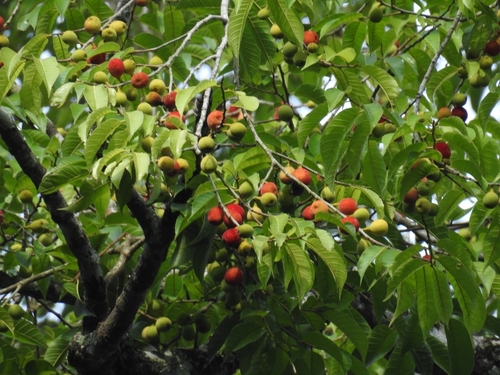
Ficus prasinicarpa
Elmer
Baola ania
MoraceaeLeaves

gbif · cc0
President and Fellows of Harvard College
President and Fellows of Harvard College

gbif · cc0
President and Fellows of Harvard College
President and Fellows of Harvard College

gbif · cc0
President and Fellows of Harvard College
President and Fellows of Harvard College
What to Eat
Edible parts: Leaves
The young leaves are commonly cooked with coconut milk.
Where to Find It
A tropical plant. It occurs in Santa Anna and Rennell in the Solomon Islands.
Asia, Indonesia, Pacific, Papua New Guinea, PNG, Philippines, SE Asia, Solomon Islands,
Countries: United Arab Emirates, Afghanistan, Armenia, Australia, Azerbaijan, Bangladesh, Bahrain, Brunei, Bhutan, China, Fiji, Micronesia, Georgia, Indonesia, Israel, India, Iraq, Iran, Jordan, Japan, Kyrgyzstan, Cambodia, Kiribati, North Korea, South Korea, Kuwait, Kazakhstan, Laos, Lebanon, Sri Lanka, Marshall Islands, Myanmar, Mongolia, Maldives, Malaysia, Nepal, Nauru, New Zealand, Oman, Papua New Guinea, Philippines, Pakistan, Palau, Qatar, Saudi Arabia, Solomon Islands, Singapore, Syria, Thailand, Tajikistan, Timor-Leste, Turkmenistan, Tonga, Turkey, Tuvalu, Taiwan, Uzbekistan, Vietnam, Vanuatu, Samoa, Yemen
How to Identify
A fig tree. This fig tree looses its leaves during the year. The fruit are bell shaped or round. They are less than 1 cm across.
Production
The young leaves that re-grow after leaf fall are picked and used.
Other Information
It is commonly used for food on Santa Anna Island in the Solomon Islands.
Notes
There are about 800-1000 Ficus species. They are mostly in the tropics. There are 120 Ficus species in tropical America. It is an unresolved name in The Plant List.
Names & Synonyms
Anga, Rawarawa
Ficus glabella var. papuana King
References (2)
- French, B.R., 2010, Food Plants of Solomon Islands. A Compendium. Food Plants International Inc. p 82
- Henderson, C.P. and I.R.Hancock, 1988, A Guide to the Useful Plants of the Solomon Islands. Res. Dept. Min of Ag. & Lands. Honiara, Solomon Islands. p 128