Ficus superba
Miq.
Sea Fig, Deciduous fig

(c) Cerlin Ng, some rights reserved (CC BY-NC-SA)
(c) Cerlin Ng, some rights reserved (CC BY-NC-SA)

(c) Cerlin Ng, some rights reserved (CC BY-NC-SA)
What to Eat
Edible parts: Leaves, Fruit
The young leaves are cooked and eaten in curry and as a vegetable; the fruit are edible though not widely popular.
Where to Find It
A tropical plant. The variety japonica occurs in China. It grows on plains or in villages near the sea coast in S China. It grows from 100-1400 m altitude. It suits hardiness zones 9-11. Geelong Botanical Gardens.
Asia, Australia, Cambodia, China, East Timor, Indochina, Indonesia, Japan, Laos, Malaysia, Myanmar, SE Asia, Thailand, Timor-Leste, Vietnam,
How to Identify
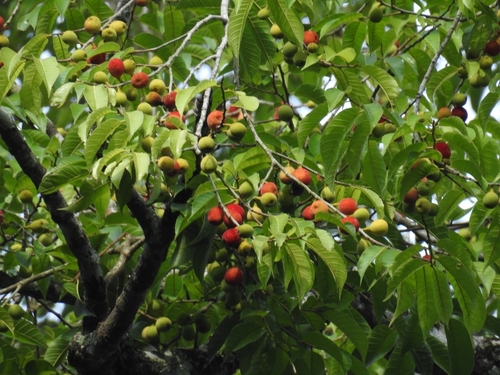
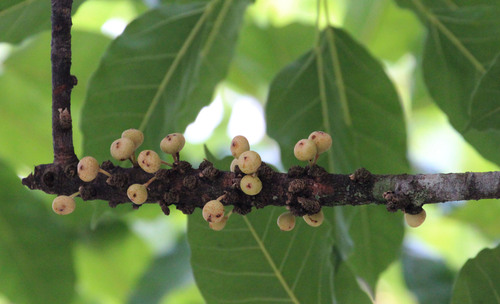
A large fig. It loses its leaves for a short time. It has some aerial roots. It grows 6-21 m high and spreads 10-18 m wide. The young leaves are pink. They become mid green. The leaves grow to 25 cm long. The figs are dull purple. They are 18 mm across. They are clustered on short stalks.
How to Grow
Plants can be grown from seeds.
Wikipedia
Source ↗Ficus superba, also known as sea fig or deciduous fig, is a hemiepiphytic tree of genus Ficus. It is one of the species known as banyans or "strangler figs" because of its potential to grow as a hemi-epiphyte and eventually progress to the strangling habit of species in this subgenus. It is, however, not an obligate hemi-epiphyte and can be found growing as single stemmed trees in forests. It is found in Japan, Taiwan, Australia, and China, as well as various parts of Southeast Asia, such as Thailand, Vietnam, Java, Kalimantan, the Lesser Sunda Islands, Moluccas, Seram Island, and Peninsular Malaysia. According to E.J.H. Corner, if this fig germinates in a boulder field its roots can extend "extraordinary distances, up to several hundred feet" over and between the rocks.
Notes
There are about 800-1000 Ficus species. They are mostly in the tropics. There are 120 Ficus species in tropical America.
Names & Synonyms
Hua li rong, Lieb, Pohon ara jerakah bulu, Pohon ara superba
References (10)
- Ann. Mus. Bot. Lugduno-Batavum 2:200. 1866
- Bodkin, F., 1991, Encyclopedia Botanica. Cornstalk publishing, p 474
- Cowie, I, 2006, A Survey of Flora and vegetation of the proposed Jaco-Tutuala-Lore National Park. Timor-Lests (East Timor) www.territorystories.nt/gov.au p 51
- Eiadthong, W., et al, 2010, Management of the Emerald Triangle Protected Forests Complex. Botanical Consultant Technical Report. p 49
- Etherington, K., & Imwold, D., (Eds), 2001, Botanica's Trees & Shrubs. The illustrated A-Z of over 8500 trees and shrubs. Random House, Australia. p 329
- Flora of China.
- Hibbert, M., 2002, The Aussie Plant Finder 2002, Florilegium. p 102
- Sukarya, D. G., (Ed.) 2013, 3,500 Plant Species of the Botanic Gardens of Indonesia. LIPI p 291
- Terra, G.J.A., 1973, Tropical Vegetables. Communication 54e Royal Tropical Institute, Amsterdam, p 46
- World Checklist of Useful Plant Species 2020. Royal Botanic Gardens, Kew