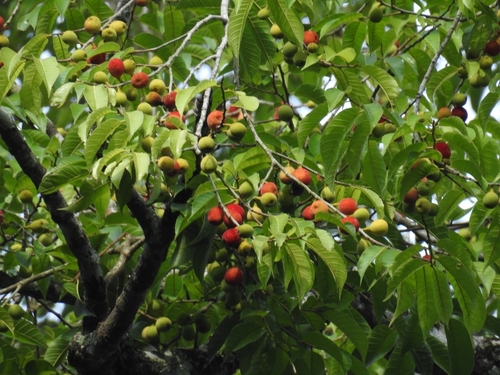
Ficus sycomorus
L.
Sycamore fig

(c) Alan Manson, some rights reserved (CC BY), uploaded by Alan Manson

(c) Ricky Taylor, some rights reserved (CC BY-NC), uploaded by Ricky Taylor

(c) Ricky Taylor, some rights reserved (CC BY-NC), uploaded by Ricky Taylor
What to Eat
Edible parts: Fruit, Leaves, Vegetable, Bark, Gum
Fruit are eaten raw or dried and made into jam. They are eaten with millet and used to make alcoholic drinks. Young leaves are cooked in soups or peanut dishes. The latex is used as a vegetable rennet.
Known Hazards
Where to Find It
A tropical plant. They will grow on most soils. Soils need to be well drained. They prefer a sunny open position. It is drought and frost resistant. It is probably damaged by frost when in leaf. It can grow in hot and arid regions. It grows well near rivers. In Africa trees are commonly near rivers in dry regions. It grows in areas with an annual rainfall between 200-1,800 mm. It can grow in salty soils. It can grow in arid places. It grows in Miombo woodland in Africa. It grows in the Sahel. It suits hardiness zones 10-12.
Africa, Angola, Arabia, Asia, Australia, Benin, Botswana, Burkina Faso, Burundi, Cameroon, Cape Verde, Central Africa, Central African Republic, CAR, Chad, Comoros, Congo, Congo DR, Côte d'Ivoire, Cuba, Cyprus, Djibouti, East Africa, Egypt, Eritrea, Eswatini, Ethiopia, Europe, Gambia, Ghana, Guinea, Guinée, Guinea-Bissau, Israel, Ivory Coast, Jordan, Kenya, Lebanon, Lesotho, Madagascar, Malawi, Mali, Mauritania, Mediterranean, Middle East, Mozambique, Namibia, Niger, Nigeria, North Africa, Oman, Palestine, Rwanda, Sahel, Saudi Arabia, Senegal, Somalia, South Africa, Southern Africa, South Sudan, Sudan, Swaziland, Syria, Tanzania, Turkey, Türkiye, Uganda, USA, West Africa, West Indies, Yemen, Zambia, Zimbabwe,
How to Identify
A fig. It is a deciduous tree. It grows to 13-25 m high and spreads to 14 m across. It has a rounded crown. The stem is erect. Sometimes the stem has buttresses. The base of the tree commonly spreads over the ground. The bark is yellowish. The leaves are olive green, oval or almost round. They are 5-12 cm long and 3-10 cm wide. The leaves are rough and leathery. They are hairy. The edge of the leaf is wavy and roughly toothed. The leaf stalk is 3 cm long. In dry seasons the tree may lose its leaves. The flowers are 2 cm across and roundish. The fruit are small and edible. They are 3 cm across. They grow in dense clusters in the axils of leaves or on main branches and on the trunk. The fruit are yellow-red when ripe.
Nutrition Score: 28/100
| Part | Moisture | kJ | kcal | Protein | Vit A | Vit C | Iron | Zinc |
|---|---|---|---|---|---|---|---|---|
| Fruit | 83.9 | 239 | 57 | 0.5 | — | — | — | — |
| Fruit | 82.7 | 210 | 50 | 1.4 | — | 7.3 | 1.7 | 0.4 |
How to Grow
In the Mediterranean region sycamore figs do not set seed because the more tropical fig wasp does not occur there. In tropical places it can be grown from seeds. It can be grown by cuttings or layering. Trees can be pruned or lopped.
Propagation: Seed - viable seed is difficult to obtain. It germinates best at a temperature around 20°c. Branches with a diameter of 50-150 mm can be used as large cuttings planted direct into the soil. To avoid rotting of the tips, they must be left in the shade for a few days to dry before planting. Most of the leaves should be removed before planting in 1 metre deep holes with some sand at the bottom. This prevents rotting of the cuttings and stimulates root formation. Smaller cuttings can also be made from either the mature wood or from wood of the current season's growth. They are first planted in the nursery to induce rooting and then planted out in the field.
Medicinal Uses
Used in soups and peanut dishes as food.
Other Uses
The inner part of the root is used as weaving fibre, and a strong rope can be made from the inner bark. An abundant white latex flows from cuts in the stem. The bark is a dye sources for traditional 'bogolan' textiles, giving red-ochre to brownish colours. The wood is creamy brown, has a fairly uniform structure, is very light (air-dry 510 kg/m³), soft to moderately hard, tough, strong, easy to work, finishes smoothly and holds nails firmly. It is not very durable and is easily attacked by termites. Mainly used for making mortars and pestles, drums, stools, doors, beehives, dugout canoes, carvings and for house building. The wood can be used as firewood and for making charcoal. Various peoples throughout Africa use a piece of dry wood from this tree as the base block when starting a fire by the friction method. Grown as a shade tree in coffee plantations. Wild fig can be used for sand-dune fixation and riverbank stabilization. Shed leaves form a valuable litter improving the nutrient status, infiltration rate and water-holding capacity of the soil. Usually intercropped with bananas as an understorey.
Wikipedia
Source ↗Ficus sycomorus, called the sycamore fig or the fig-mulberry (because the leaves resemble those of the mulberry), sycamore, or sycomore, is a fig species that has been cultivated since ancient times.
Production
Trees are fairly fast growing. The young fruit are gashed to assist ripening. In Tanzania fruit are collected at the end of the rainy season.
Other Information
Fruit are widely eaten and sold in markets in the Middle East. The fruit are also commonly eaten by children. It is cultivated.
Notes
Biblical references Amos 7:14 There are about 800-1000 Ficus species. They are mostly in the tropics. There are 120 Ficus species in tropical America.
Names & Synonyms
Asses fig, Atielowinyo, Bamba, Barde, Bobi, Daray, Ebobore, Ebwalai, Ecalawinyo, Egyptian sycamore, Ejinga, Emidit, Engop, Eta, Figueira-branca, Fuqa, Ganyaya, Gomeiz, Harbu, Hillteta, Ibbi debbi, Ikuku, Ingaboli, Kajare, Kankanga, Katjere, Le'a, Mochaba, Mbuyo, Mkuu, Mkuwa, Mkuyu, Mochaba, Mogoboya, Msoho, Msombe, Mtsombe, Muhuyalukuse, Muhuyuvhuwa, Mukankanwa, Mukuiu, Mukumyu, Mukunyu, Mukuyu, Mulberry fig, Muonde, Mutole, Nkuwa, Nomas, Nshembe, Oda, Odaa, Olam, Ol-gnagboli, Omukwiyu, Orng'aboli, Ourof, Pharoah's fig, Saqam, Saqum, Shafa, Shola, Sou toro, Subula, Suqmi, Sycamore in the Bible, Trosvy, Umkhiwa, Wokoyo, Wola, Wuuri
References (125)
- Abbiw, D.K., 1990, Useful Plants of Ghana. West African uses of wild and cultivated plants. Intermediate Technology Publications and the Royal Botanic Gardens, Kew. p 42
- andel-Hameed, E. S., 2009, Total phenolic contents and free radical scavenging activity of certain Egyptian Ficus species leaf samples. Food Chemistry 114: 1271-1277
- Acipa, A. et al, 2013, Nutritional Profile of some Selected Food Plants of Otwal and Ngai Counties, Oyam District, Northern Uganda. African Journal or Food, Agriculture, Nutrition and Development. 13(2)
- Addis, G., et al, 2005, Ethnobotanical Study of Edible Wild Plants in Some Selected Districts of Ethiopia. Human Ecology, Vol. 33, No. 1, pp. 83-118
- Addis, G., Asfaw, Z & Woldu, Z., 2013, Ethnobotany of Wild and Semi-wild Edible Plants of Konso Ethnic Community, South Ethiopia. Ethnobotany Research and Applications. 11:121-141
- Addis, G., et al, 2013, The Role of Wild and Semi-wild Edible Plants in Household Food Sovereignty in Hamer and Konso Communities, South Ethiopia. Ethnobotany Research & Applications. 11:251-271
- Al-Fatimi, M. A., Wild Edible Plants Traditionally Collected and Used in Southern Yemen. Research Square. University of Aden. p 19
- Allen, D. J., 2007, Wildflowers and Common Trees of East Africa. Camerapix Publishers p 126
- Anywar, G., et al, 2014, Wild Plants Used as Nutraceuticals from Nebbi District, Uganda. European Journal of medicinal Plants. 4(6):641-660
- Asfaw, Z. and Tadesse, M., 2001, Prospects for Sustainable Use and Development of Wild Food Plants in Ethiopia. Economic Botany, Vol. 55, No. 1, pp. 47-62
- Awas, T., 1997, A Study on the Ecology and Ethnobotany of Non-cultivated Food Plants and Wild Relatives of Cultivated crops in Gambella Region, Southwestern Ethiopia. Addis Ababa University. p 58
- Bahru, T., et al, 2013, Wild Edible Plants: Sustainable Use and Management by Indigenous Communities in and the Buffer Area of Awah National Park, Ethiopia. Ethiop. J. Sci., 36(2): 93-108
- Balemie, K., & Kebebew, F., 2006, Ethnobotanical study of wild edible plants in Derashe and Kucha Districts, South Ethiopia. Journal of Ethnobiology and Ethnomedicine.
- Ballal, M. E., et al, 2014, Ethno-botany of Natural Forests of Nuba Mountains, South Kordofan State, Sudan. Journal of Forest Poducts & Industries. 3(1):13-19
- Barwick, M., 2004, Tropical and Subtropical Trees. A Worldwide Encyclopedic Guide. Thames and Hudson p 187
- Beche D, Gebeyehu G, Feyisa K., 2016, Indigenous Utilization and Management of Useful Plants in and around Awash National Park, Ethiopia. J Plant Biol Soil Health. 3(1):12.
- Bekele-Tesemma A., Birnie, A., & Tengnas, B., 1993, Useful Trees and Shrubs for Ethiopia. Regional Soil Conservation Unit. Technical Handbook No 5. p 250
- Belem, M., et al, 2017, Strategy of Conservation and Protection of Wild Edible Plants Diversity in Burkina Faso. ANADOLU 27 (2) 2017, 82- 90
- Berihun, T. & Molla, E., 2017, Study on the Diversity and Use of Wild Edible Plants in Bullen District Northwest Ethiopia. Hindawi Journal of Botany. Article ID 8383468
- Bernholt, H. et al, 2009, Plant species richness and diversity in urban and peri-urban gardens of Niamey, Niger. Agroforestry Systems 77:159-179
- Blamey, M and Grey-Wilson, C., 2005, Wild flowers of the Mediterranean. A & C Black London. p 34
- Bodkin, F., 1991, Encyclopedia Botanica. Cornstalk publishing, p 474
- Bonou, A., et al, 2013, Valeur economique des Produits Forestiers Non Ligneux (PFNL) au Benin. Editions Universitaires Europeennes p 91
- Bussman, R. W., et al, 2011, Plant Use in Odo-Bulu and Demaro, Bale region, Ethiopia. Journal of Ethnobiology and Ethnomedicine. 2011, 7:28
- Cheikhyoussef, A & Embashu, W., 2013, Ethnobotanical knowledge on Indigenous fruits in Ohangwena and Oshito regions in Northern Namibia. Journal of Ethnobiology and Ethnomedicine 9:34
- Codjia, J. T. C., et al, 2003, Diversity and local valorisation of vegetal edible products in Benin. Cahiers Agricultures 12:1-12 (Also as Ficus gnaphalocarpa)
- Cundall, P., (ed.), 2004, Gardening Australia: flora: the gardener's bible. ABC Books. p 604
- Dansi, A., et al, 2008, Traditional leafy vegetables and their use in the Benin Republic. Genet Resour Crop Evol (2008) 55:1239–1256
- Demise, S. & Asfaw, Z., 2020, Ethno Botanical Study of Wild Edible Plants in Adola District, Southern, Ethiopia. International Journal of Research and Analytical Reviews (IJRAR) 7(2).
- Dharani, N., 2002, Field Guide to common Trees & Shrubs of East Africa. Struik. p 112
- Diarra, N. et al, 2016, Etude ethnobotanique des plantes alimentaires utilisées en période de soudure dans les régions Sud du Mali. Int. J. Biol. Chem. Sci. 10(1): 184-197
- Duarte, M. C., et al, 2022, Diversity of Useful Plants in Cabo Verde Islands: A Biogeographic and Conservation Perspective. Plants 2022, 11, 1313 p 6
- Emire, A., et al, 2021, Ethnobotanical Study of Wild Edible Fruit Tree and Shrub Species in Adola Rede and Odo Shakiso Midland Districts of Guji Zone, Southern Ethiopia. Int. J. Adv. Res. Biol. Sci. (2021). 8(12): 96-109
- Etherington, K., & Imwold, D., (Eds), 2001, Botanica's Trees & Shrubs. The illustrated A-Z of over 8500 trees and shrubs. Random House, Australia. p 329
- Facciola, S., 1998, Cornucopia 2: a Source Book of Edible Plants. Kampong Publications, p 155
- FAO, 1988, Traditional Food Plants, FAO Food and Nutrition Paper 42. FAO Rome p 288
- Feyssa, D. H., et al, 2011, Seasonal availability an consumption of wild edible plants in semiarid Ethiopia; Implications to food security and climate change adaptation. Journal of Horticulture and Forestry 3(5): 138-149
- Fowler, D. G., 2007, Zambian Plants: Their Vernacular Names and Uses. Kew. p 49
- Fox, F. W. & Young, M. E. N., 1982, Food from the Veld. Delta Books. p 271
- Gemedo-Dalle, T., et al, 2005, Plant Biodiversity and Ethnobotany of Borana Pastoralists in Southern Oromia, Ethiopia. Economic Botany 59(1) pp. 43-65
- Gilbert, T., et al, 2017, Diversity and local transformation of indigenous edible fruits in sahelian domain of Cameroon. Journal of Animal & Plant Sciences Vol. 26 (2): 5289-5300
- Goode, P., 1989, Edible Plants of Uganda. FAO p 30
- Goode, P., 1989, Edible Plants of Uganda. FAO p 37
- Grubben, G. J. H. and Denton, O. A. (eds), 2004, Plant Resources of Tropical Africa 2. Vegetables. PROTA, Wageningen, Netherlands. p 562
- Hahn, K., et al, 2018, The Use of Wild Plants for Food: a National Scale Analysis for Burkina Faso (West Africa) Flora et Vegetatio Sudano-Sambesica 21, 25-33
- Hanawa, Y., 2013, Wild edible plants used by Guiziga people of far north region of Cameroon. Int. J. Med. Arom. Plants. Vol 3 (2) : 136-143
- Hinnawi, N. S. A., 2010, An ethnobotanical study of wild edible plants in the Northern West Bank "Palestine". An-Najah National University. p 94
- Ichikawa, M., 1980, The Utilization of Wild Food Plants by the Suiei Dorobo in Northern Kenya. J. Anthrop. Soc. Nippon. 88(1): 25-48
- INFOODS:FAO/INFOODS Databases
- Jardin, C., 1970, List of Foods Used In Africa, FAO Nutrition Information Document Series No 2.p 138
- Joffe, P., 2007, Creative Gardening with Indigenous Plants. A South African Guide. Briza. p 126
- Johns, T., Mhoro, E. B. and Sanaya, P., 1996, Food Plants and Masticants of the Batemi of Ngorongoro District, Tanzania. Economic Botany, Vol. 50, No. 1, pp. 115-121
- Katende, A.B., Birnie, A & Tengnas B., 1995, Useful Trees and Shrubs for Uganda. Identification, Propagation and Management for Agricultural and Pastoral Communities. Technical handbook No 10. Regional Soil Conservation Unit, Nairobi, Kenya. p 324
- Kebebew, M. & Leta, G., 2016, Wild Edible Plant Bio-diversity and Utilization System in Nech Sar National Park, Ethiopia. International Journal of Bio-resource and Stress Management 2016, 7(4):885-896
- Kidane, B., et al, 2014, Ethnobotany of Wild and Semi-wild Edible Fruit Species used by Maale and Ari Ethnic Communities in South Ethiopia. Ethnobotany Research and Applications. Vol. 12, 1546-3465-12-455
- Kristensen, M and Lykke, A. M., 2003, Informant-Based Valuation of Use and Conservation Preferences of Savanna Trees in Burkina Faso. Economic Botany, Vol 57, No. 2, pp. 203-271
- Lamien-Meda, A., et al, 2008, Polyphenol Content and Antioxidant Activity of Fourteen Wild Edible Fruits from Burkina Faso. Molecules 2008,13, 581-594
- Larson, T. J., 1970, Hambukushu Ethno-botany. Botswana Notes and Records. Vol 13.
- Le Houerou, H. N., (Ed.), 1980, Browse in Africa. The current state of knowledge. International Livestock Centre for Africa, Ethiopia. p 163 (As Ficus gnaphalocarpa)
- Long, C., 2005, Swaziland's Flora - siSwati names and Uses http://www.sntc.org.sz/flora/
- Lovett, J. C. et al, Field Guide to the Moist Forest Trees of Tanzania. p 109
- Lulekal, E., et al, 2011, Wild edible plants in Ethiopia: a review on their potential to combat food insecurity. Afrika Focus - Vol. 24, No 2. pp 71-121
- Magwede, K., van Wyk, B.-E., & van Wyk, A. E., 2019, An inventory of Vhavenḓa useful plants. South African Journal of Botany 122 (2019) 57–89
- Malaisse, F., 1997, Se nourrir en floret claire africaine. Approche ecologique et nutritionnelle. CTA., p 63
- Mannheimer, C. A. & Curtis. B.A. (eds), 2009, Le Roux and Muller's Field Guide to the Trees and Shrubs of Namibia. Windhoek: Macmillan Education Namibia. p 26
- Maroyi, A., 2011, The Gathering and Consumption of Wild Edible Plants in Nhema Communal Area, Midlands Province, Zimbabwe. Ecology of Food and Nutrition 50:6, 506-525
- Maroyi, A. & Cheikhyoussef, A., 2017, Traditional knowledge of wild edible fruit in southern Africa: A comparative use patterns in Namibia and Zimbabwe. Indian Journal of Traditional Knowledge. 16(3): 385-392
- Masters, T., 2021, Traditional food plants of the upper Aswa River catchment of northern Uganda—a cultural crossroads. Journal of Ethnobiology and Ethnomedicine (2021) 17:24
- Maundu, P. et al, 1999, Traditional Food Plants of Kenya. National Museum of Kenya. 288p
- Maydell, H. von, 1990, Trees and shrubs of the Sahel: their characteristics and uses. Margraf. p 273 (As Ficus gnaphalocarpa)
- Mbuvi, M. T. E., et al, 2019, Annonated checklist of plant species of Loita Forest Narok County, Kenya. Int. J. Adv. Res. Biol. Sci. (2019). 6(3): 54-110
- Mbuya, L.P., Msanga, H.P., Ruffo, C.K., Birnie, A & Tengnas, B., 1994, Useful Trees and Shrubs for Tanzania. Regional Soil Conservation Unit. Technical Handbook No 6. p 270
- Mengistu, F. & Hager, H., 2008, Wild Edible Fruit Species Cultural Domain, Informant Species Competence and Preference in Three Districts of Amhara Region, Ethiopia. Ethnobotany Research & Applications 6:487-502
- Miguel, E., et al, 1989, A checklist of the cultivated plants of Cuba. Kulturpflanze 37. 1989, 211-357
- Miller, A. G., Morris, M. & Stuart-Smith, S., 1988, Plants of Dhofar. The Southern Region of Oman, Traditional, Economic and Medicinal Uses. Sultanate of Oman. p 206
- Mokganya, M. G. et al, 2018, An evaluation of additional uses of some wild edible fruit plants of the Vhembe District Municipality in the Limpopo Province, South Africa. Indian Journal of Traditional Knowledge. Vol 17(2) April 2018, pp 276-281
- Moksia, F., et al, 2019, Diversity and Socio-Economic Value of Wild Edible Plants in the Mounts Mandara Region, Cameroon. International Journal of Sciences. Vol. 8:10 (Also as Ficus gnaphalocarpa)
- Msuya, T. S., et al, 2010, Availability, Preference and Consumption of Indigenous Foods in the Eastern Arc Mountains, Tanzania, Ecology of Food and Nutrition, 49:3, 208-227
- Mutie, F. G., 2020, Conservation of Wild Food Plants and Their Potential for Combatting Food Insecurity in Kenya as Exemplified by the Drylands of Kitui County. Plants 2020, 9, 1017
- Neudeck, L. et al, 2012, The Contribution of Edible Wild Plants to Food Security, Dietary Diversity and Income of Households in Shorobe Village, Northern Botswana. Ethnobotany Research & Applications 10:449-462
- Njana, M. A., et al, 2013, Are miombo woodlands vital to livelihoods of rural households? Evidence from Urumwa and surrounding communities, Tabora, Tanzania. Forests, Trees and Livelihoods, 22:2, 124-140
- Oryema, C., et al, 2013, Edible wild fruit species of Gulu District, Uganda. International Journal of Biology and Biological Sciences Vol 2(4) pp 068-082
- Palgrave, K.C., 1996, Trees of Southern Africa. Struik Publishers. p 116
- Palmer, E and Pitman, N., 1972, Trees of Southern Africa. Vol. 1. A.A. Balkema, Cape Town p 443
- Peters, C. R., O'Brien, E. M., and Drummond, R.B., 1992, Edible Wild plants of Sub-saharan Africa. Kew. p 151
- Plowes, N. J. & Taylor, F. W., 1997, The Processing of Indigenous Fruits and other Wildfoods of Southern Africa. in Smartt, L. & Haq. (Eds) Domestication, Production and Utilization of New Crops. ICUC p 191
- Regassa, T., et al, 2014, Ethnobotany of Wild and Semi-Wild Edible Plants of Chelia District, West-Central Ethiopia. Science, Technology and Arts Research Journal. 3(4): 122-134
- Rivera, D. et al, 2006, Gathered Mediterranean Food Plants - Ethnobotanical Investigations and Historical Development, in Heinrich M, Müller WE, Galli C (eds): Local Mediterranean Food Plants and Nutraceuticals. Forum Nutr. Basel, Karger, 2006, vol 59, pp 18–74
- RILEY & BROKENSHA,
- Roodt, V., 1998, Trees & Shrubs of the Okavango Delta. Medicinal Uses and Nutritional value. The Shell Field Guide Series: Part 1. Shell Botswana. p 21
- Royal Botanic Gardens, Kew (1999). Survey of Economic Plants for Arid and Semi-Arid Lands (SEPASAL) database. Published on the Internet; http://www.rbgkew.org.uk/ceb/sepasal/internet [Accessed 4th May 2011]
- Ruffo, C. K., Birnie, A. & Tengnas, B., 2002, Edible Wild Plants of Tanzania. RELMA p 326
- Ruiters-Welcome, A. K., 2019, Food plants of southern Africa. Ph.D. thesis. Univ. of Johannesburg p 80
- Salih, N. K. M., & Ali, A. H., 2014, Wild food trees in Eastern Nuba Mountain, Sudan: Use, diversity, and threatening factors. Journal of Agriculture and Rural Development in the Tropics and Subtropics Vol. 115 No. 1 pp 1-7
- Sambou, A., et al, 2016, The contribution of trees and palms to a blanced diet in three rural villages of the Fatick Province, Senegal. FORESTS, TREES AND LIVELIHOODS, 2016 VOL. 25, NO. 3, 212–225 (As Ficus gnaphalocarpa)
- Schmidt, E., Lotter, M., & McCleland, W., 2007, Trees and shrubs of Mpumalanga and Kruger National Park. Jacana Media p 82
- Schuler, S., (Ed.), 1977, Simon & Schuster's Guide to Trees. Simon & Schuster. No. 116
- Segnon, A. C. & Achigan-Dako, E. G., 2014, Comparative analysis of diversity and utilization of edible plants in arid and semi-arid areas in Benin. Journal of Ethnobiology and Ethnomedicine 2014, 10:80
- Seyoum, Y., et al, 2015, Edible Wild Fruit Trees and Shrubs and Their Socioeconomic Significance in Central Ethiopia. Ethnobotany Research & Applications. 14:183-197
- Sp. pl. 2:1059. 1753
- Storey, W.B., 1979, Fig, in Simmonds, N.W., (ed), Crop Plant Evolution. Longmans. London. p 205
- Tebkew, M. et al, 2014, Underutilized wild edible plants in the Chilga District, northwestern Ethiopia: focus on wild woody plants. Agriculture & Food Security 3:12
- Tebkew, M., et al, 2018, Uses of wild edible plants in Quara district, northwest Ethiopia: implication for forest management. Agriculture and Food Security (2018) 7:12
- Terashima, H., et al, 1992, Ethnobotany of the Lega in the Tropical Rainforest of Eastern Zaire (Congo): Part Two, Zone de Walikale, African Study Monographs, Suppl. 19:1-60 (As Ficus gnaphalocarpa)
- Termote, C., et al, 2014, Assessing the potential of wild foods to reduce the cost of a nutritionally adequate diet: An example from eastern Baringo District, Kenya. Food and Nutrition Bulletin, vol. 35, no. 4
- Tredgold, M.H., 1986, Food Plants of Zimbabwe. Mambo Press. p 101
- Ulian, T., et al, 2020, Unlocking plant resources to support food security and promote sustainable agriculture. Plants, People, Planet. 2020;2:421–445.
- USDA, ARS, National Genetic Resources Program. Germplasm Resources Information Network - (GRIN). [Online Database] National Germplasm Resources Laboratory, Beltsville, Maryland. Available: www.ars-grin.gov/cgi-bin/npgs/html/econ.pl (10 April 2000)
- Van Damme, P et al, 1922, Plant Uses by the Topnaar of the Kuiseb Valley Namib Desert. Afrika Focus Vol. 8(3-4):223-252
- van Wyk, Be., & Gericke, N., 2007, People's plants. A Guide to Useful Plants of Southern Africa. Briza. p 42
- van Wyk, Br., van Wyk, P, and van Wyk B., 2000, Photographic guide to Trees of Southern Africa. Briza. p 158
- Van Wyk, Br. and van Wyk P., 2009, Field Guide to Trees of Southern Africa. Struik Nature. p 80
- van Wyk, Be., & Gericke, N., 2007, People's plants. A Guide to Useful Plants of Southern Africa. Briza. p 104
- van Wyk, B-E., 2011, The potential of South African plants in the development of new food and beverage products. South African Journal of Botany 77 (2011) 857–868
- Venter, F & J., 2009, Making the most of Indigenous Trees. Briza. p 172
- Vivien, J., & Faure, J.J., 1996, Fruitiers Sauvages d'Afrique. Especes du Cameroun. CTA p 220
- Wehmeyer, A. S, 1986, Edible Wild Plants of Southern Africa. Data on the Nutrient Contents of over 300 species
- Welcome, A. K. & Van Wyk, B.-E., 2019, An inventory and analysis of the food plants of southern Africa. South African Journal of Botany 122 (2019) 136–179
- Wiersema, J. H. & Leon, B., 2013, World Economic Plants. A Standard Reference CRC Press. 2nd Ed. p 306
- World Checklist of Useful Plant Species 2020. Royal Botanic Gardens, Kew
- www.worldagroforestrycentre.org/treedb/
- www.figweb.org
- www.zimbabweflora.co.zw 2011
- Zeven, A. C. & de West, J. M. J., 1982, Dictionary of cultivated plants and their regions of diversity. Wageningen. p 99, 116
- Zika, A., et al, 2015, Traditional plant use in Burkina Faso (West Africa): a national-scale analysis with focus on traditional medicine. Journal of Ethnobiology and Ethnomedicine 2015, 11:9