Ficus tettensis
Hutch.
Rock fig, Small-leaved rock fig

(c) Troos van der Merwe, some rights reserved (CC BY-NC), uploaded by Troos van der Merwe

(c) Troos van der Merwe, some rights reserved (CC BY-NC)

(c) Bodo Nuñez Oberg, some rights reserved (CC BY-NC), uploaded by Bodo Nuñez Oberg
What to Eat
Edible parts: Fruit
The figs are edible.
Where to Find It
A tropical plant. It occurs on and in rocks. It can grow in arid places. In Zimbabwe it grows up to 1,310 m above sea level.
Africa, Botswana, East Africa, Ethiopia, Guinea, Guinée, Malawi, Mozambique, Namibia, Somalia, South Africa, Southern Africa,West Africa, Zambia, Zimbabwe,
How to Identify
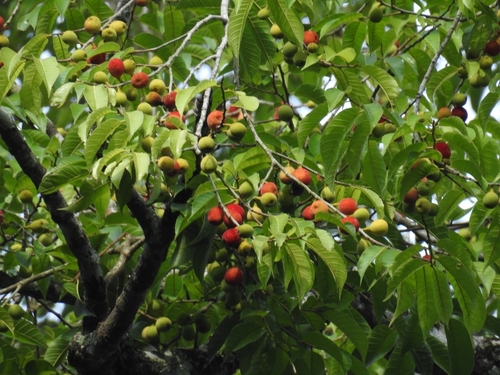
A small sturdy fig. It is a shrub. It grows up to 5-7 m high. The bark is white or very pale grey. The stem and roots are often plastered over the rock face. The leaves are small and kidney shaped. They are 2-5 cm long. They are densely velvety. Underneath is pale grey. The base of lobed and the edges are wavy. The leaf stalk is 2.5 cm long. The figs are 10 mm across and hairy. They occur singly or in pairs in the axils of leaves. They are green to reddish when ripe.
How to Grow
The pollinator wasp is Nigeriella excavata Compton.
Notes
There are about 800-1000 Ficus species. They are mostly in the tropics. There are 120 Ficus species in tropical America.
Names & Synonyms
Ibozane, Inkiwanyane, Mudohonya, Umkululu, Umpayamputsane
References (7)
- Palgrave, K.C., 1996, Trees of Southern Africa. Struik Publishers. p 116
- Royal Botanic Gardens, Kew (1999). Survey of Economic Plants for Arid and Semi-Arid Lands (SEPASAL) database. Published on the Internet; http://www.rbgkew.org.uk/ceb/sepasal/internet [Accessed 4th May 2011]
- Schmidt, E., Lotter, M., & McCleland, W., 2007, Trees and shrubs of Mpumalanga and Kruger National Park. Jacana Media p 84
- Tredgold, M.H., 1986, Food Plants of Zimbabwe. Mambo Press. p 101
- World Checklist of Useful Plant Species 2020. Royal Botanic Gardens, Kew
- www.figweb.org
- www.zimbabweflora.co.zw 2011