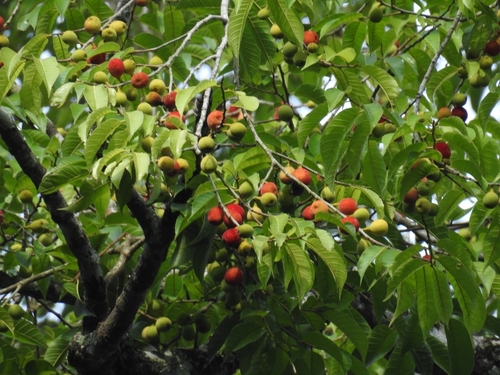
Ficus verruculosa
Warb.
Water fig

(c) Ricky Taylor, some rights reserved (CC BY-NC), uploaded by Ricky Taylor
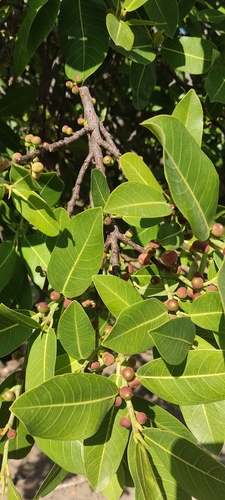
(c) Octávio Mateus, some rights reserved (CC BY-NC)
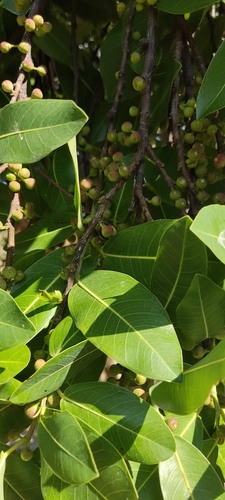
(c) Octávio Mateus, some rights reserved (CC BY-NC)
What to Eat
Edible parts: Fruit
Ripe fruits. The figs are produced in pairs, sometimes 4 together. The subglobose to ellipsoid fruit is 5 - 20mm in diameter when fresh.
Where to Find It
A tropical plant. It grows in patches of forest and in grassland. It is always near water. It forms low clumps in swamp forest.
Africa, Angola, Botswana, Cameroon, Central Africa, East Africa, Malawi, Mozambique, Namibia, Niger, Nigeria, Sahel, South Africa, Southern Africa, Uganda, West Africa, Zambia, Zimbabwe,
How to Identify
A fig. It is a shrub or weak stemmed tree. It grows to 8-12 m high. The bark is grey. The leaves are oblong and 5-15 cm long by 2.5-7.5 cm wide. They are very thick and leathery. They are glossy green above and paler underneath. The edges of the leaves are rolled under. The figs are 1-1.3 cm across. The pore at the end is slightly raised. Fruit are in pairs in the axils of leaves. The fruit are bright red when mature.
How to Grow
The pollinating wasp is Platyscapa binghami Wiebes.
Wikipedia
Source ↗Ficus verruculosa, the water fig, is a species of fig from sub-saharan Africa. It is found from north eastern South Africa, northern Botswana and Namibia to Uganda and west to Nigeria in riverine and swamp fringes or grassland, always near water. It is pollinated by the wasp Platyscapa binghami. The growth form of Ficus verruculosa is as a shrub, or weak-stemmed, sparsely branched shrub 0.2-0.6 m tall, less often a small tree up to 12m, often forming low, creeping thickets. Leaves oblong to lanceolate, 3.5-20 x 1.5-8.5 cm, leathery, hairless. Figs are produced mostly in pairs in leaf axils, greenish when unripe, ripening to red and are fed on by African green pigeons Treron calvus.
Notes
There are about 800-1000 Ficus species. They are mostly in the tropics. There are 120 Ficus species in tropical America.
Names & Synonyms
Chimpanana, Ghomoti, Komoti, Nadrale
References (12)
- Burkill, H. M., 1985, The useful plants of west tropical Africa, Vol. 4. Kew.
- Fowler, D. G., 2007, Zambian Plants: Their Vernacular Names and Uses. Kew. p 49
- Jardin, C., 1970, List of Foods Used In Africa, FAO Nutrition Information Document Series No 2.p 138
- Mannheimer, C. A. & Curtis. B.A. (eds), 2009, Le Roux and Muller's Field Guide to the Trees and Shrubs of Namibia. Windhoek: Macmillan Education Namibia. p 28
- Palgrave, K.C., 1996, Trees of Southern Africa. Struik Publishers. p 118
- Roodt, V., 1998, Trees & Shrubs of the Okavango Delta. Medicinal Uses and Nutritional value. The Shell Field Guide Series: Part 1. Shell Botswana. p 27
- Ruiters-Welcome, A. K., 2019, Food plants of southern Africa. Ph.D. thesis. Univ. of Johannesburg p 80
- von Katja Rembold, 2011, Conservation status of the vascular plants in East African rain forests. Dissertation Universitat Koblenz-Landau p 168
- Welcome, A. K. & Van Wyk, B.-E., 2019, An inventory and analysis of the food plants of southern Africa. South African Journal of Botany 122 (2019) 136–179
- White, F., Dowsett-Lemaire, F. and Chapman, J. D., 2001, Evergreen Forest Flora of Malawi. Kew. p 393
- World Checklist of Useful Plant Species 2020. Royal Botanic Gardens, Kew
- www.figweb.org