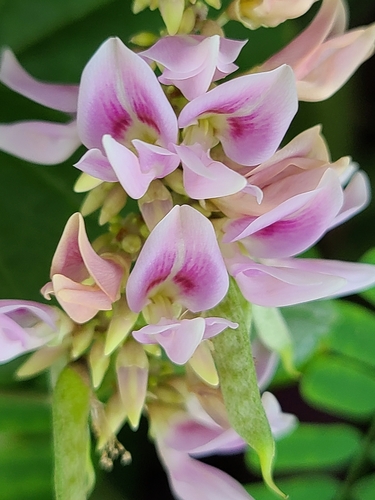
Flemingia involucrata
Benth.
Flemingia

(c) sworboys, some rights reserved (CC BY-NC)

(c) sworboys, some rights reserved (CC BY-NC)

(c) sworboys, some rights reserved (CC BY-NC)
What to Eat
Edible parts: Roots
The roots are eaten.
Where to Find It
A tropical plant. It grows in open places often amongst rocks. Plants can die back and regrow in dry places. In Papua New Guinea it grows to 2,000 m altitude but mostly it is near sea-level. In southern China it grows in disturbed grassland between 500-1,000 m above sea level. In Yunnan.
Asia, Australia, Bangladesh, Cambodia, China, India, Indochina, Indonesia, Laos, Malaysia, Myanmar, Pacific, Papua New Guinea, PNG, Philippines, SE Asia, Thailand, Vietnam,
How to Identify
A small shrub. It grows 50 cm to 1 m high. It spreads 50 cm to 1 m across. It has a thick rootstock from which it can re-grow year after year. Some branches re-grow each year while others continue to grow. The young shoots are softly hairy. The leaves are divided into 3 leaflets. The leaflets are 5-8 cm long by 2-4 cm across. They are oval and pale green and pointed towards the tip. They are softly hairy on both surfaces. The dense clusters of flowers are 2-3 cm across. They are produced in the axils of the upper leaves near the ends of small branches. The flowers are 0.8 cm long and purple. They have distinct outer bracts which are sword shaped. They are brown and form a covering around the flowers. The fruit are pods which are 0.6 cm long. The seeds are black and 4.5 mm long.
How to Grow
Plants are grown from seed. Seed need to be treated to break the hard seed coat.
Notes
There are about 35 Flemingia species.
Names & Synonyms
Nandjirr, Topmo tongbao
References (9)
- Cherikoff V. & Isaacs, J., The Bush Food Handbook. How to gather, grow, process and cook Australian Wild Foods. Ti Tree Press, Australia p 200
- Crawford, I. M., 1982, Traditional Aboriginal Plant Resources in the Kalumburu Area: Aspects in Ethno-economics. Records of the Western Australian Museum Supplement No. 15
- Elliot, W.R., & Jones, D.L., 1992, Encyclopedia of Australian Plants suitable for cultivation. Vol 4. Lothian. p 301
- Paczkowska, G . & Chapman, A.R., 2000, The Western Australian Flora. A Descriptive Calatogue. Western Australian Herbarium. p 429
- Pham-Hoang Ho, 1999, An Illustrated Flora of Vietnam. Nha Xuat Ban Tre. p 968
- Sukarya, D. G., (Ed.) 2013, 3,500 Plant Species of the Botanic Gardens of Indonesia. LIPI p 631
- Verdcourt, B., 1979, Manual of New Guinea Legumes. Botany Bulletin No 11, Division of Botany, Lae, Papua New Guinea. p 547 (Drawing)
- Vigilante, T., et al, 2013, Island country: Aboriginal connections, values and knowledge of the Western Kimberley islands in the context of an island biological survey. Records of the Western Australian Museum Supplement 81: 145-182
- Wheeler, J.R.(ed.), 1992, Flora of the Kimberley Region. CALM, Western Australian Herbarium, p 399