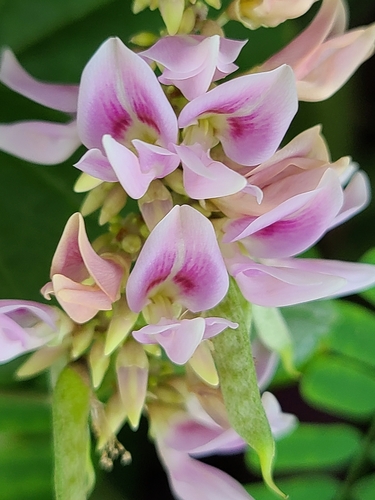
Flemingia macrophylla
(Willd.) Merr.
Longleaf Wurrus, Large leaf flemingia

(c) 橘子拔(橘子熊), some rights reserved (CC BY-NC)

(c) 橘子拔(橘子熊), some rights reserved (CC BY-NC)
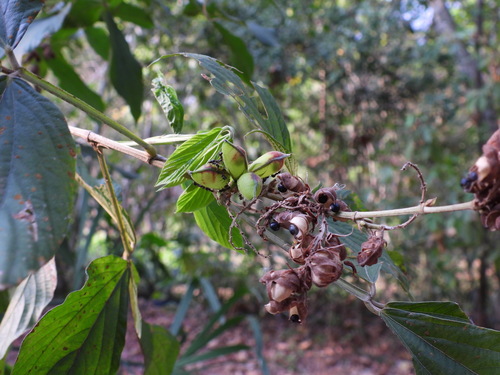
(c) Chen Shu, some rights reserved (CC BY-NC)
What to Eat
Edible parts: Leaves, Pods, Vegetable, Seeds - flavouring
The leaves, pods, and seeds are edible. The pods are eaten, the leaves are used as a vegetable, and the seeds serve as a flavouring.
Known Hazards
Where to Find It
A tropical plant. In Papua New Guinea it is introduced and used as a shelter belt in tea. It grows from 60 m to 1,650 m altitude. In southern China it grows between 200-1,800 m above sea level. In Yunnan.
Africa, Asia, Bangladesh, Bhutan, Cambodia, China, East Africa, Ghana, Himalayas, India, Indochina, Indonesia, Laos, Malaysia, Mozambique, Myanmar, Nepal, Pacific, Papua New Guinea, PNG, Philippines, SE Asia, Taiwan, Tanzania, Thailand, Tibet, Vietnam, West Africa,
How to Identify
A small shrub or climber. It grows 1.2-3.5 m high. The stems have ridges and are softly hairy. The leaves have 3 leaflets. These are oval or sword shaped and 3-15 cm long by 1.3-8 cm wide. They taper towards the tip and are rounded at the base. There are hairs mainly along the veins. The leaf stalk can be 2-10 cm long. The flowers are about 1 cm long and in dense clusters which are 2.5-7 cm long. The fruit are oblong pods 1.2-1.5 cm long by 7 mm wide. They are softly hairy. They are dotted with glands. The seeds are black and 3 mm wide.
How to Grow
A plant of the moist to wet tropics, where it is found at elevations from sea level up to 2,000 metres. It grows best in areas where annual daytime temperatures are within the range 22 - 28°c, but can tolerate 12 - 36°c. It prefers a mean annual rainfall in the range 1,300 - 2,200mm, but tolerates 1,100 - 3,500mm. Prefers a sunny position, but is tolerant of light shade. Capable of surviving on poorly drained soils with waterlogging. Prefers a pH in the range 5 - 7, tolerating 4 - 8. Established plants can tolerate fairly long dry spells. Tolerant of up to 4 months drought a year. Often cultivated as a green manure and dye plant, it has been introduced into many areas outside its native range. It sometimes escapes from cultivation and becomes naturalized - in some Pacific Islands, including the Cook Islands, Solomon Islands and Tonga, it is reported to be invasive. Plants are moderately able to survive fires. Good weed control is required during the first 6 months of sowing since the plants are relatively slow to establish; once established, they require little attention. A two year old stand of plants with a spacing of 50cm x 400cm can produce about 6.8 tonnes of dry woody stems per hectare for fuel. Plants can be cut more frequently than every 3 months, but preferably not at intervals of less than 40 days. With an excellent coppicing capacity, the shrub will survive under this cutting regime for many years. This species has a symbiotic relationship with certain soil bacteria, these bacteria form nodules on the roots and fix atmospheric nitrogen. Some of this nitrogen is utilized by the growing plant but some can also be used by other plants growing nearby.
Propagation: The seed has a hard coat and benefits from scarification before sowing. Pour a small amount of nearly boiling water over the seeds (taking care not to cook them), then soak in warm water for 12–24 hours. Seeds that have not swollen after this time should be carefully nicked in the seedcoat, avoiding the embryo, then soaked for a further 12 hours before sowing. When introducing the plant to a new area, sow seed inoculated with a suitable strain of Bradyrhizobium, such as CIAT 4203 or 4215.
Medicinal Uses
The leaves are febrifuge and are used for treating postpartum fever and to address paralysis and joint pain. A decoction of the leaves is used to bathe sores and swellings.
Other Uses
The plant is grown on terraces to control soil erosion and is used as a cover and shade crop in young plantations of cocoa, sisal, coffee, banana, plantain, oil palm, and rubber, also serving as an effective windbreak. It provides mulch for associated food crops; due to slow leaf decomposition, this mulch has long-term effects on weed control, moisture conservation, and soil temperature reduction. Flemingia mulch forms a relatively solid layer that prevents germination of weed seeds or stunts their early development for 100 days. It is grown as a live fence and hedge, and in Malaysia is planted alongside creeping legumes as a deep-rooted climbing support. It features in alley-cropping systems and is grown in pineapple plantations to control nematode infestation, as well as an understorey for Honduras pine (Pinus caribaea var. hondurensis). One of the sources of the Arab dye known as 'waras' or 'warrus' — a coarse purple or orange-brown powder of glandular hairs rubbed from dry Flemingia fruit, with an active component called flemingin. The powder dyes silk but not wool or cotton, and is used in India, the Arab world, and parts of Africa (including Uganda, Zimbabwe, and Malawi) for dyeing silk and cotton golden-yellow, dyeing bamboo for baskets, and making coloured ink. Cosmetically, a small amount of powder moistened in the palm produces a bright gamboge-coloured lather that is applied as required. To prepare the dye, dissolve the powder with an equal weight of sodium carbonate; introduce yarns or textiles when the bath reaches 40°C, then slowly heat to boiling. Washing the fibre in slightly acidic water (e.g. with lemon juice) brightens the colour. The resulting deep yellow or orange shades are fast to light and acids, though less so to alkaline substances, and were historically combined with indigo blue in renowned ikat textiles from Yemen. Firewood is a valuable by-product.
Wikipedia
Source ↗Flemingia macrophylla is a tropical woody leguminous shrub in the family Fabaceae. It is a multipurpose plant widely used in agriculture, crop improvement, fodder, dyes and for various therapeutic purposes. Perhaps, it is the most versatile species of Flemingia in terms of adaptation, medicinal and agricultural applications.
Notes
It is used in some countries in medicine. There are about 35 Flemingia species.
Names & Synonyms
Apa-apa, Bara-salpan, Batwasi, Beringan, Bhalia, Birbut, Bonokandulo, Caay dau ma, Dowdowla, False saffron, Hahapaan, Kamatteri, Khamin-ling, Korkattachedi, Lao, Lavglo, Ote garsul, Palan-byu, Phalan-phyu, Pokkepokan, Samnaskhat, Serengan jantan, Taw-shwe-war, Topmo la-to
References (12)
- Ambasta, S.P. (Ed.), 2000, The Useful Plants of India. CSIR India. p 225, 377 (As Moghania macrophylla)
- Burkill, H. M., 1985, The useful plants of west tropical Africa, Vol. 3. Kew.
- Grubben, G. J. H. and Denton, O. A. (eds), 2004, Plant Resources of Tropical Africa 2. Vegetables. PROTA, Wageningen, Netherlands. p 562
- Hani Medicine of Xishuangbanna, 1999, p 387
- INFOODSUpdatedFGU-list.xls (As Flemingia congesta)
- Martin, F.W. & Ruberte, R.M., 1979, Edible Leaves of the Tropics. Antillian College Press, Mayaguez, Puerto Rico. p 199
- Mbuya, L.P., Msanga, H.P., Ruffo, C.K., Birnie, A & Tengnas, B., 1994, Useful Trees and Shrubs for Tanzania. Regional Soil Conservation Unit. Technical Handbook No 6. p 276
- Pham-Hoang Ho, 1999, An Illustrated Flora of Vietnam. Nha Xuat Ban Tre. p 969
- Philipp. J. Sci., C 5:130. 1910 (Kuntze ex Prain, J. Asiat. Soc. Bengal, Pt. 2, Nat. Hist. 66(2):440. 1897, nom. inval.)
- Seidemann J., 2005, World Spice Plants. Economic Usage, Botany, Taxonomy. Springer. p 157
- Verdcourt, B., 1979, Manual of New Guinea Legumes. Botany Bulletin No 11, Division of Botany, Lae, Papua New Guinea. p 549
- World Checklist of Useful Plant Species 2020. Royal Botanic Gardens, Kew