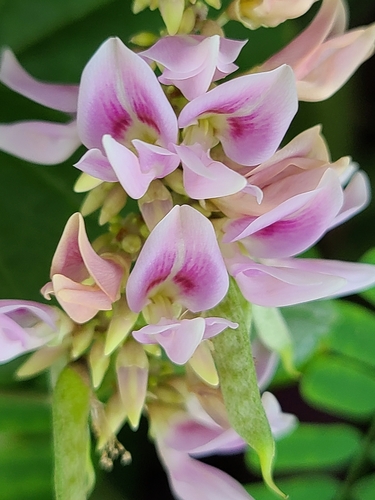
Flemingia procumbens
Roxb.
Sohphlong
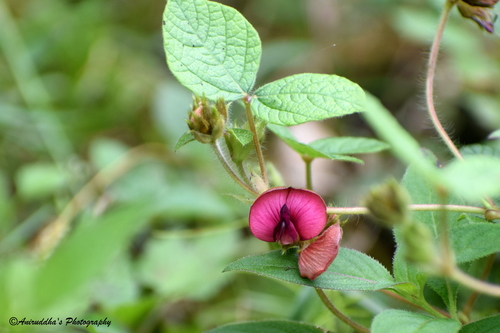
(c) Aniruddha Singhamahapatra, some rights reserved (CC BY-NC), uploaded by Aniruddha Singhamahapatra
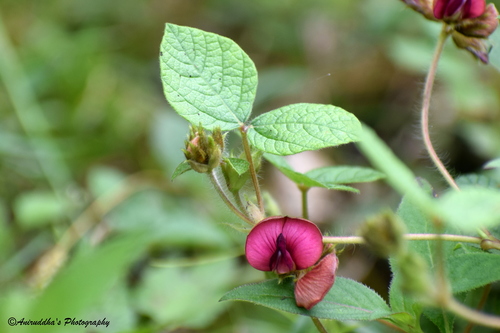
(c) Aniruddha Singhamahapatra, some rights reserved (CC BY-NC)
What to Eat
Edible parts: Roots, Tubers
Root - raw. The soft, fleshy, tuberous root is sweet and juicy with an agreeable nut-like flavour. It is rich in iron and phosphorous. Contains more than 3 times the protein content of cassava. The root is also used as a source of starch.
Where to Find It
A tropical plant. It grows in savannah grassland and on roadsides. It grows between 1000-3000 m altitude. It is cultivated in the hills in Assam in India. It grows in mountainous tracts in Assam between 1,000-1,600 m altitude. In Sichuan and Yunnan.
Asia, China, Himalayas, India, Indochina, Laos, Nepal, Northeastern India, Pacific, Philippines, SE Asia, Vietnam,
How to Identify
A small shrub. It grows 1 m high. The roots form tubers. The tubers are smooth and long. They are soft and 3-5 cm long. The leaves have 3 leaflets like fingers. The leaf stalk is 1-2 cm long. The leafy growths (stipules) near the base of the leaves is sword shaped and 0.5 cm long. The leaflets are oblong and 4-6 cm long by 2-3 cm wide. They are softly hairy. The flowers are in a compact group 2 cm long. The petals are like tongues. They are red or purplish. The fruit is an inflated pod 7 mm long. It contains 2 black kidney shaped seeds. These are 2 mm long.
How to Grow
It is grown from small tubers plants in holes about 10-15 cm deep. They are spaced 25 cm apart. It is also inter-cropped with potatoes.
Propagation: Like many species within the family Fabaceae, once they have been dried for storage the seeds of this species may benefit from scarification before sowing in order to speed up and improve germination. This can usually be done by pouring a small amount of nearly boiling water on the seeds (being careful not to cook them!) and then soaking them for 12 - 24 hours in warm water. By this time they should have imbibed moisture and swollen - if they have not, then carefully make a nick in the seedcoat (being careful not to damage the embryo) and soak for a further 12 hours before sowing.
Medicinal Uses
A decoction of the tuber is used as a vermifuge. The outer skin of the tuber is used. Four isoflavones (genistein, formononetin, pseudobaptigenin and daidzein) have been isolated from the outer tissues of the tuber. Tests have shown that a crude extract of the tuber peel has anthelmintic properties against flukes and tapeworms, but is ineffective against nematodes. Genistein (an isoflavone found in the root peel) is known to have a wide spectrum of biological activities - oestrogenic activity being one of its most remarkable properties. Tests have shown that an ethanol extract of the tubers exhibits good oestrogenic activity and might be useful for alleviating menopausal health concerns.
Production
It takes 7 months to grow. The yield of tubers can be 10t/ha.
Other Information
It is a cultivated food crop. It is a minor cultivated food crop.
Notes
The tubers are rich in starch. There are about 35 Flemingia species.
Names & Synonyms
Boh phlang, Sohplong, Topmo nghien
References (19)
- Ambasta, S.P. (Ed.), 2000, The Useful Plants of India. CSIR India. p 377 (As Moghania vestita)
- Arora, R. K., 2014, Diversity in Underutilized Plant Species - An Asia-Pacific Perspective. Bioversity International. p 26 (As Moghania vestita)
- Facciola, S., 1998, Cornucopia 2: a Source Book of Edible Plants. Kampong Publications, p 104 (As Flemingia vestita)
- Fl. ind. ed. 1832, 3:338. 1832
- Hedrick, U.P., 1919, (Ed.), Sturtevant's edible plants of the world. p 311 (As Flemingia vestita)
- Kays, S. J., and Dias, J. C. S., 1995, Common Names of Commercially Cultivated Vegetables of the World in 15 languages. Economic Botany, Vol. 49, No. 2, pp. 115-152 (As Flemingia vestita)
- Kew Plants of the World Online
- Lim, T. K., 2015, Edible Medicinal and Non Medicinal Plants. Volume 9, Modified Stems, Roots, Bulbs. Springer p 42
- Macmillan, H.F. (Revised Barlow, H.S., et al) 1991, Tropical Planting and Gardening. Sixth edition. Malayan Nature Society. Kuala Lumpur. p 323
- Neogi, B., Prasad, M. N. V. and Rao, R. R., 1989, Ethnobotany of Some Weeds of Khasi and Garo Hills, Meghalaya, Northeastern India. Economic Botany 43(4): 471-479 (As Flemingia vestita)
- PROSEA handbook Volume 9 Plants yielding non-seed carbohydrates. p 176
- Sawian, J. T., et al, 2007, Wild edible plants of Meghalaya, North-east India. Natural Product Radiance Vol. 6(5): p 417 (As Flemingia vestita)
- Singh, B., et al, 2012, Wild edible plants used by Garo tribes of Nokrek Biosphere Reserve in Meghalaya, India. Indian Journal of Traditional Knowledge. 11(1) pp 166-171 (As Flemingia vestita)
- Singh, H.B., Arora R.K.,1973, Son-phlong, Moghania vestita A Leguminous Root Crop of India. Economic Botany 27:332-338. (As Moghania vestita)
- Singh, H.B., Arora R.K.,1978, Wild edible Plants of India. Indian Council of Agricultural Research, New Delhi. p14 (As Moghania vestita)
- USDA, ARS, National Genetic Resources Program. Germplasm Resources Information Network - (GRIN). [Online Database] National Germplasm Resources Laboratory, Beltsville, Maryland. Available: www.ars-grin.gov/cgi-bin/npgs/html/econ.pl (10 April 2000)
- Wiersema, J. H. & Leon, B., 2013, World Economic Plants. A Standard Reference CRC Press. 2nd Ed. p 308
- World Checklist of Useful Plant Species 2020. Royal Botanic Gardens, Kew
- Zeven, A. C. & de West, J. M. J., 1982, Dictionary of cultivated plants and their regions of diversity. Wageningen. p 83 (As Flemingia vestita)