Fockea angustifolia
K. Schum.
Water root, Narrow-leafed kambro

(c) Barbara Schneider, some rights reserved (CC BY-NC-ND), uploaded by Barbara Schneider

(c) Barbara Schneider, some rights reserved (CC BY-NC-ND), uploaded by Barbara Schneider
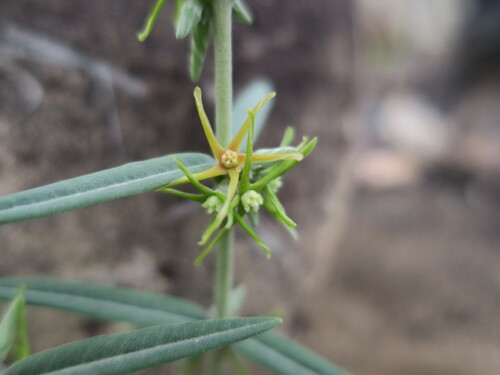
(c) Christien Steyn, some rights reserved (CC BY-NC-ND), uploaded by Christien Steyn
What to Eat
Edible parts: Tuber, Root, Stems
The tubers are eaten raw when young or roasted when older, and are also made into jams and preserves by cutting them into small squares, soaking them in lime-treated water, and cooking them into a chunky jam. The stems and roots are also edible.
Where to Find It
A tropical plant. It grows in hot arid places. They need a sunny warm position. In Swaziland it grows in the lowveld only. It grows in the Kalahari. It grows in regions with a dry period of 6-11 months. It is best in shade. In southern Africa it grows between 800-1,200 m altitude.
Africa, Angola, Botswana, Central Africa, East Africa, Eswatini, Kenya, Namibia, South Africa, Southern Africa, Swaziland, Tanzania, Zambia, Zimbabwe,
How to Identify
A climber. It has a few fine hairs. It has a taproot and keeps growing from year to year. The stems and tubers have a milky sap. The leaves are oblong or strap shaped and 7 cm long by 5 mm wide. The flowers are almost without stalks. They occur in compact clusters. They are green and white. The flowers are about 1 cm long. The flower stalks are hairy. The fruit are 8 cm long by less than 1 cm wide. The seeds are 10 mm long by 3 mm wide. The tubers are 50 cm long and 30 cm wide. They have a brown skin and are somewhat spongy.
Nutrition Score: 14/100
| Part | Moisture | kJ | kcal | Protein | Vit A | Vit C | Iron | Zinc |
|---|---|---|---|---|---|---|---|---|
| Tubers | 91.3 | 103 | 25 | 0.5 | — | 3.8 | 0.6 | 0.2 |
How to Grow
The top of the tuber is usually left in the ground to re-grow.
Propagation: Seed - Cuttings
Medicinal Uses
The tubers are the most important source of water for bushmen in Namibia.
Production
The tuber can be harvested again after 2-3 years.
Other Information
The tubers is the most important source of water for bushmen in Namibia.
Notes
There are 6 Fockea species.
Names & Synonyms
Dicava, Ecava, Enongo, Kambro, Kghoa, Khoa, Leruswa, Licava
References (25)
- Arnold, T.H., Wells, M.J. & Wehmeyer, A.S., Khoisan food plants: taxa with potential for future economic exploitation, in Wickens, G.E., Goodin, J.R., and Field, D.V.,(Eds.) 1985, Plants for Arid Lands. Unwin Hyman, London, p 73
- Facciola, S., 1998, Cornucopia 2: a Source Book of Edible Plants. Kampong Publications, p 32
- Fowler, D. G., 2007, Zambian Plants: Their Vernacular Names and Uses. Kew. p 76
- Fox, F. W. & Young, M. E. N., 1982, Food from the Veld. Delta Books. p 109
- Ichikawa, M., 1980, The Utilization of Wild Food Plants by the Suiei Dorobo in Northern Kenya. J. Anthrop. Soc. Nippon. 88(1): 25-48 - Vegetables of African hunters (As Fockea monroi)
- Lee, 1979,
- Leger, S., 1997, A Description of Today's Use of Plants in West Bushmanland (Namibia). German Development Service. PO Box 220035, 14061 Berlin, Germany. http://www.sigridleger.de/book/
- Lim, T. K., 2015, Edible Medicinal and Non Medicinal Plants. Volume 9, Modified Stems, Roots, Bulbs. Springer p 43
- Long, C., 2005, Swaziland's Flora - siSwati names and Uses http://www.sntc.org.sz/flora/
- Maguire, 1978,
- Marshall, 1976,
- Neudeck, L. et al, 2012, The Contribution of Edible Wild Plants to Food Security, Dietary Diversity and Income of Households in Shorobe Village, Northern Botswana. Ethnobotany Research & Applications 10:449-462
- Peters, C. R., O'Brien, E. M., and Drummond, R.B., 1992, Edible Wild plants of Sub-saharan Africa. Kew. p 63
- Plowes, N. J. & Taylor, F. W., 1997, The Processing of Indigenous Fruits and other Wildfoods of Southern Africa. in Smartt, L. & Haq. (Eds) Domestication, Production and Utilization of New Crops. ICUC p 191
- Ruiters-Welcome, A. K., 2019, Food plants of southern Africa. Ph.D. thesis. Univ. of Johannesburg p 23
- Story, 1958,
- Sullivan, S., 1998, People plants and practice in drylands: Socio-political and ecological dimensions of resource-use by Damara farmers in north-west Namibia. Ph.D. Univ. College London.
- Swaziland's Flora Database http://www.sntc.org.sz/flora
- Tanno, T., Plant Utilization of the Mbuti Pygmies. (As Fockea monroi)
- van Wyk, Be., & Gericke, N., 2007, People's plants. A Guide to Useful Plants of Southern Africa. Briza. p 88
- Wehmeyer, A. S, 1986, Edible Wild Plants of Southern Africa. Data on the Nutrient Contents of over 300 species.
- van Wyk, B-E., 2011, The potential of South African plants in the development of new food and beverage products. South African Journal of Botany 77 (2011) 857–868
- Welcome, A. K. & Van Wyk, B.-E., 2019, An inventory and analysis of the food plants of southern Africa. South African Journal of Botany 122 (2019) 136–179
- World Checklist of Useful Plant Species 2020. Royal Botanic Gardens, Kew
- Youngblood, D., 2004, Identification and Quantification of Edible Plant Foods in the Upper (Nama) Karoo, South Africa. Economic Botany 58 (Supplement) :S43-S65


