Fockea edulis
(Thunb.) K. Schum.
Kambro
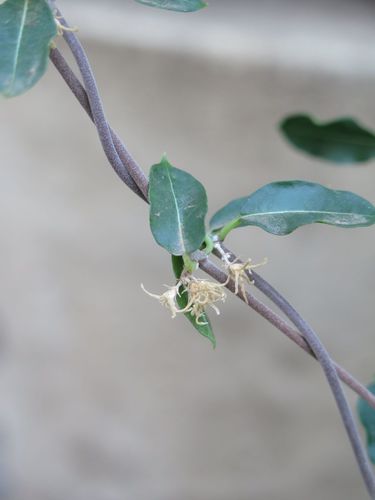
(c) AnneLise Vlok, some rights reserved (CC BY-NC), uploaded by AnneLise Vlok

(c) Andrew Hankey, some rights reserved (CC BY-SA), uploaded by Andrew Hankey
What to Eat
Edible parts: Root, Tubers, Leaves
Root. A milky, somewhat sweetish flavour. The large tubers have been used to make a 'konfyt' (a type of jam) as an alternative to watermelon. The tubers can be up to 60cm in diameter.
Known Hazards
Where to Find It
It is a tropical plant. It cannot tolerate frost. It grows in drier places.
Africa, Australia, Eswatini, Japan, Namibia, South Africa, Southern Africa, Swaziland,
How to Identify
A climber. It is a plant with a large storage organ near the ground. This is white and rough. It can vary in shape. It produces vines. The vines can grow 30 cm in a year. The leaves are dark green. They are 3-4 cm long and 1 cm wide. They have wavy edges. The flowers are green and 1.5 cm wide. The fruit are greyish pods 8 cm long.
How to Grow
Plants are grown from seed.
Medicinal Uses
The root and tubers are used traditionally as food and medicine.
Wikipedia
Source ↗Fockea edulis is a species of caudiciform plant in the family Apocynaceae that is native to the Cape Provinces and KwaZulu-Natal in South Africa.
Production
An edible tuber may weigh 22 kg.
Notes
There are about 10 Fockea species.
References (17)
- Andersohn, G., 1983, Cacti and Succulents. EP Publishing. p 260
- Anderson, M., 2002, The World Encyclopedia of Cacti and Succulents. Hermes House, New York. p 165
- Barkhuizen, 1978,
- Bodkin, F., 1991, Encyclopedia Botanica. Cornstalk publishing, p 477
- Bruyns, P. V. & Klak, C., 2006, A Systematic Study of the Old World Genus Fockea (Apocynaceae) Annals of the Missouri Botanical garden, Vol. 93(4): 535-564
- Facciola, S., 1998, Cornucopia 2: a Source Book of Edible Plants. Kampong Publications, p 32
- Fox, F. W. & Young, M. E. N., 1982, Food from the Veld. Delta Books. p 109
- Hedrick, U.P., 1919, (Ed.), Sturtevant's edible plants of the world. p 471 (As Pergularia edulis)
- Jardin, C., 1970, List of Foods Used In Africa, FAO Nutrition Information Document Series No 2.p 79
- Lim, T. K., 2015, Edible Medicinal and Non Medicinal Plants. Volume 9, Modified Stems, Roots, Bulbs. Springer p 43
- Long, C., 2005, Swaziland's Flora - siSwati names and Uses http://www.sntc.org.sz/flora/
- Peters, C. R., O'Brien, E. M., and Drummond, R.B., 1992, Edible Wild plants of Sub-saharan Africa. Kew. p 63
- Ruiters-Welcome, A. K., 2019, Food plants of southern Africa. Ph.D. thesis. Univ. of Johannesburg p 24
- Swaziland's Flora Database http://www.sntc.org.sz/flora
- van Wyk, Be., & Gericke, N., 2007, People's plants. A Guide to Useful Plants of Southern Africa. Briza. p 88
- Welcome, A. K. & Van Wyk, B.-E., 2019, An inventory and analysis of the food plants of southern Africa. South African Journal of Botany 122 (2019) 136–179
- Youngblood, D., 2004, Identification and Quantification of Edible Plant Foods in the Upper (Nama) Karoo, South Africa. Economic Botany 58 (Supplement) :S43-S65


