Fragaria chiloensis
(L.) Duchesne ex Weston
Sand strawberry, Beach strawberry, Pine strawberry

(c) Alan Siegel, some rights reserved (CC BY-NC), uploaded by Alan Siegel
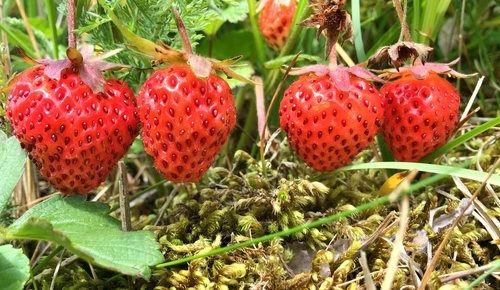
(c) Peter Zika, some rights reserved (CC BY-NC), uploaded by Peter Zika

(c) Anthony Scott, some rights reserved (CC BY-NC), uploaded by Anthony Scott
What to Eat
Edible parts: Fruit, Leaves - tea
The fruit can be eaten raw or cooked — it is large, sweet, and succulent with a delicate flavour. The berries are also suitable for making jams and preserves. A tea can be brewed from the leaves.
Known Hazards
Where to Find It
A temperate plant. It grows naturally in coastal areas in cool locations. In Hawaii they grow between 1,200-2,000 m altitude. It suits hardiness zones 4-10. In Chile it grows from sea level to over 2,000 m altitude.
Andes, Argentina, Asia, Australia, Canada, Chile*, Colombia, Dominican Republic, Ecuador, Haiti, Hawaii, Indochina, North America, Pacific, Peru, SE Asia, South America, USA, Vietnam, West Indies,
How to Identify
A small herb that keeps growing from year to year. The rootstocks are stout, thick and scaly. It grows 15 cm high and spreads 50 cm across. The fruit can be red, white or yellow. The leaves are short and thick and hairy underneath. The flowers are on long slender stalks. The flowers have 5 petals. The flowers are white. The fruit are red and edible. They can be 2-3 cm long.
How to Grow
Propagation: Sow seed in early spring in a greenhouse; germination can take four weeks or more. Seedlings are small and slow-growing at first but then develop rapidly. Prick out into individual pots when large enough to handle and plant out during the summer. Divide runners preferably in July or August so plants can establish before the following year's crop, though division can also be done the following spring — plants should not be allowed to fruit in their first year after a spring move. Runners can be planted directly into their permanent positions.
Medicinal Uses
The plant is antiseptic, astringent, emmenagogue, galactogogue, and odontalgic. It has been used to help regulate the menstrual cycle. A poultice of chewed leaves has been applied to treat burns.
Other Uses
Strawberries spread by runners and can be grown as a ground cover to help prevent soil erosion, and integrated into mixed cropping systems to enhance biodiversity. The plant is a dynamic accumulator, gathering minerals and nutrients from the soil and storing them in a more bioavailable form for use as fertiliser or to improve mulch. The flowers are rich in nectar and pollen, attracting bees, butterflies, and other pollinators. The fruit provides food for birds and other wildlife, and the plants offer ground-level habitat and invertebrate shelter. This species is also noted as a suitable low-level perennial ground cover for zone 2 firebreaks — the second zone out from buildings in the US government's wildfire mitigation system — as it provides little fuel.
Wikipedia
Source ↗Fragaria chiloensis, the beach strawberry, Chilean strawberry, or coastal strawberry, is one of two species of wild strawberry that were hybridized to create the modern garden strawberry (F. × ananassa). It is native to the Pacific Ocean coasts of North and South America.
Names & Synonyms
Chilean strawberry, Dau-tay, Fresa, Frutilla, Frutilla silvestre, Ilahuen, Kellen, Pineapple strawberry, Quellen
References (42)
- Barreau, A., et al, 2016, How Can We Teach Our Children if We Cannot Access the Forest? Generational Change in Mapuche Knowledge of Wild Edible Plants in Andean Temperate Ecosystems of Chile. Journal of Ethnobiology 36(2): 412–432
- Beckstrom-Sternberg, Stephen M., and James A. Duke. "The Foodplant Database." http://probe.nalusda.gov:8300/cgi-bin/browse/foodplantdb.(ACEDB version 4.0 - data version July 1994)
- Bianchini, F., Corbetta, F., and Pistoia, M., 1975, Fruits of the Earth. Cassell. p 158
- Bodkin, F., 1991, Encyclopedia Botanica. Cornstalk publishing, p 478
- Brouk, B., 1975, Plants Consumed by Man. Academic Press, London. p 202
- Castillo, R. O., 1995, Plant Genetic Resources in the Andes: Impact, Conservation, and Management. Crop Science 35:355-360
- Chamorro, M. F., & Ladio, A., 2020, Native and exotic plants with edible fleshy fruits utilized in Patagonia and their role as sources of local functional foods. BMC Complementary Medicine and Therapies. 20:155
- Cordero, S. E., Abello, L. A., & Galvez, F. L., 2017, Plantas silvestres comestibles y medicinales de Chile y otras partes del mundo. CORMA p 226 (As Potentilla chiloensis)
- Cundall, P., (ed.), 2004, Gardening Australia: flora: the gardener's bible. ABC Books. p 609
- Daly, A. B., 20014, Narrating changing foodways: wild edible plant knowledge and traditional food systems in Mapuche lands of the Andean Temperate Forests, Chile. Masters Thesis Vancouver. p 45
- Facciola, S., 1998, Cornucopia 2: a Source Book of Edible Plants. Kampong Publications, p 198
- Fuentes, L., et al, 2019, Patagonian Berries: Healthy Potential and the Path to Becoming Functional Foods. Foods 2019, 8, 289
- Galluzzi, G. & Noriega, I. L., 2014, Conservation and Use of Genetic Resources of Underutilized Crops in the Americas - A Continental Analysis. Sustainability, 6:980-1017
- Gard. dict. ed. 8: Fragaria no. 4. 1768 (A. N. Duchesne, Hist. nat. frais. 165. 1766, as "races principales") - Duchesne's (1766) usage of binary names for "races principales" do not qualify as species names
- Hedrick, U.P., 1919, (Ed.), Sturtevant's edible plants of the world. p 315, 318
- Heller, C. A., 1962, Wild Edible and Poisonous Plants of Alaska. Univ. of Alaska Extension Service. p 40
- Hermandez Bermejo, J.E., and Leon, J. (Eds.), 1994, Neglected Crops. 1492 from a different perspective. FAO Plant Production and Protection Series No 26. FAO, Rome. p 17
- Jones, J.K., 1979, Strawberry, in Simmonds, N.W., (ed), Crop Plant Evolution. Longmans. London. p 238
- Glowinski, L., 1999, The Complete Book of Fruit Growing in Australia. Lothian. p 150
- Kiple, K.F. & Ornelas, K.C., (eds), 2000, The Cambridge World History of Food. CUP p 1859, 1881
- Ladio, A. H. & Lozada, M., 2000, Edible Plant Use in a Mapuche Community of North-western Patagonia, Human Ecology. Vol. 28, No. 1. pp. 53-71
- Ladio, A. H., 2001, The Maintenance of Wild Edible Plant Gatherings in a Mapuche Community of Patagonia. Economic Botany, Vol. 55, No. 2, pp. 243-254
- Ladio, A. H. and Lozada, M., 2004, Patterns of use and knowledge of wild edible plants in distinct ecological environments: a case study of a Mapuche community from northwestern Patagonia. Biodiversity and Conservation 13:1153-1173
- Lamoureux, C.H., 1976, Trailside Plants of Hawaii's National Parks. Hawaii Natural History Association. p 28
- Leon-Lobos, P., et al, 2022, Patterns of Traditional and Modern Uses of Wild Edible Native Plants of Chile: Challenges and Future Perspectives. Plants (Basel) v 11 (6) Table S1
- MacKinnon, A., et al, 2009, Edible & Medicinal Plants of Canada. Lone Pine. p 177
- Martin, J. S. & Villagra M. M., 2013, Productos forestales no madereros de la Region del Maule. p 14
- Moerman, D. F., 2010, Native American Ethnobotany. Timber Press. p 234
- Pham-Hoang Ho, 1999, An Illustrated Flora of Vietnam. Nha Xuat Ban Tre. p 797
- Plants for a Future database, The Field, Penpol, Lostwithiel, Cornwall, PL22 0NG, UK. http://www.scs.leeds.ac.uk/pfaf/
- Plants of Haiti Smithsonian Institute http://botany.si.edu/antilles/West Indies
- Rapoport, E. H. & Ladio, A. H., 1999, Plantas comestibles. Bosque Volume 20 No. 2. ISSN 0314-8799
- Rapoport, E., H., et al, 2003, Plantas Nativas Comestibles de la Patagonia Andina Argentino/Chilena Parte 1, Department de Ecologi Centro Regional Universitario Briloche p 28
- Roa, J. A. G. & Boada, D. S. G., 2018, Fundación para el Fortalecimiento de la Fruticultura y Plantas Alimenticias no Convencionales en Colombia.
- Torre, de la, L., et al, 2008, Enciclopedia de las Plantas Útiles del Ecuador. Herbario QCA. Pontificia Universidad Católica del Ecuador. p 532
- Turner, N., 1995, Food Plants of Coastal First Peoples. Royal BC Museum Handbook p 110
- USDA, ARS, National Genetic Resources Program. Germplasm Resources Information Network - (GRIN). [Online Database] National Germplasm Resources Laboratory, Beltsville, Maryland. Available: www.ars-grin.gov/cgi-bin/npgs/html/econ.pl (10 April 2000)
- van Wyk, B., 2005, Food Plants of the World. An illustrated guide. Timber press. p 198
- Velasquez, P. & Montenegro, G., 2017, Chilean Endemic/Native Plant Resources as Functional and Superfoods. Chp. 6 in Superfood and Functional Food - An Overview of Their Processing and Utilization
- Wiersema, J. H. & Leon, B., 2013, World Economic Plants. A Standard Reference CRC Press. 2nd Ed. p 310
- World Checklist of Useful Plant Species 2020. Royal Botanic Gardens, Kew
- www.chileflora.com
More from Rosaceae


