Fragaria moschata
Duchesne ex Weston
Musk strawberry, Hautbois strawberry
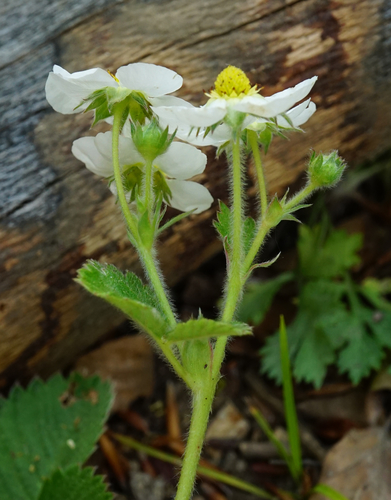
(c) Patrick Hacker, some rights reserved (CC BY), uploaded by Patrick Hacker
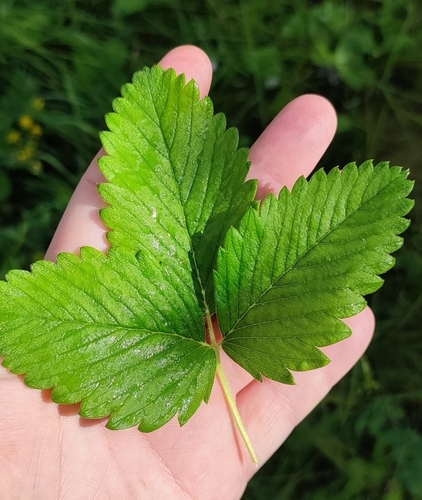
(c) Yurii Basov, some rights reserved (CC BY), uploaded by Yurii Basov
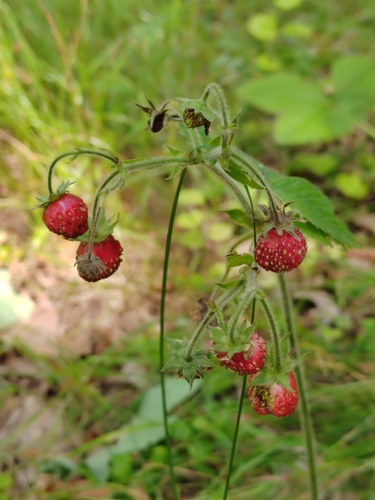
(c) Alexey V. Ivanov, some rights reserved (CC BY-NC), uploaded by Alexey V. Ivanov
What to Eat
Edible parts: Fruit
The fruit is eaten raw. It is sweet and succulent, small in size but excellent in flavour and very aromatic. Though greatly superior to cultivated strawberries, it is not produced very freely.
Where to Find It
It is a temperate plant. It grows in hardiness zone 5.
Asia, Balkans, Bosnia, Bulgaria, Caucasus, Europe, France, Hungary, India, Indochina, Italy, Lithuania, Luxembourg, Mediterranean, Myanmar, Northeastern India, Russia, Scandinavia, SE Asia, Siberia, Slovakia, Slovenia, Vietnam,
How to Identify
A small spreading plant. The fruit is a deep red colour. The flesh is white or yellow. There are some named cultivated varieties.
How to Grow
Prefers a fertile, well-drained, moisture retentive soil in a sunny position. Tolerates semi-shade though fruit production will be reduced. Another report says that this species prefers shade. Succeeds in acid and alkaline soils. Likes a mulch of pine or spruce leaves. At one time this species was widely cultivated for its edible fruit, but it is fairly low yielding and has now been almost totally superseded by cultivars of F. x. ananassa. There are some named varieties. The flowers are usually unisexual. (This report does not say if the plants are dioecious or monoecious.) This species produces few or no stolons. An evergreen. Strawberries are typically harvested in late spring to early summer depending on the variety and climate. Strawberries usually flower in spring. Strawberries grow relatively quickly, with plants producing fruit within the first year of planting, especially when propagated through runners.
Propagation: Sow seed in early spring in a greenhouse; germination can take four weeks or more. Seedlings begin small and slow but develop rapidly. Prick out into individual pots when large enough and plant out during summer. Divide runners preferably in July or August to allow establishment before the following year's crop, or transplant the following spring — plants should not be allowed to fruit in their first year after a spring move. Runners can go directly into permanent positions.
Medicinal Uses
None known
Other Uses
Strawberries can serve as ground cover to help prevent soil erosion and can be integrated into mixed cropping systems to enhance biodiversity. This species spreads vigorously via surface stolons, forming a dense carpet that grows well among shrubs, though it is likely to suffocate smaller plants. It is a dynamic accumulator, drawing minerals and nutrients from the soil and storing them in a more bioavailable form for use as fertiliser or to improve mulch. The flowers are rich in nectar and pollen, attracting bees, butterflies, and other pollinators. The fruit provides food for birds and wildlife, and the plants offer ground-level habitat and invertebrate shelter.
Wikipedia
A vigorous perennial growing 0.5 m tall at a fast rate with hermaphroditic, insect-pollinated flowers blooming April to July; seeds ripen June to August. Not self-fertile. Accepts sandy, loamy, and clay soils with good drainage and moist conditions across mildly acid to mildly alkaline pH. Grows in semi-shade or full sun. Hardy to UK zone 6. Attracts wildlife.
Production
It is fast growing but short lived.
Other Information
It is cultivated.
Names & Synonyms
Beekeeper, Dau-tay cao, Dau-tay sa, Eper, Kijuromvu, Kitnjaca, Muškatni jagodnjak, Piroseper, Smokva, Sunitsa
References (23)
- Beitr. Naturk. 7:23. 1792 (As Fragaria elatior)
- Bot. univ. 2:327. 1771 (A. N. Duchesne, Hist. nat. frais. 145. 1766, as "races principales")
- Brouk, B., 1975, Plants Consumed by Man. Academic Press, London. p 202
- Chase, P. & Singh, O. P., 2016, Bioresources of Nagaland: A Case of Wild 4 Edible Fruits in Khonoma Village Forest. in J. Purkayastha (ed.), Bioprospecting of Indigenous Bioresources of North-East India. p 50
- Crate, S. A., 2008, "Eating Hay": The Ecology, Economy and Culture of Viliui Sakha Smallholders of Northeastern Siberia. Human Ecology 36:161-174 (As Fragaria elatior)
- Davis, S.D., Heywood, V.H., & Hamilton, A.C. (eds), 1994, Centres of plant Diversity. WWF. Vol 1 or 2. p 109 (As Fragaria elatior)
- Denes, A., et al, 2012, Wild plants used for food by Hungarian ethnic groups living in the Carpathian Basin. Acta Societatis Botanicorum Poloniae 81 (4): 381-396
- Facciola, S., 1998, Cornucopia 2: a Source Book of Edible Plants. Kampong Publications, p 198
- John, L., & Stevenson, V., 1979, The Complete Book of Fruit. Angus & Robertson p 268
- Jones, J.K., 1979, Strawberry, in Simmonds, N.W., (ed), Crop Plant Evolution. Longmans. London. p 237
- Glowinski, L., 1999, The Complete Book of Fruit Growing in Australia. Lothian. p 150
- Hedrick, U.P., 1919, (Ed.), Sturtevant's edible plants of the world. p 316 (As Fragaria elatior)
- Jackes, D. A., Edible Forest Gardens
- Kiple, K.F. & Ornelas, K.C., (eds), 2000, The Cambridge World History of Food. CUP p 1881
- Luczaj, L., 2012, Ethnobotanical review of wild edible plants of Slovakia. Acta Societatis Botanicorum Poloniae 81(4):245-255
- Lyle, S., 2006, Discovering fruit and nuts. Land Links. p 216
- Nedelcheva A., 2013, An ethnobotanical study of wild edible plants in Bulgaria. EurAsian Journal of BioSciences 7, 77-94
- Pham-Hoang Ho, 1999, An Illustrated Flora of Vietnam. Nha Xuat Ban Tre. p 797
- Plants for a Future database, The Field, Penpol, Lostwithiel, Cornwall, PL22 0NG, UK. http://www.scs.leeds.ac.uk/pfaf/
- Redzic, S. J., 2006, Wild Edible Plants and their Traditional Use in the Human Nutrition in Bosnia-Herzegovina. Ecology of Food and Nutrition, 45:189-232 (As Fragaria elatior)
- Sasi, R. & Rajendran, A., 2012, Diversity of Wild Fruits in Nilgiri Hills of the Southern Western Ghats - Ethnobotanical Aspects. IJABPT, 3(1) p 82-87 (As Fragaria elatior)
- van Wyk, B., 2005, Food Plants of the World. An illustrated guide. Timber press. p 198
- Wiersema, J. H. & Leon, B., 2013, World Economic Plants. A Standard Reference CRC Press. 2nd Ed. p 310
More from Rosaceae


