Fragaria orientalis
Lozinsk.
Oriental strawberry
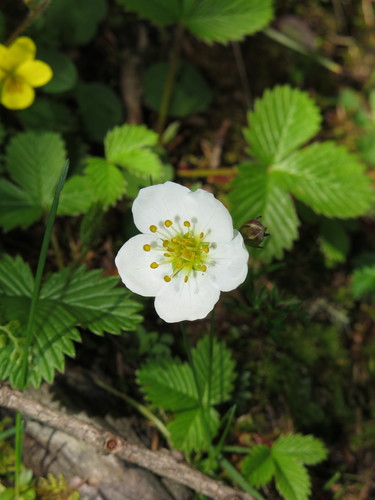
(c) yaoshawn, some rights reserved (CC BY-NC), uploaded by yaoshawn

(c) Alexey P. Seregin, some rights reserved (CC BY-NC)
What to Eat
Edible parts: Fruit
The fruit is eaten raw. It is sweet and succulent, and approximately 5mm wide.
Where to Find It
It is a temperate plant. It grows in mountains in northern China. It grows between 600-4,000 m above sea level.
Asia, China, Korea, Mongolia, Russia, Siberia,
How to Identify
A strawberry like herb. The leaflets are small 1-5 cm long by 1-4 cm wide. They are hairy on both surfaces. The stalks are up to 1.5 cm long. The berry is 1.5 cm across. It is bright red.
How to Grow
Prefers a fertile, well-drained, moisture retentive soil in a sunny position. Tolerates semi-shade though fruit production will be reduced. Plants like a mulch of pine or spruce leaves. A vigorous plant, spreading quickly by means of runners. Plants flower freely with us, but have not as yet fruited at our Cornwall trial ground, possibly because they are all one clone.
Propagation: Sow seed in early spring in a greenhouse; germination can take four weeks or more. Seedlings are initially small and slow-growing before developing more quickly. Prick out into individual pots when large enough and plant out during summer. Divide runners preferably in July or August to allow plants to establish before the following year's crop, or move them the following spring — plants should not be allowed to fruit in their first year after a spring division. Runners can be planted directly into their permanent positions.
Medicinal Uses
None known
Other Uses
None known Special Uses
Wikipedia
Source ↗Fragaria orientalis is a tetraploid species of wild strawberry native to E. Asia – Eastern Siberia. It is occasionally cultivated as a novelty edible.
Production
In China plants flower in May to July and fruit July to September.
References (10)
- "Chinese Nutrition Journal", 2002, Vol 23(8) p 298
- Fan, L., et al, The Use of Edible Wild Plants and Fungi in Korean-Chinese Villages. Journal of Environmental Information Science 44-5 p 71-79
- https://en.wikipedia.org/wiki/List of wild edible plants in Mongolian cuisine
- Hu, Shiu-ying, 2005, Food Plants of China. The Chinese University Press. p 434
- Izv. Glavn. Bot. Sada S.S.S.R. 25:70, fig. 5. 1926
- Kang, J. et al, 2016, Wild food plants and fungi used in the mycophilous Tibetan community of Zhagana (Tewo Country, Gansu, China) Journal of Ethnobiology and Ethnomedicine. 12:21
- Plants for a Future database, The Field, Penpol, Lostwithiel, Cornwall, PL22 0NG, UK. http://www.scs.leeds.ac.uk/pfaf/
- Reis, S. V. and Lipp, F. L., 1982, New Plant Sources for Drugs and Foods from the New York Botanical Garden herbarium. Harvard. p 98
- Urgamal, M., Oyuntsetseg, B., Nyambayar, D. & Dulamsuren, Ch. 2014. Conspectus of the vascular plants of Mongolia. (Editors: Sanchir, Ch. & Jamsran, Ts.). Ulaanbaatar, Mongolia. “Admon“ Press. 334pp. (p. 143-158).
- Zhang, Y., et al, Yunatov’s Records of Wild Edible Plant Used by the Mongols in Mongolia During 1940- 1951: Ethnobotanical Arrangements and Discussions. Inner Mongolia Normal University. p 10
More from Rosaceae


