Gagea lutea
(L.) Ker-Gawl.
Cowslip Primrose, Yellow star-of-Bethlehem
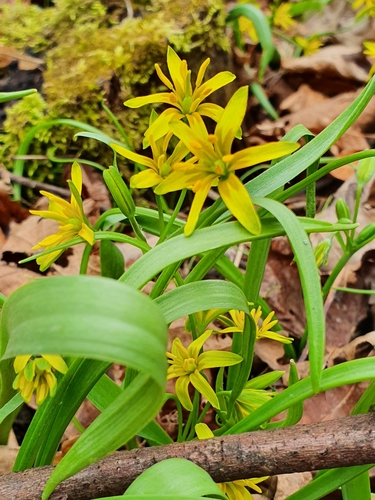
(c) Stela Beatričė, some rights reserved (CC BY-NC), uploaded by Stela Beatričė

(c) Богданович Светлана, some rights reserved (CC BY-NC), uploaded by Богданович Светлана
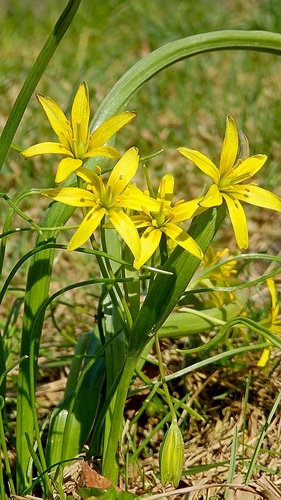
(c) Zdeňka Nováková, some rights reserved (CC BY-NC), uploaded by Zdeňka Nováková
What to Eat
Edible parts: Leaves, Root, Bulb, Spice
The bulb can be eaten raw or cooked, though it is regarded as a famine food used only in times of scarcity. Young leaves are edible when cooked.
Where to Find It
It is a temperate plant.
Asia, Britain, Europe, France, Himalayas, India, Japan, Luxembourg, Norway, NW India, Scandinavia, Spain, Turkey, Türkiye,
How to Identify
A small bulbous plant growing to 0.2 m tall. Hardy to UK zone 6. Flowers March to May. Hermaphrodite, pollinated by insects. Grows in light sandy to heavy clay soils across mildly acid, neutral, and basic pH ranges. Tolerates semi-shade to full sun and prefers moist soil.
How to Grow
Propagation: Sow seed in spring in a greenhouse, sowing thinly to avoid the need for transplanting. Grow seedlings in the same pot for their first year or two, feeding occasionally with liquid fertiliser to prevent nutrient deficiency. Pot up small bulbs during dormancy, placing 2–3 per pot, and grow on in the greenhouse for another year or two before planting out during dormancy. Division is also possible; the best time is likely after the leaves die down in summer, though no specific guidance is confirmed.
Medicinal Uses
No medicinal uses are known.
Other Uses
No other uses are known.
Wikipedia
Source ↗Gagea lutea, known as the yellow star-of-Bethlehem, is a Eurasian flowering plant species in the family Liliaceae. It is widespread in central Europe with scattered populations in Great Britain, Spain, and Norway to Siberia and Japan. Gagea lutea is a bulb-forming herbaceous perennial with lanceolate leaves and green-tinged yellow flowers with 6 tepals. It is a predominantly lowland species that inhabits moist, base-rich, shady habitats including; broad-leaf woodlands, hedgerows, limestone pavements, pastures, and riverbanks. It has been used as an indicator of ancient woodland in East Anglia.
Notes
There are about 90 Gagea species.
Names & Synonyms
Artetyke, Arthritica, Buckles, Butti, Cowslip, Jardu
References (8)
- Bot. Mag. 30: t. 1200. 1809
- Khan, M. & Hussain, S., 2014, Diversity of wild edible plants and flowering phenology of district Poonch (J & K) in the northwest Himalaya. Indian Journal of Sci, Res. 9(1): 032-038 (As Gagea elegans)
- Lim, T. K., 2015, Edible Medicinal and Non Medicinal Plants. Volume 9, Modified Stems, Roots, Bulbs. Springer p 60
- Masoodi, H. U. R. & Sundriyal, R. C., 2020, Richness of non-timber forest products in Himalayan communities—diversity, distribution, use pattern and conservation status. Journal of Ethnobiology and Ethnomedicine 16:56
- PARMENTIER (As Ornithogalum luteum)
- Plants for a Future database, The Field, Penpol, Lostwithiel, Cornwall, PL22 0NG, UK. http://www.scs.leeds.ac.uk/pfaf/
- Rana, D., et al, 2019, Ethnobotanical knowledge among the semi-pastoral Gujjar tribe in the high altitude (Adhwari’s) of Churah subdivision, district Chamba, Western Himalaya. Journal of Ethnobiology and Ethnomedicine (2019) 15:10
- Williams, D., 2017, Ainu Ethnobiology. Contributions in Ethnobiology. Society of Ethnobiology. p 106


