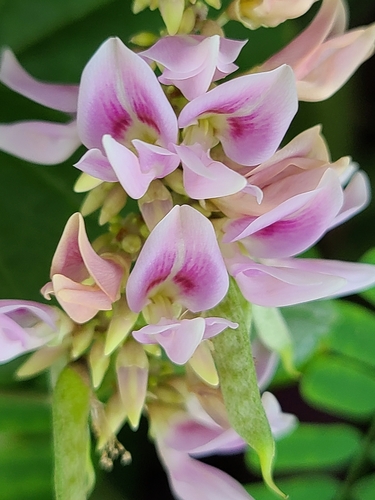
Galega officinalis
L.
Goat’s rue, Galega

(c) Gian-Andrea Catrina, some rights reserved (CC BY-NC), uploaded by Gian-Andrea Catrina

(c) Thanasis Papanikolaou, some rights reserved (CC BY-NC)

(c) Marsh Maiden, some rights reserved (CC BY-NC), uploaded by Marsh Maiden
What to Eat
Edible parts: Leaves, Herb
Leaves can be cooked and used like spinach, though some caution is advised due to reports of possible toxicity. The herb is also used as a substitute for rennet when curdling plant milks.
Known Hazards
Where to Find It
It is a temperate plant. It is frost hardy. It grows in moist, well-drained soil. It can grow in sun or part shade. In Argentina it grows below 500 m above sea level. It suits hardiness zones 4-9. Hobart Botanical Gardens 1
Africa, Albania, Argentina, Asia, Australia, Austria, Balkans, Bosnia, Britain, Bulgaria, Chile, Czech, Europe, France, Germany, Greece, Hungary, Italy, Lebanon, Macedonia, Mediterranean, Middle East, North Africa, Pakistan, Poland, Romania, Russia, Slovenia, Spain, Tasmania, Turkey, Türkiye, Uruguay, Yugoslavia,
How to Identify
A perennial plant. It grows 90-150 cm high and 90-120 cm wide. It is a bushy plant. The leaves are compound with leaflets arranged along the stalk. There can be 17 narrow leaflets. They are soft green. The flowers are pale mauve-pink. The pods are cylinder shape and are constricted between the seeds. The pods are 20-50 mm long.
How to Grow
Succeeds in most soils but repays generous treatment. Prefers full sun and a deep moist soil but it also succeeds in light shade. Grows well even in poor soils. Plants are very tolerant of neglect and can be grown in quite coarse grass, which can be cut annually in the autumn. A long-lived plant, it can be invasive in good growing conditions. This species has a symbiotic relationship with certain soil bacteria, these bacteria form nodules on the roots and fix atmospheric nitrogen. Some of this nitrogen is utilized by the growing plant but some can also be used by other plants growing nearby.
Propagation: Pre-soak seed for 12 hours in warm water, then sow in spring or autumn in a cold frame. Spring-sown seed can be slow to germinate; cold stratification may help. Prick seedlings into individual pots once large enough and plant out in summer. With sufficient seed, direct sowing outdoors in situ is possible in mid to late spring. Divide in spring or autumn; larger clumps can go directly into permanent positions, while smaller clumps are best potted up and grown on in a cold frame until well rooted before planting out in spring.
Medicinal Uses
Goat's rue was once important in treating plague, fevers, and infectious diseases. It is now used mainly to promote milk flow in lactating mothers — shown to increase milk production in cows and goats by 35–50% — and to support the digestive system. The plant contains galegine, an alkaloid that significantly reduces blood sugar levels, making it useful in treating diabetes. The leaves and flowering tops are diaphoretic, diuretic, galactogogue, and hypoglycaemic. It is taken internally for insufficient lactation, late-onset diabetes, pancreatitis, and digestive problems including chronic constipation caused by a lack of digestive enzymes. The plant is harvested just as it comes into flower and dried for later use. Some caution is advised regarding toxicity.
Other Uses
A fast-growing plant that makes a good green manure, enriching the soil with organic matter and fixing atmospheric nitrogen. It is also used cosmetically in hand and foot baths.
Wikipedia
Source ↗Galega officinalis, commonly known as galega or goat's-rue, is a herbaceous plant in the subfamily Faboideae of the legume family Fabaceae. It is native to parts of northern Africa, western Asia and Europe, but is widely cultivated and naturalised elsewhere. The plant has been extensively cultivated as a forage crop, an ornamental, a bee plant, and as green manure. G. officinalis is rich in galegine, a substance with blood glucose-lowering activity and the foundation for the discovery of metformin, a treatment for managing symptoms of diabetes mellitus. In ancient herbalism, goat's-rue was used as a diuretic. It can be poisonous to mammals, but is a food for various insects.
Notes
There are 6 Galega species.
Names & Synonyms
Alfalfa gallega, Keçisedefi, Kecisakali, Navadna jastrebina, Piskavica, Ruda cabruna
References (17)
- Blamey, M and Grey-Wilson, C., 2005, Wild flowers of the Mediterranean. A & C Black London. p 85
- Bremness, L., 1994, Herbs. Collins Eyewitness Handbooks. Harper Collins. p 172
- Brown, D., 2002, The Royal Horticultural Society encyclopedia of Herbs and their uses. DK Books. p 218
- Cerne, M., 1992, Wild Plants from Slovenia used as Vegetables. Acta Horticulturae 318
- Cundall, P., (ed.), 2004, Gardening Australia: flora: the gardener's bible. ABC Books. p 623
- Dogan, Y., et al, 2004, The Use of Wild Edible Plants in Western and Central Anatolia (Turkey). Economic Botany 58(4) pp. 684-690
- Dogan, Y., 2012, Traditionally used wild edible greens in the Aegean Region of Turkey. Acta Societatis Botanicorum Poloniae 81(4): 329-342
- Ertug, F, Yenen Bitkiler. Resimli Türkiye Florası -I- Flora of Turkey - Ethnobotany supplement
- Facciola, S., 1998, Cornucopia 2: a Source Book of Edible Plants. Kampong Publications, p 105
- Hedrick, U.P., 1919, (Ed.), Sturtevant's edible plants of the world. p 322
- Hibbert, M., 2002, The Aussie Plant Finder 2002, Florilegium. p 108
- Joyce, D., 1998, The Garden Plant Selector. Ryland, Peters and Small. p 228
- Kiple, K.F. & Ornelas, K.C., (eds), 2000, The Cambridge World History of Food. CUP p 1779
- Ozbucak, T. B. et al, 2006, The Contribution of Wild Edible Plants to Human Nutrition in the Black Sea Region of Turkey. Ethnobotanical Leaflets 10: 98-103
- Plants for a Future database, The Field, Penpol, Lostwithiel, Cornwall, PL22 0NG, UK. http://www.scs.leeds.ac.uk/pfaf/
- Redzic, S. J., 2006, Wild Edible Plants and their Traditional Use in the Human Nutrition in Bosnia-Herzegovina. Ecology of Food and Nutrition, 45:189-232
- Sp. pl. 2:714. 1753