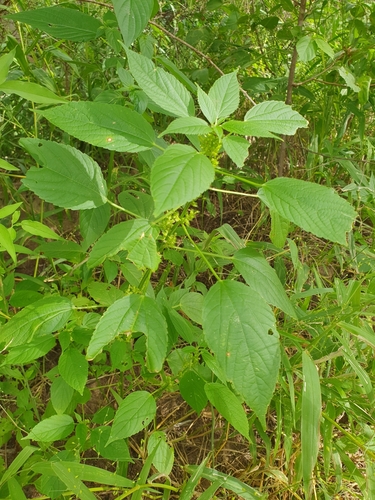
Aleurites cordatus
(Thunb.) Muell. Arg.
Japan Wood Oil
EuphorbiaceaeSeeds/Nuts

gbif · cc-by-nc
s60103
s60103

gbif · cc-by-nc
s60103
s60103

gbif · cc-by-nc
s60103
s60103
What to Eat
Edible parts: Seeds
The seeds are eaten.
Where to Find It
It grows in cool climates. It is best in rich, moist well-drained soil. It is damaged by drought and frost. It suits hardiness zones 10-12.
Asia, Australia, China, India, Japan*, Myanmar, SE Asia,
Countries: United Arab Emirates, Afghanistan, Armenia, Australia, Azerbaijan, Bangladesh, Bahrain, Brunei, Bhutan, China, Georgia, Indonesia, Israel, India, Iraq, Iran, Jordan, Japan, Kyrgyzstan, Cambodia, North Korea, South Korea, Kuwait, Kazakhstan, Laos, Lebanon, Sri Lanka, Myanmar, Mongolia, Maldives, Malaysia, Nepal, Oman, Philippines, Pakistan, Qatar, Saudi Arabia, Singapore, Syria, Thailand, Tajikistan, Timor-Leste, Turkmenistan, Turkey, Taiwan, Uzbekistan, Vietnam, Yemen
How to Identify
A small evergreen tree. It grows 6-9 m tall. The leaves are oval to heart shaped and very thin and glossy. The leaves can have 3 lobes at the tip. The flowers are white and in panicles. The fruit are fleshy and 25 mm across. Correct name is now probably Vernicia cordata.
How to Grow
Plants can be grown by seed.
Notes
There are 2-5 Aleurites species. The oil of this one is burnt in lamps.
Names & Synonyms
Vernicia cordata (Thunb.) Airy Shaw
References (8)
- Ambasta S.P. (Ed.), 2000, The Useful Plants of India. CSIR India. p 26 (As Aleurites cordatus)
- Bodkin, F., 1991, Encyclopedia Botanica. Cornstalk publishing, p 63 (As cordata)
- Burkill, I.H., 1966, A Dictionary of the Economic Products of the Malay Peninsula. Ministry of Agriculture and Cooperatives, Kuala Lumpur, Malaysia. Vol 1 (A-H) p 90
- A. L. P. P. de Candolle, Prodr. 15(2):724. 1866 "cordata"
- Etherington, K., & Imwold, D., (Eds), 2001, Botanica's Trees & Shrubs. The illustrated A-Z of over 8500 trees and shrubs. Random House, Australia. p 85
- Lamberton, K (Ed.), 2004, The Australian gardening encyclodepia. Murdoch Books, NSW Australia. p 156
- Menninger, E.A., 1977, Edible Nuts of the World. Horticultural Books. Florida p 49
- Wit, F., 1979, Tung, in Simmonds N.W.,(ed), Crop Plant Evolution. Longmans. London. p 74