Gelsemium elegans
(Gardn. et Champ.) Benth
Yellow jessamine, Chinese Gelsemium

(c) Bryan To, some rights reserved (CC BY-NC-SA)
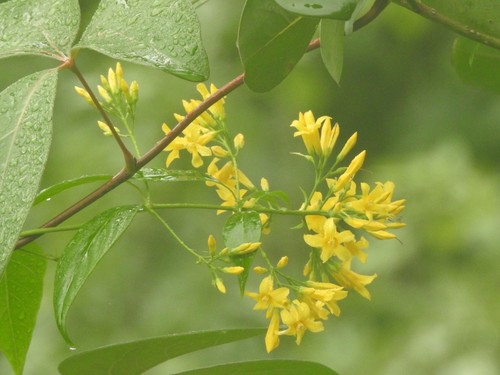
(c) johnallcock, some rights reserved (CC BY-NC)
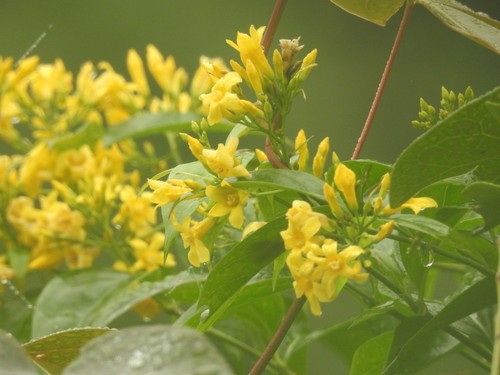
(c) johnallcock, some rights reserved (CC BY-NC)
What to Eat
Edible parts: Poisonous
CAUTION: It is poisonous. It produces alkaloids. Many Loganiaceae are very poisonous.
Known Hazards
Where to Find It
A tropical plant. It grows in shrubby forests between 200-2000 m altitude in China. In Yunnan.
Asia, China, India, Indochina, Indonesia, Laos, Malaysia, Myanmar, SE Asia, Taiwan, Thailand, Vietnam,
How to Identify
A climber or twining plant. It is 12 m long. The leaf stalk is 6-12 mm long. The leaf blade is oval and 5-12 cm long by 2-6 cm wide. The base of the leaf circles the branch. The flower is yellow to orange with red spots. They occur at the tips of the branches in groups of 3. The fruit is a capsule 1-1.4 cm long by 6-8 mm wide. The seeds are kidney shaped and about 5.5 mm long.
How to Grow
In view of its twining habit, the plant is suitable for training on trellis and pergolas or for growing on steep banks. Severe pruning after flowering is recommended to retain a moderately sized plant.
Propagation: Seed - Cuttings of semi-ripe wood root easily.
Medicinal Uses
Although very poisonous, the plant is used in Chinese traditional medicine as an analgesic, antispasmodic and as a remedy for certain kinds of skin ulcers. Externally fresh plant parts or aqueous extracts are applied to various skin afflictions including eczema, boils, ulcers, ringworm as well as in the treatment of haemorrhoids or neuralgic pains. Numerous oxindole and indole-alkaloids have been isolated from the plant, include gelsemine, and additional alkaloids such as hydroxydihydrogelsemine, gelsemicine, gelsenicine, gelsevirine, koumine, koumidine, kumantenidine, kumantenine and sempervirine. Fractional amounts of the alkaloids have a stimulating effect on the central nervous system. Toxic symptoms in humans may vary considerably between individuals, but in general these will include loss of appetite, stomach upset, internal bleeding, muscle weakness, paralysis of respiration (which will eventually lead to death), heart rate disturbances, hypotensive and and vasodilating effects..
Wikipedia
Source ↗Gelsemium elegans, commonly known as heartbreak grass, is a poisonous plant of the family Gelsemiaceae found in China and other Asian countries. It contains toxic alkaloids such as gelsemine, gelsenicine, gelsevirine, koumine and 14-Hydroxygelsenicine. Crumbled leaves of this plant, surreptitiously added to food, were used in the 23rd of December 2011 poisoning of Long Liyuan, a magnate of the Chinese timber industry, and perhaps in the 10th of November 2012 poisoning of Alexander Perepilichny, a Russian financier cooperating with a fraud investigation in London, though the role of the plant in his death has been disputed. This plant is also reputed to be the cause of death for Shennong, the first Yan emperor, who is said to have consumed many plants as part of his study of medicinal herbs.
Notes
There are 3 Gelsemium species. One is in Asia and 2 in the Americas. It is also used in medicine.
Names & Synonyms
Lashiru, Palaungse, Xiaq
References (8)
- Ambasta, S.P. (Ed.), 2000, The Useful Plants of India. CSIR India. p 233
- Hani Medicine of Xishuangbanna, 1999, p 735
- Heywood, V.H., Brummitt, R.K., Culham, A., and Seberg, O. 2007, Flowering Plant Families of the World. Royal Botanical Gardens, Kew. p 152
- J. Proc. Linn. Soc., Bot. 1:90. 1857
- Li Ping-tao, Leewenburg, A., Loganiaceae. Flora of China. p 325
- Llamas, K.A., 2003, Tropical Flowering Plants. Timber Press. p 225 (Genus)
- Mot So Rau Dai an Duoc O Vietnam. Wild edible Vegetables. Ha Noi 1994, p 256
- Xu, Z., Tao, G. & Tan, J., 1988, Tropical Wild Flowers and Plants in Xishuangbanna, Agricultural Publishing House. photo 74
