Geum aleppicum
Jacq.
Yellow avens, Aleppo avens

(c) Joshua Mayer, some rights reserved (CC BY-SA)
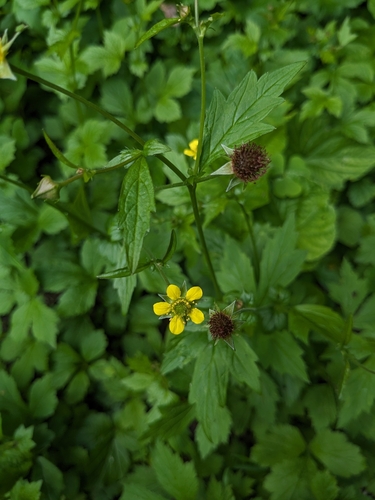
(c) Morgan Outside, some rights reserved (CC BY-NC), uploaded by Morgan Outside
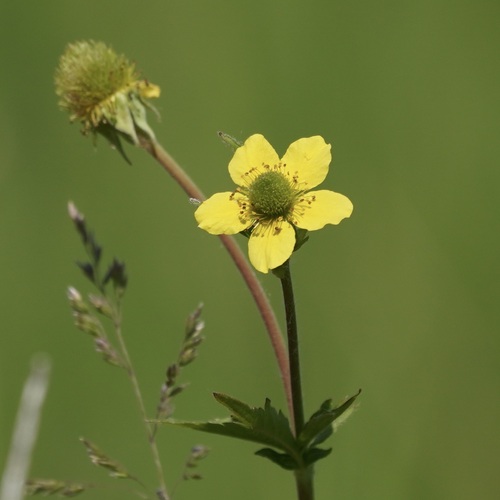
(c) Jason Cooper, some rights reserved (CC BY-NC), uploaded by Jason Cooper
What to Eat
Edible parts: Leaves, Roots - tea
Young leaves are gathered in spring and eaten cooked.
Where to Find It
It is a temperate plant. It grows in wetlands and meadows. In China it grows between 200-3,500 m above sea level. It suits hardiness zones 3-9. In Sichuan and Yunnan.
Asia, Australia, Canada, China, Europe, Indochina, Japan, Korea, Mongolia, New Zealand, North America, SE Asia, Slovenia, USA, Vietnam,
How to Identify
A small herb. It grows 50 cm high and spreads 40 cm wide. The leaves are made up of several pairs of toothed leaflets. They grow on opposite sides of the stem. There is one leaflet at the end. The leaves have 5-11 segments. Each one is 10 cm long. They have fine teeth. The flower stem is upright and branching. The flowers have 5 yellow petals. They occur in groups on stalks. The flowers are yellow to orange. They are 18 mm wide. The seeds are hairy and in a tight cluster. Each one has a hook at the tip.
How to Grow
Easily grown in any moderately good garden soil that is well-drained. Prefers a soil rich in organic matter. Hybridizes freely with other members of this genus.
Propagation: Sow seed in spring or autumn in a cold frame. Once seedlings are large enough to handle, prick them out into individual pots and plant out during summer. Divide clumps in spring or autumn, ideally every 3–4 years to maintain plant vigour. Larger clumps can go directly into permanent positions, but smaller ones are best potted up and grown on in a cold frame until well rooted, then planted out in spring.
Medicinal Uses
The plant is anodyne and is used in treating sores, wounds, and skin diseases. The root is astringent, diaphoretic, and febrifuge. A decoction of the root has been used to treat diarrhoea, fevers, children's coughs, toothache, and sore throats.
Other Uses
None known
Wikipedia
Source ↗Geum aleppicum, commonly called yellow avens or common avens is a flowering plant native to most of the temperate Northern Hemisphere, from eastern Europe across Asia and North America. It is a herbaceous perennial plant growing to 1 m tall with pinnate leaves. The flowers are 2 cm diameter, yellow, with five to seven toothed petals. There are two subspecies: Geum aleppicum subsp. aleppicum. Europe and Asia. Geum aleppicum subsp. strictum. North America.
Notes
There are about 40-50 Geum species.
Names & Synonyms
Ke, Kopata
References (9)
- Collectanea 1:88. 1787 ("1786"); Icon. pl. rar. 1: t. 93. 1787? ("1781-1786")
- Cormack, R. G. H., 1967, Wild Flowers of Alberta. Commercial Printers Edmonton, Canada. p 150
- Cundall, P., (ed.), 2004, Gardening Australia: flora: the gardener's bible. ABC Books. p 637
- Flora of China @ efloras.org Volume 9
- Hu, Shiu-ying, 2005, Food Plants of China. The Chinese University Press. p 435
- Plants for a Future database, The Field, Penpol, Lostwithiel, Cornwall, PL22 0NG, UK. http://www.scs.leeds.ac.uk/pfaf/
- Skinner, G. & Brown, 1981, C., Simply Living. A gatherer's guide to New Zealand's fields, forests and shores. Reed. p 12 (As Geum strictum)
- Urgamal, M., Oyuntsetseg, B., Nyambayar, D. & Dulamsuren, Ch. 2014. Conspectus of the vascular plants of Mongolia. (Editors: Sanchir, Ch. & Jamsran, Ts.). Ulaanbaatar, Mongolia. “Admon“ Press. 334pp. (p. 143-158).
- Zhang, Y., et al, 2014, Diversity of wetland plants used traditionally in China: a literature review. Journal of Ethnobiology and Ethnomedicine. 10:72
More from Rosaceae


