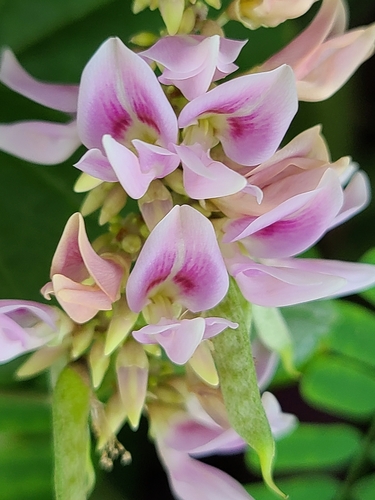
Gleditsia triacanthos
Linn.
Honey locust, Thorny locust
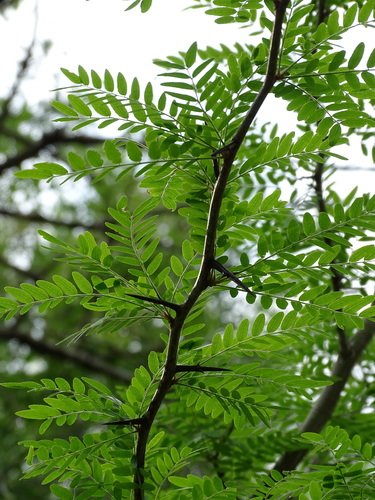
(c) Dwight Bohlmeyer, some rights reserved (CC BY-NC), uploaded by Dwight Bohlmeyer
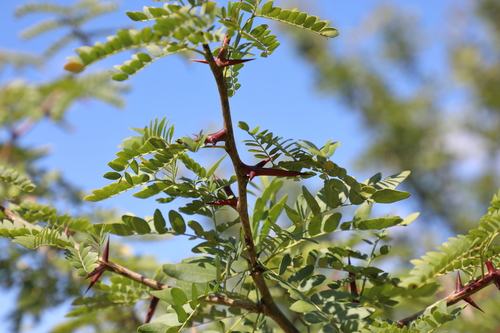
(c) Roberto González, some rights reserved (CC BY-NC)

(c) Radu Chibzii, some rights reserved (CC BY-SA)
What to Eat
Edible parts: Pulp, Seeds, Fruit, Seeds - coffee
The seeds can be eaten raw or cooked and can contain up to 30% sugar; young seeds taste like raw peas. The oval seeds are about 8mm long and contain 10.6–24.1% protein, 0.8–4.3% fat, 84.7% carbohydrate, 21.1% fibre, 4% ash, 280mg calcium, and 320mg phosphorus per 100g. Seeds are not always produced in maritime regions, as the tree prefers long hot summers. They have also been roasted and used as a coffee substitute. The pulp inside the seedpods is sweet and can be eaten raw or processed into sugar; the tender young pods can be cooked and eaten whole. The pulp in older pods turns bitter. Seedpods grow up to 40cm long and 4cm wide. A sweet, pleasant-tasting drink can also be made from the pods or seed pulp.
Known Hazards
Where to Find It
A warm temperate plant. It will grow on most soils if there is adequate moisture. It does best in a protected sunny position. They cannot tolerate shade. It is damaged by drought but resistant to frost. It prefers long hot summers so seed are not always produced in coastal regions. Trees are frost tender when young but withstand heavy frosts once established. It can grow on alkaline soils. It grows from sea level to about 2,000 m above sea level in Africa. It can grow in arid places. It suits hardiness zones 3-10. Hobart Botanical Gardens.
Afghanistan, Africa, Argentina, Asia, Australia, Austria, Balkans, Belarus, Britain, Bulgaria, Canada, Caucasus, Central Asia, China, Czech Republic, East Africa, Easter island, Europe, France, Germany, Hungary, India, Iran, Iraq, Italy, Kazakhstan, Kyrgystan, Lesotho, Macedonia, Mauritius, Mediterranean, Mexico, Middle East, Morocco, Mozambique, New Zealand, North Africa, North America, Pacific, Pakistan, Papua New Guinea, PNG, Portugal, Romania, Russia, Saudi Arabia, South Africa, Southern Africa, South America, Spain, Syria, Tajikistan, Tasmania, Tunisia, Turkey, Türkiye, Turkmenistan, Uganda, Uruguay, USA*, Uzbekistan, Yugoslavia, Zimbabwe,
How to Identify
A deciduous tree. It grows to a height of 30 m and spreads to 5-20 m across. The trunk can be 90 cm across. The stem is erect and straight. It has thorny branches and a broad crown. The leaves are glossy dark green and sword shaped. They have 10 to 12 pairs of leaflets. Some forms have more compound leaves. The leaflets have saw like teeth around the edge. The male and female flowers are on the same tree but separate. The flowers are small and greenish yellow. They occur in clusters. Flowers are pollinated by insects. The fruit are brown, curved and twisted pods. They are 45 cm long and burst open naturally. The seeds are oval and 8 mm long. The pods fall without opening. There are several named varieties.
How to Grow
Succeeds in most soils, acid or alkaline, so long as they are well-drained. Requires a sunny position. Tolerates drought once established and atmospheric pollution. Salt tolerant. The honey locust is speculated to tolerate an annual precipitation of 60 to 150cm, an annual temperature range of 10 to 21°C, and a pH in the range of 6 to 8. Trees are rather tender when young, but they are hardy to about -30°c once they are established. They grow best in southern Britain. The honey locust is often cultivated in warm temperate zones for its edible seeds and seedpods, trees start to bear when about 10 years old and produce commercial crops for about 100 years. Wild trees seldom live longer than 120 years. Trees are shy to flower and therefore do not often produce a worthwhile crop in Britain due to our cooler summers. There are some named varieties. The sub-species nana produced lots of viable seed in the hot summer of 1989 at Kew, it also had a very good crop in 1994, 1996 and in 1999. The sub-species inermis had a very good crop of pods in the autumn of 1996. 'Ashworth' has pods with a very sweet pulp that has a melon-like flavour. The flowers have a pleasing scent. A very ornamental tree, the flowers are very attractive to bees. Trees have a light canopy, they come into leaf late and lose their leaves early making them an excellent canopy tree for a woodland garden. Plants in this genus are notably resistant to honey fungus. Unlike most plants in this family, honey locusts do not fix atmospheric nitrogen.
Propagation: Pre-soak seed for 24 hours in warm water, then sow in spring in a greenhouse. The seed should have swollen; if not, soak for another 24 hours. If soaking alone fails, carefully file away part of the seed coat without damaging the embryo, then soak again until the seed swells. Once swollen, germination takes 2–4 weeks at 20°C. Prick seedlings into individual deep pots as soon as they are large enough to handle, and plant out into permanent positions in summer. Provide some protection from cold during the first few winters outdoors.
Medicinal Uses
A tea made from the pods has been used to treat indigestion, measles, and catarrh. The juice of the pods is antiseptic, and the pods have been regarded as useful for children's complaints. An alcoholic extract of the fruits, after removal of tannin, retarded the growth of Ehrlich mouse carcinoma by up to 63%, though cytotoxicity was high and test animals showed weight loss and dystrophic changes in the liver and spleen. The same extract showed moderate oncostatic activity against sarcoma 180 and Ehrlich carcinoma at a total dose of 350mg/kg body weight per mouse, with considerable weight loss. An infusion of the bark has been drunk and applied as a wash to treat dyspepsia, and has also been used for whooping cough, measles, and smallpox. The twigs and leaves contain the alkaloids gleditschine and stenocarpine; stenocarpine has been used as a local anaesthetic, while gleditschine causes stupor and loss of reflex activity. Current research is investigating the leaves as a potential source of anticancer compounds.
Other Uses
The tree has been planted for land reclamation on mining waste. Gum from the seeds has been proposed as an emulsifying substitute for acacia and tragacanth. The heartwood contains 4–4.8% tannin. The wood is strong, coarse-grained, elastic, very hard, highly shock-resistant, and very durable in contact with soil. It does not shrink much but splits rather easily and does not glue well, weighing 42lb per cubic foot. It is widely used for fence posts and rails, wheel hubs, farm implements, and general construction.
Wikipedia
Source ↗A deciduous tree reaching 20m tall and 15m wide, growing at a medium rate. Hardy to UK zone 3. Flowers appear in July with seeds ripening October to November. Hermaphroditic and insect-pollinated. Tolerates light sandy, medium loamy, and heavy clay soils; prefers well-drained conditions but grows in poor soils. Adapts to mildly acid, neutral, basic, and saline soils. Requires full sun, tolerates both dry and moist conditions, and resists drought and atmospheric pollution.
Production
A fast growing tree. Seed germinate in 2-4 weeks at 20°C. Trees start to produce seed when 10 years old and can produce for 100 years. Trees can live for 120 years.
Notes
Seeds contain 10.6 - 24.1% protein, 0.8 - 4.3% fat, 84.7% carbohydrate, 21.1% fibre, 4% ash, 280 mg calcium and 320 mg phosphorus per 100g[218]. There are about 14 Gleditsia species. Also as Caesalpinaceae.
Names & Synonyms
Honeyshuck, Sweet bean, Sweet locust
References (44)
- Ambasta, S.P. (Ed.), 2000, The Useful Plants of India. CSIR India. p 237
- Beckstrom-Sternberg, Stephen M., and James A. Duke. "The Foodplant Database." http://probe.nalusda.gov:8300/cgi-bin/browse/foodplantdb.(ACEDB version 4.0 - data version July 1994)
- Blamey, M and Grey-Wilson, C., 2005, Wild flowers of the Mediterranean. A & C Black London. p 110
- Bodkin, F., 1991, Encyclopedia Botanica. Cornstalk publishing, p 498
- Brickell, C. (Ed.), 1999, The Royal Horticultural Society A-Z Encyclopedia of Garden Plants. Convent Garden Books. p 476
- Coombes, A.J., 2000, Trees. Dorling Kindersley Handbooks. p 195
- Cundall, P., (ed.), 2004, Gardening Australia: flora: the gardener's bible. ABC Books. p 641
- Denes, A., et al, 2012, Wild plants used for food by Hungarian ethnic groups living in the Carpathian Basin. Acta Societatis Botanicorum Poloniae 81 (4): 381-396
- Duke, J.A., 1992, Handbook of Edible Weeds. CRC Press. p 106
- Etherington, K., & Imwold, D., (Eds), 2001, Botanica's Trees & Shrubs. The illustrated A-Z of over 8500 trees and shrubs. Random House, Australia. p 347
- Fabaceae Illustrated Flora of Central Texas p 662
- Facciola, S., 1998, Cornucopia 2: a Source Book of Edible Plants. Kampong Publications, p 68
- Farrar, J.L., 1995, Trees of the Northern United States and Canada. Iowa State University press/Ames p 216
- Flora of Australia Volume 12, Mimosaceae (excl. Acacia) Caesalpiniaceae. Melbourne: CSIRO Australia (1998) p 56
- Flora of Pakistan. www.eFloras.org
- Fox, F. W. & Young, M. E. N., 1982, Food from the Veld. Delta Books. p 226
- Gouldstone, S., 1983, Growing your own Food-bearing Plants in Australia. Macmillan p 170
- Grandtner, M. M., 2008, World Dictionary of Trees. Wood and Forest Science Department. Laval University, Quebec, Qc Canada. (Internet database http://www.wdt.qc.ca)
- Hall, N. et al, 1972, The Use of Trees and Shrubs in the Dry Country of Australia, AGPS, Canberra. p 393
- Harris, E & J., 1983, Field Guide to the Trees and Shrubs of Britain. Reader's Digest. p 175
- Hedrick, U.P., 1919, (Ed.), Sturtevant's edible plants of the world. p 329
- Hussey, B.M.J., Keighery, G.J., Cousens, R.D., Dodd, J., Lloyd, S.G., 1997, Western Weeds. A guide to the weeds of Western Australia. Plant Protection Society of Western Australia. p 124
- ILDIS Legumes of the World http:www:ildis.org/Legume/Web
- Jackes, D. A., Edible Forest Gardens
- Joyce, D., 1998, The Garden Plant Selector. Ryland, Peters and Small. p 112
- Kew Plants of the World Online
- Kiple, K.F. & Ornelas, K.C., (eds), 2000, The Cambridge World History of Food. CUP p 1786
- Lazarides, M. & Hince, B., 1993, Handbook of Economic Plants of Australia, CSIRO. p 121
- Little, E.L., 1980, National Audubon Society Field Guide to North American Trees. Alfred A. Knopf. p 523
- Lord, E.E., & Willis, J.H., 1999, Shrubs and Trees for Australian gardens. Lothian. p 56
- Lyle, S., 2006, Discovering fruit and nuts. Land Links. p 229
- Moerman, D. F., 2010, Native American Ethnobotany. Timber Press. p 248
- Plants for a Future database, The Field, Penpol, Lostwithiel, Cornwall, PL22 0NG, UK. http://www.scs.leeds.ac.uk/pfaf/
- Recher, P, 2001, Fruit Spirit Botanical Gardens Plant Index. www.nrg.com.au/~recher/ seedlist.html p 2
- Royal Botanic Gardens, Kew (1999). Survey of Economic Plants for Arid and Semi-Arid Lands (SEPASAL) database. Published on the Internet; http://www.rbgkew.org.uk/ceb/sepasal/internet [Accessed 21st April 2011]
- Ruiters-Welcome, A. K., 2019, Food plants of southern Africa. Ph.D. thesis. Univ. of Johannesburg p 58
- Self, M., 199, Phoenix Seeds catalogue. p 15
- Sp. pl. 2:1056. 1753
- van Wyk, Ben-Erik, 2019, The diversity and multiple uses of southern African legumes. Australian Systematic Botany, 2019, 32, 519–546
- Welcome, A. K. & Van Wyk, B.-E., 2019, An inventory and analysis of the food plants of southern Africa. South African Journal of Botany 122 (2019) 136–179
- World Checklist of Useful Plant Species 2020. Royal Botanic Gardens, Kew
- www.worldagroforestrycentre.org/treedb/
- Young, J., (Ed.), 2001, Botanica's Pocket Trees and Shrubs. Random House. p 413
- Zizka, G., 1991, Flowering Plants of Easter Island. Palmarum Hortus Francofurtensis