Gloriosa superba
Lindl.
Flame lily
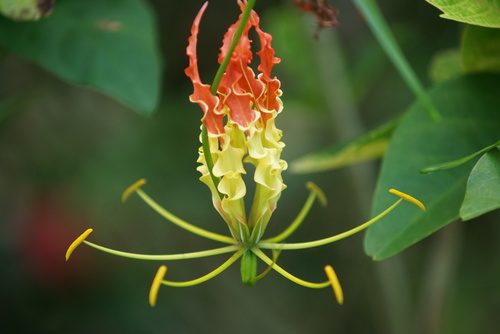
(c) Tan Yi Hern, Tan Chin Qian, Tan Li TA, Tan Hou Aun, some rights reserved (CC BY-NC), uploaded by Tan Yi Hern, Tan Chin Qian, Tan Li TA, Tan Hou Aun
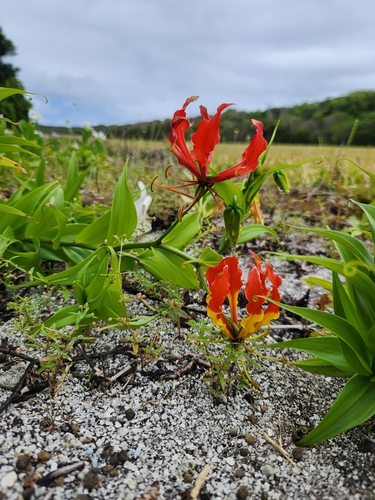
(c) Shelomi Doyle, some rights reserved (CC BY), uploaded by Shelomi Doyle
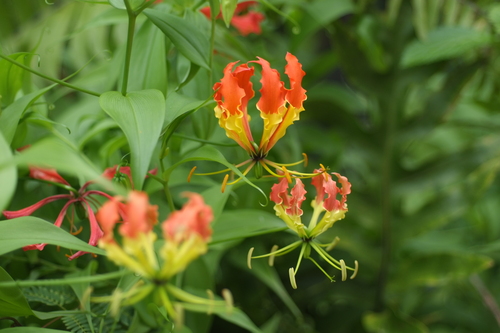
(c) Pierre-Louis Stenger, some rights reserved (CC BY-NC), uploaded by Pierre-Louis Stenger
What to Eat
Edible parts: Leaves, Caution, Fruit
None known
Known Hazards
Where to Find It
A tropical plant. It grows in grassland and woodland. In southern China it grows between 900-1,300 m above sea level. In Yunnan.
Africa, Asia, Botswana, Burkina Faso, Cambodia, China, Central Africa, Central African Republic, CAR, Congo, East Africa, Ethiopia, Guinea, Guinée, Guinea-Bissau, Himalayas, India, Indochina, Indonesia, Kiribati, Laos, Madagascar, Malaysia, Maldives, Myanmar, Mozambique, Nepal, Pacific, Rotuma, SE Asia, Sierra Leone, South Africa, Sri Lanka, Thailand, Tuvalu, Vietnam, West Africa, Zambia, Zimbabwe,
How to Identify
A scrambling herb. It keeps growing from year to year. It grows 1.5 m long. The leaves are alternate. The leaf tips end in a coiled tendril. The flowers are orange or red and have 6 tepals that curve backwards. There are 6 long stamen that spread out parallel to the ground under the flower. The fruit is a leathery capsule with bright red seeds.
How to Grow
A plant of the lowland tropics and subtropics, where it can be found at elevations up to 600 metres, the plant has a clear preference for seasonal, monsoon climates with a pronounced dry season. The plant is not resistant to frost. Succeeds in full sun to partial shade. Prefers a moist but well-drained, humus-rich soil. Prefers an acid to neutral soil. The plant has often escaped from cultivation and has been classified as 'Invasive' in some areas. Plants propagated from seeds take 3 - 4years to bloom. Plants can flower and produce seeds all year round, though mainly during the rainy season. In Tamil Nadu, India, small-scale plantings, raised from tubers, yield on average 250 - 300 kilos of seed per hectare from the second year onwards. In South Africa the seed production of 'wild-type' plants is positively correlated with height of the plant, and is on average 258 seeds per plant for plants 60 - 65cm tall compared with about 30 seeds per plant for plants 30 - 40cm tall. Flowering Time: Late Spring/Early Summer Mid Summer Late Summer/Early Fall. (early summer, mid summer, late summer, early fall, mid fall, late fall). Bloom Color: Red-Orange Bright Yellow. (red, orange, yellow, pink). Spacing: 36-48 in. (90-120 cm).
Propagation: Chemical scarification (such as treatment with 1% hypochlorite) or removal of the sarcotesta reduces seed dormancy from 6–9 months to about 4 months, and accelerates germination from 29–30 days down to 11–15 days. Germination rates as high as 97% have been achieved when seeds are incubated at 20–25°C for 31 days; higher temperatures have adverse effects. Vegetative propagation by tubers is common practice but is not well suited to establishing large plantings, as a maximum of only two daughter corms are produced per plant. Separating the bilobed hypopodial tubers produces a higher percentage of flowering plants than leaving them undivided (approximately 97% versus 63%). Tuber dormancy can be overcome by soaking in continuously aerated water, and small tubers have been found to have a higher multiplication rate than larger ones.
Medicinal Uses
Although poisonous, the plant is widely used in traditional medicine across Asia and Africa, mainly in external applications but also sometimes ingested in small quantities. In Ayurvedic medicine the tuber is used as an abortifacient, alterative, antiarthritic, antihaemorrhoid, antileprotic, antiperiodic, cholagogue, purgative, and tonic, and is considered useful for ulcers, leprosy, piles, inflammations, abdominal pains, itching, and thirst. In Africa, a decoction of the tuber is taken to treat abdominal disorders, induce abortions, and act as a tonic and purgative. The tuber is sometimes used as an emetic to remove toxins, and also features in a preparation for treating impotence and as an abortifacient. The sap is an ingredient in a sleep-inducing drink. Applied externally, the tuber treats bruises, colic, chronic ulcers, haemorrhoids, and cancer. It is used in poultices to relieve neuralgia and in topical applications for arthritis, joint swellings, sprains, and dislocations, and is claimed to have antidotal properties against snakebites. Macerated tuber is taken against smallpox, leprosy, eczema, itch, and ringworm. A paste made from the tuber is applied externally to facilitate childbirth. Tuber juice is used as ear drops for earache and applied to the gums to relieve toothache. The anthelmintic properties of the tuber, fruits, and leaves are widely recognised; all are used to treat Guinea worm, schistosomes (bilharzia), roundworm, tapeworm, liver fluke, and filaria. Leaf juice, unripe fruits mixed with butter, and tuber macerate are used to kill head lice. Soup made from leaf or tuber sap is given to women for sterility, delayed puberty, delayed childbirth, and menstrual problems. Leaves are administered as an enema for decongestant purposes. The plant juice is drunk as an antimalarial. A leaf decoction applied as a liniment eases coughs, general pain, and scrotal dropsy. Leaf juice instilled into the nose treats fainting. Crushed leaves are applied to the chest for asthma and to affected areas for rheumatism. Burning the herb and applying the ash to wounds is said to promote healing. Sap from the leaf tip is applied externally to treat pimples and skin eruptions. The seeds are a commercial source of colchicine, an amino alkaloid biosynthetically derived from phenylalanine and tyrosine. The tubers also contain colchicine, but seed content is reported to be up to ten times higher, making good seed set important when the plant is grown for colchicine production. Colchicine is used to treat gout and rheumatism and is currently the drug of choice for acute gout, reducing the inflammatory reaction to urate crystals in the joints. Due to its highly toxic nature, colchicine should only be used under physician supervision.
Other Uses
Colchicine, obtained from all parts of the plant but especially the seeds, inhibits cell division and is used in plant breeding to produce polyploidy. Extracts of the shoots and tubers show strong nematicidal activity, largely attributable to colchicine.
Wikipedia
Source ↗Gloriosa superba is a species of flowering plant in the family Colchicaceae. Common names include flame lily, climbing lily, creeping lily, glory lily, gloriosa lily, tiger claw, and fire lily.
Notes
There are about 5 Gloriosa species. Some say it is one variable species. Gloriosa superba rhizomes in China are rich in the alkaloid colchicine. The plant are used for the treatment of gout. In Slovenia possibly in a hot house.
Names & Synonyms
Bunga sung-sang, Cumaretron, Cumaro-turo, Gondivoro, Kalihari, Mokuku, Papassuque, Razkošna lilija, Simidauk, Tititamba, Vehathan, Vihalagondi, Yemariam twa