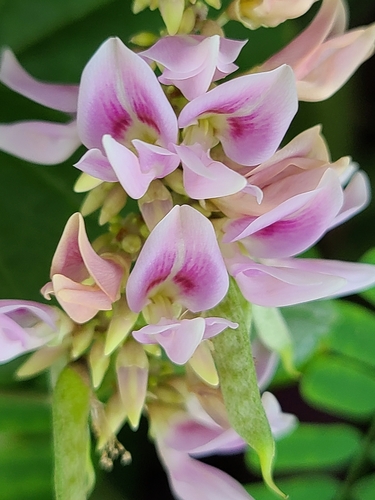
Glycine max subsp. soja
(Siebold & Zuccarini)
Wild soya bean

iNaturalist · cc-by-nc
(c) Christopher David Benda, some rights reserved (CC BY-NC)
(c) Christopher David Benda, some rights reserved (CC BY-NC)
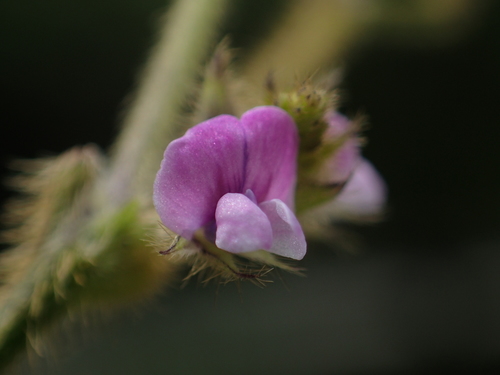
iNaturalist · cc0
no rights reserved, uploaded by 葉子
no rights reserved, uploaded by 葉子

iNaturalist · cc-by-nc
(c) Christopher David Benda, some rights reserved (CC BY-NC)
(c) Christopher David Benda, some rights reserved (CC BY-NC)
What to Eat
Edible parts: Leaves, Seeds
Both the leaves and seeds are edible. The seeds are used as a grain and must be well cooked before consumption.
Known Hazards
Where to Find It
It is a subtropical plant. It grows between 150-2,650 m above sea level in China. It grows in wetlands.
Afghanistan, Asia, China, Europe, India, Japan, Korea, Mongolia, Russia, Taiwan, Turkey, Türkiye,
Countries: Andorra, United Arab Emirates, Afghanistan, Albania, Armenia, Austria, Azerbaijan, Bosnia & Herzegovina, Bangladesh, Belgium, Bulgaria, Bahrain, Brunei, Bhutan, Belarus, Switzerland, China, Cyprus, Czechia, Germany, Denmark, Estonia, Spain, Finland, France, United Kingdom, Georgia, Greece, Croatia, Hungary, Indonesia, Ireland, Israel, India, Iraq, Iran, Iceland, Italy, Jordan, Japan, Kyrgyzstan, Cambodia, North Korea, South Korea, Kuwait, Kazakhstan, Laos, Lebanon, Liechtenstein, Sri Lanka, Lithuania, Luxembourg, Latvia, Monaco, Moldova, Montenegro, North Macedonia, Myanmar, Mongolia, Malta, Maldives, Malaysia, Netherlands, Norway, Nepal, Oman, Philippines, Pakistan, Poland, Portugal, Qatar, Romania, Serbia, Russia, Saudi Arabia, Sweden, Singapore, Slovenia, Slovakia, San Marino, Syria, Thailand, Tajikistan, Timor-Leste, Turkmenistan, Turkey, Taiwan, Ukraine, Uzbekistan, Vietnam, Yemen
How to Identify
An annual climber. The branches are slender. The leaves have 3 leaflets. The leaflets are broadly sword shaped. The flowers are purple-red. They are 4 mm long. They are in groups in the axils of leaves. The pods are 3 cm long and 4 mm wide. There are 2-4 black seeds.
Notes
There are 10 Glycine species.
Names & Synonyms
Glycine formosa Hosok.Glycine soja Siebold & Zucc.and others
References (9)
- Abh. Math.-Phys. Cl. Koenigl. Bayer. Akad. Wiss. 4(2):119. 1845
- Hu, Shiu-ying, 2005, Food Plants of China. The Chinese University Press. p 474
- Hwang, H., et al, 2013, A Study on the Flora of 15 Islands in the Western Sea of Jeollanamdo Province, Korea. Journal of Asia-Pacific Biodiversity Vol. 6, No. 2 281-310
- Hwang, HS, et al, 2014, Distribution characteristics of plant in the Ungseokbong Mountain, Gyeongsangnam-do, Korea. Journal of Asia-Pacific Biodiversity. 7(2014) e164-e178
- Khasbagan, Hu-Yin Huai, and Sheng-Ji pei, 2000, Wild Plants in the Diet of Athorchin Mongol Herdsmen in Inner Mongolia. Economic Botany 54(4): 528-536
- Plants for a Future database, The Field, Penpol, Lostwithiel, Cornwall, PL22 0NG, UK. http://www.scs.leeds.ac.uk/pfaf/
- van Wyk, B., 2005, Food Plants of the World. An illustrated guide. Timber press. p 201
- Zeven, A. C. & de West, J. M. J., 1982, Dictionary of cultivated plants and their regions of diversity. Wageningen. p 40
- Zhang, Y., et al, 2014, Diversity of wetland plants used traditionally in China: a literature review. Journal of Ethnobiology and Ethnomedicine. 10:72