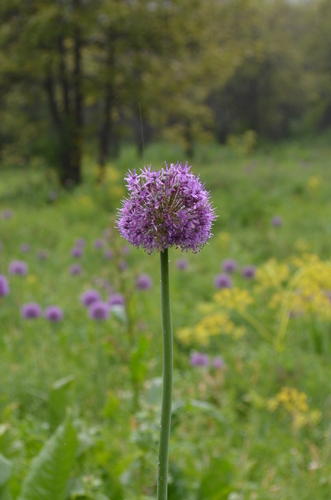
Allium acuminatum
Hook.
Hooker’s onion, Taper-tip Onion, Pink wild onion

(c) sarahifelix, some rights reserved (CC BY-NC)

(c) Alex Abair, some rights reserved (CC BY), uploaded by Alex Abair

(c) BJ Stacey, some rights reserved (CC BY-NC), uploaded by BJ Stacey
What to Eat
Edible parts: Seeds, Flowers, Leaves, Roots, Bulb
The bulb, which is typically 10–15mm wide, can be eaten raw or cooked and is best in spring and early summer. It has a strong onion flavour and can be roasted, sautéed, or added to soups and stews. The leaves are edible raw or cooked and used as a relish or seasoning much like chives, though they are best finely chopped to avoid stringiness. Flowers can be eaten raw as a garnish on salads. Seed heads can be placed in hot ashes for a few minutes, then the seeds extracted and eaten. The flavour is excellent, though the small bulb size limits overall yield.
Known Hazards
Where to Find It
It is a temperate plant. It grows naturally in Western North America from Washington to Northern California amongst dry sunny rocks on hills and plains. It grows in a sunny position in a light well drained soil. They do not suit cool wet climates. It suits hardiness zones 4-9.
Australia, Canada, North America, USA,
How to Identify
An onion family plant with a bulb. It grows to 30 cm tall and spreads to 8 cm across. The leaves are 12 mm long. The leaves taper to the tip. The bulb is 10-15 mm wide. The flowers are pinkish purple. They are urn shaped.
How to Grow
Prefers a sunny position in a light well-drained soil. The bulbs tend to rot when grown in cool wet climates, even if they are given sharp drainage. This species is best in a cold frame and given a dry summer rest. The bulbs should be planted fairly deeply. Most members of this genus are intolerant of competition from other growing plants. Grows well with most plants, especially roses, carrots, beet and chamomile, but it inhibits the growth of legumes. This plant is a bad companion for alfalfa, each species negatively affecting the other. Members of this genus are rarely if ever troubled by browsing deer.
Propagation: Sow seed in spring in a cold frame. Prick out seedlings into individual pots when large enough to handle — placing three per pot will produce clumps more quickly. Grow on in a greenhouse through at least the first winter, then plant out into permanent positions in spring once growing vigorously. Divide in spring. Plants can be divided successfully at any point during the growing season and divisions can be planted straight out into permanent positions if needed.
Medicinal Uses
No specific medicinal uses have been recorded for this species, but members of this genus are generally considered healthy dietary additions. They contain sulphur compounds responsible for their onion flavour, and regular consumption is thought to help reduce blood cholesterol levels, act as a tonic to the digestive system, and support the circulatory system.
Other Uses
The growing plant is said to repel insects and moles. The bulbs can also be rubbed directly on the skin as an insect repellent.
Wikipedia
Source ↗Allium acuminatum, also known as the tapertip onion or Hooker's onion, is a species in the genus Allium native to North America.
Notes
There are about 300-700 Allium species. Most species of Allium are edible (Flora of China). All alliums are edible but they may not all be worth eating! They have also been put in the family Alliaceae.
Names & Synonyms
Kyyga
References (9)
- Beckstrom-Sternberg, Stephen M., and James A. Duke. "The Foodplant Database." http://probe.nalusda.gov:8300/cgi-bin/browse/foodplantdb.(ACEDB version 4.0 - data version July 1994)
- Brickell, C. (Ed.), 1999, The Royal Horticultural Society A-Z Encyclopedia of Garden Plants. Convent Garden Books. p 95
- Couture, M. D., 1978, Recent and Contemporary Foraging Practices of the Harney Valley Paiute. Thesis, Portland State University
- Coutre, M. D., et al, 1986, Foraging Behaviour of a Contemporary Northern Great Basin Population. Journal of California and Great Bason Anthropology Vol. 8(2) pp 150-160
- Cundall, P., (ed.), 2004, Gardening Australia: flora: the gardener's bible. ABC Books. p 125
- Fl. bor.-amer. 2:184, t. 196. 1838
- Plants for a Future database, The Field, Penpol, Lostwithiel, Cornwall, PL22 0NG, UK. http://www.scs.leeds.ac.uk/pfaf/
- Turner, N., 1995, Food Plants of Coastal First Peoples. Royal BC Museum Handbook p 40
- Turner, N., 1997, Food Plants of Interior First Peoples. Royal BC Museum Handbook p 59