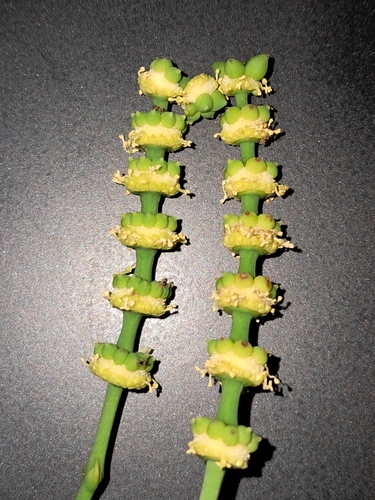
Gnetum costatum
K. Schumann

(c) Yanuar Ishaq Dc, some rights reserved (CC BY-NC-SA), uploaded by Yanuar Ishaq Dc

(c) Yanuar Ishaq Dc, some rights reserved (CC BY-NC-SA)
What to Eat
Edible parts: Fruit, Kernels, Leaves, Flowers, Nuts
The fruit are boiled and eaten after extended cooking to remove bitterness. Male and female flowers and leaves are also cooked and eaten.
Known Hazards
Where to Find It
A tropical plant. It grows in rainforest up to 1350 m altitude. It can be on ridge tops or along streams. It does not grow in swamps. It does best where there are distinct wet and dry seasons.
Asia, Indonesia (Papua), Pacific, Papua New Guinea, PNG, SE Asia, Solomon Islands,
How to Identify
A tree which loses its leaves. It grows 15-20 m tall. The bark is reddish-brown. The leaves are broadly oval and 15-18 cm long. They taper at both ends. The leaf stalk is 0.5 cm long. Male and female flowers are separate. The male flowering shoots occur singly in the axils of leaves. They are 6-7 cm long and simple. The flowers do not have stalks and occur in rings. The female flowers have fine white hairs. The fruit are nut-like and taper at both ends. They are 4 cm long by 1 cm wide. They can be red or pink. The seed taper and have furrows.
How to Grow
A plant of the moist tropics, where it is found at elevations up to 1,350 metres. Areas experiencing both wet and dry seasons seem to be ideal for the species. Species in this genus usually prefer a position in light to deep shade, growing best in a moist but well-drained, humus-rich soil. A dioecious species, both male and female forms need to be grown if fruit and seed are required.
Other Uses
The inner bark provides a fibre which is used for making string bags known as 'bilum'. The wood is of no commercial value.
Notes
There are about 28 Gnetum species.
References (8)
- French, B.R., 2010, Food Plants of Solomon Islands. A Compendium. Food Plants International Inc. p 69
- Plants of Papua New Guinea LAE herbarium record
- PROSEA (Plant Resources of South East Asia) handbook, Volume 2, 1991, Edible fruits and nut. p 181
- K. M. Schumann & U. M. Hollrung, Fl. Kais. Wilh. Land 13. 1889
- van Wyk, B., 2005, Food Plants of the World. An illustrated guide. Timber press. p 203
- Walter, A. & Sam C., 2002, Fruits of Oceania. ACIAR Monograph No. 85. Canberra. p 178, 280
- Wickens, G.E., 1995, Edible Nuts. FAO Non-wood forest products. FAO, Rome. p 175
- www.worldagroforestrycentre.org/treedb/