Gnetum gnemon
L.
Tu-lip, Melimjo, Spinach Joint fir
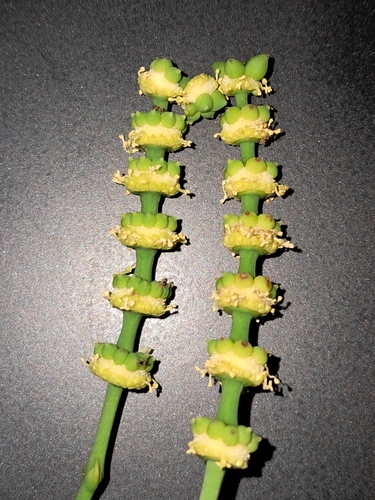
(c) Bayan Izzani, some rights reserved (CC BY-NC), uploaded by Bayan Izzani

(c) gbohne, some rights reserved (CC BY-SA)
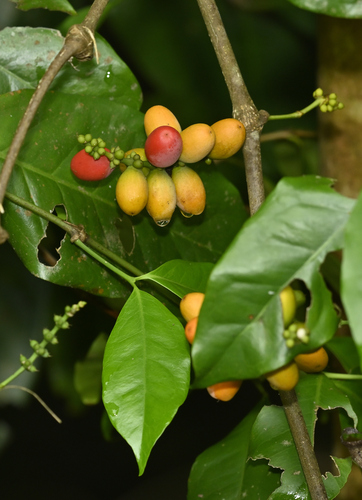
(c) ytw, some rights reserved (CC BY-NC), uploaded by ytw
What to Eat
Edible parts: Leaves, Fruit, Flowers, Seeds, Nuts, Vegetable
Young leaves can be eaten raw or cooked, often steamed and served as a potherb. The seeds, which are 2–4cm long and turn scarlet to red-tinged orange when ripe, are nutritious and usually cooked — boiled and eaten as a snack like peanuts or served as a dessert nut. They have a slight bitterness. Ground seed produces a fine flour used to make thin crackers known as 'emping', which are fried in coconut oil and eaten with rice. The fruits and inflorescences are added to soups, and the peel of ripe fruit is dried and also used in soups, though it is somewhat tasteless. Sap from the stem is drinkable.
Where to Find It
A tropical plant. It suits the lowland tropics. Trees occur in tropical rainforest from sea level to about 1200 metres altitude. It does best with rainfalls of 3000-5000 mm per year. It is best with an annual temperature of 22-30°C. It needs a temperature above 13°C. These trees grow in Malaysia, Indonesia and islands out to Fiji. They can grow on a range of soils but do best on deep well drained soils. It grows well in acid soils. It can grow in full sun but also tolerate shade. It cannot tolerate salt spray. It suits hardiness zones 10-12.
Andamans, Asia, Australia, Bougainville, Cambodia, China, East Timor, Fiji, India, Indochina, Indonesia, Malaysia, Micronesia, Myanmar, Northeastern India, Pacific, Palau, Papua New Guinea, PNG, Philippines, Samoa, SE Asia*, Singapore, Solomon Islands, Thailand, Timor-Leste, Vanuatu, Vietnam, West Papua,
How to Identify
A shrub or small tree about 10 m high. It can grow to 20 m high. It normally has a cone shaped crown. The bark is greyish brown. The small branches are slender and like a vine. The leaves are produced in pairs opposite each other. They are dark green and shiny, oval and pointed at both ends. The leaves are 7.5-12.5 cm long by 2.5-7.5 cm wide. Trees are either male or female. Male spikes are 3-6 cm long. They consist of 50-80 very small flowers in rings along the stalk. Flowers are produced as cones made up of rings of scales along stalks 3-6 or 12 cm long. There are 5-8 flowers at each node. Fruits are oval and green when young but red when ripe. Fruit are 2-3 cm long and contain one seed.
Nutrition Score: 78/100
| Part | Moisture | kJ | kcal | Protein | Vit A | Vit C | Iron | Zinc |
|---|---|---|---|---|---|---|---|---|
| Seeds | 13 | 1442 | 345 | 12 | — | — | 5 | — |
| Fruit | 72.6 | 385 | 92 | 5.2 | — | 2.9 | 15.6 | 11.8 |
| Leaves | 66 | 378 | 90 | 5.9 | 3700 | 200 | 2.7 | — |
| Leaves | 88 | 147 | 35 | 1.6 | 2220 | 66 | 1.6 | 0.2 |
How to Grow
Trees are grown from seed. For using as seed for growing, a fully ripe red fruit is needed. Seeds exhibit a natural dormancy due to a hard impermeable seed coat. Breaking this seed coat can normally hasten germination. This is done by boring a hole into the seed. Propagation can be naturally by seeds distributed by birds, by planting seeds or by cuttings. A spacing of 6 m is suitable although in rows they are often put more closely. Trees appear to establish in the forest under-storey indicating some shade tolerance. Trees recover readily from pruning. Coppicing can produce a rapid flush of new leaves. Flushes of new leaves tends to occur seasonally. Trees can be topped to keep them shorter. If plants are grown by air layering they are shorter and more compact.
Propagation: Seed is best sown in situ. Daily watering of the sand and seed mixture can hasten germination, possibly to three months. Without pre-germination treatment, germination may be only 1–2% at six months but can reach 100% at twelve months. Other propagation methods include air layering, short cuttings taken beneath a node, budding, and grafting.
Medicinal Uses
The leaf sap is used medicinally to treat an eye complication.
Other Uses
The bast fibres provide durable cordage for fishing nets, lines, string bags, and other tools, and the bark has potential for rope making. Wood smoke and topical applications reduced biting by anopheline mosquitoes by 79% and 51%, respectively. Enzyme inhibition in the plant also prevents insect predation of foliage. The wood is used for pulp, house construction, paper, and boxes. The fruit attracts wild birds and bats. The tree is suitable for dryland rehabilitation and reforestation, tolerating annual rainfall of 750–1,000mm, and is intercropped with species such as Arctocarpus camansi, Pandanus spp., Durio spp., Nephelium lappaceum (rambutan), and Parkia sp.
Wikipedia
Source ↗Gnetum gnemon is a gymnosperm species of Gnetum. Its native area spans from Mizoram and Assam in India down south through Malay Peninsula, Malay Archipelago and the Philippines in southeast Asia to the western Pacific islands. Common names include gnetum, joint fir, two leaf, melinjo/belinjo (Indonesian), bago/lumbay (Filipino), hanthu (Karbi) and tulip (Tok Pisin).
Production
Trees grow by flushes of young reddish leaves. Flowers are produced throughout the year. Trees grown from seed take 5-8 years to bear fruit. Air layered trees produce fruit in 2-3 years. Leaves are harvested when fully expanded but still soft and succulent. The fruit are harvested when the skin turns red. Trees can produce 20,000 fruit per year or 6-7 kg. Yields of up to 80-100 kg per tree per year have been achieved.
Other Information
It is a commercially cultivated vegetable. A particularly well liked edible green leaf occurring in almost all lowland areas of Papua New Guinea either cultivated or wild. Leaves are sold in local markets. Nuts are sold locally and internationally.
Notes
In Slovenia presumably in a hot house. The nut contains, per 100 g edible portion, 30% moisture, 9-11% protein, 1.6-1.8% fat, 47.6-50.4% starch and 277 cal food energy. The young leaves containing, per 100 g, 71% moisture, 104 cal food energy, 7.4% protein, 2% fat, 19.4% total carbohydrates, 11.9% fibre, 44 mg calcium, 15 mg phosphorus, 1680 I.U. vitamin A and 121 mg vitamin C. There are about 28 Gnetum species. Demo
Names & Synonyms
Ambiam, Annel, Asisang, Bago, Bagor, Bagu, Banago, Belingar, Belingo, Belinjau, Belinjo, Dae fasia, Dae malefo, Dae, Daefasia, Daemalefo, Daun dodah, Daun melinjo, Daun sabong, Eso, Gam cay bet, Gnemo, Guan zhuang mai ma teng, Hagenamu, Hanthu, Hawa, Houka, Hyinbyin, Hyingyin, Kegalu, Kekoso, Keigi, Khlow, Ki tangkil, Kopaiyo, Kusalu, Lenge, Leqe, Liang, Lota badam, Maninjau, Melindjo, Melinjau, Meninjau, Mhalivo, Molingu, Nyia nwasoli, Pee sae, Peesae, Pelh, Phak kariang, Phak miang, Phalap ri, Poke, Rangkil sake, Sa naroka, Sabong, Sake, Sejunteh, Shangpan, Sikau, So, Sokak, Suagafa, Suga, Sukau, Tanyin-ywe, Trangkil, Two leaf, Voe Khlaet, Wanso, Wansu, Wasu, Xian zhou mai ma teng, Yabare
References (132)
- Tul ip references Gnetum gnemon
- Ambasta, S.P. (Ed.), 2000, The Useful Plants of India. CSIR India. p 241
- Arora, R. K., 2014, Diversity in Underutilized Plant Species - An Asia-Pacific Perspective. Bioversity International. p 94
- Barrau, J., 1976, Subsistence Agriculture in Melanesia. Bernice P. Bishop Museu, Bulletin 219 Honolulu Hawaii. Kraus reprint. p 56
- Barwick, M., 2004, Tropical and Subtropical Trees. A Worldwide Encyclopedic Guide. Thames and Hudson p 204
- Biswas, S. C., et al, 2018, Diversity of wild edible minor fruits used by the ethnic communities of Tripura, India. Indian Journal of Traditional Knowledge. Vol 17(2), April 2018, pp 282-289
- Blench, R., 2004, Fruits and Arboriculture in the Indo-Pacific Region. Indo-Pacific Prehistory Association Bulletin 24. (Taipei Papers Volume 2) p 38
- Blume, 1848, Rumphia 4 p3 t176
- Borrell, O.W., 1989, An Annotated Checklist of the Flora of Kairiru Island, New Guinea. Marcellin College, Victoria Australia. p 11, 153
- Bremness, L., 1994, Herbs. Collins Eyewitness Handbooks. Harper Collins. p 59
- Brown, W.H., 1920, Wild Food Plants of the Philippines. Dept. Ag & Natural Resources Bureau of Forestry. Bulletin No 21 p
- Brown, W.H., 1920, Wild Food Plants of the Philippines. Bureau of Forestry Bulletin No. 21 Manila. p 22
- Burkill, I.H., 1966, A Dictionary of the Economic Products of the Malay Peninsula. Ministry of Agriculture and Cooperatives, Kuala Lumpur, Malaysia. Vol 1 (A-H) p 1109
- Cabalion, P. and Morat, P., 1983, Introduction le vegetation, la flore et aux noms vernaculaires de l'ile de Pentcoste (Vanuatu), In: Journal d'agriculture traditionnelle et de botanique appliquee JATBA Vol. 30, 3-4
- Chai, P. P. K. (Ed), et al, 2000, A checklist of Flora, Fauna, Food and Medicinal Plants. Lanjak Entimau Wildlife Sanctuary, Sarawak. Forestry Malaysia & ITTO. p 159, 168
- Chin, H.F., & Yong, H.S., 1996, Malaysian Fruits in Colour. Tropical press, Kuala Lumpur p 65
- Clarke, W.C. & Thaman, R.R., 1993, Agroforestry in the Pacific Islands: Systems for sustainability. United Nations University Press. New York. p 240
- Corner, 1940, Wayside Trees of Malaya. p726 pl 1227-228
- Coronel, R.E., 1982, Fruit Collections in the Philippines. IBPGR Newsletter p 7
- Cowie, I, 2006, A Survey of Flora and vegetation of the proposed Jaco-Tutuala-Lore National Park. Timor-Lests (East Timor) www.territorystories.nt/gov.au p 48
- Crevost, 1920, Bull. Econ., Indochine 22:428
- Cundall, P., (ed.), 2004, Gardening Australia: flora: the gardener's bible. ABC Books. p 645
- De Clerq 1909, Niew Plantk. Woordenb. p249 no. 1671
- Den Berger, 1949, Determinatietabel Houtsoorten van Malesie Wageningen 35
- Dobriyal, M. J. R. & Dobriyal, R., 2014, Non Wood Forest Produce an Option for Ethnic Food and Nutritional Security in India. Int. J. of Usuf. Mngt. 15(1):17-37
- Duke, J.A., 1989, CRC Handbook of Nuts. CRC Press Florida p 166, 167
- Etherington, K., & Imwold, D., (Eds), 2001, Botanica's Trees & Shrubs. The illustrated A-Z of over 8500 trees and shrubs. Random House, Australia. p 349
- Ethnobotany of Karbis. Chapter 4 in p 104
- Evans, B. R, 1999, Edible nut Trees in Solomon Islands. A variety collection of Canarium, Terminalia and Barringtonia. ACIAR Technical Report No. 44 96pp
- Facciola, S., 1998, Cornucopia 2: a Source Book of Edible Plants. Kampong Publications, p 119
- Fagerlind, 1946, Ark, For. Bot. 33A no 8
- Filet, 1888, Plantk Woordenb. 2nd ed p 38 No. 820
- Flavelle, A. J., 1991, A Traditional Agroforestry Landscape on Fergusson Island, Papua New Guinea. M. Sc. Univ. of British Columia. p 144
- Flora Malesiana Vol 13 p 341
- Food Composition Tables for use in East Asia FAO http://www.fao.org/infoods/directory No. 320
- French, B.R., 1986, Food Plants of Papua New Guinea, A Compendium. Asia Pacific Science Foundation p 57
- French, B.R., 2010, Food Plants of Solomon Islands. A Compendium. Food Plants International Inc. p
- Furusawa, T., et al, 2014, Interaction between forest biodiversity and people's used of forest resources in Roviana, Solomon Islands: implications for biocultural conservation under socioeconomic changes. Journal of Ethnobiology and Ethnomedicine, 10:10
- Gillaumin, R., 1954, Les Plantes utiles des Nouvelles-Hebrides (fin et complement) In: Journal d'agriculture tropicale et de botanique appliquee Vol. 1, No. 10-12 pp 453-460
- GTZ 1996, A Guide to some Indigenous Fijian Trees. GTZ Suva. p 175
- Hale, P.R. & Williams, B.D., 1977, Liklik Buk p22 Melanesian Council of Churches.
- Hartley, T.C., 1973, A Survey of New Guinea Plants for Alkaloids. Lloydia 36(3):232.
- Havel, J.J., 1975, Forest Botany, Volume 3 Part 2 Botanical taxonomy. Papua New Guinea Department of Forests, p 28
- Hedrick, U.P., 1919, (Ed.), Sturtevant's edible plants of the world. p 331
- Henderson, C.P. and I.R.Hancock, 1988, A Guide to the Useful Plants of the Solomon Islands. Res. Dept. Min of Ag. & Lands. Honiara, Solomon Islands. p 120 (As Gnetum gnemon var. gnemon)
- Heyne, K., 1927, Nutt. Pl. p121-125
- Hunter, 1909, Jourmn Roy As. Soc. Straits branch 53 p116
- Hutton, W., 1997, Tropical Herbs and Spices of Indonesia. Periplus. p 40
- Jacquat, C., 1990, Plants from the Markets of Thailand. D.K. Book House p 34
- Jansen, A. A. J., et al, (Eds), 1990, Food and Nutrition in Fiji. Volume One. p 52
- Japanese International Research Centre for Agricultural Science www.jircas.affrc.go.jp/project/value_addition/Vegetables
- Johns, R.J., 1976, Common Forest Trees of Papua New Guinea. Part 1 Gymnospermae, Forestry College Bulolo, PNG p 26
- Kar, A., & Borthakur, S. K., 2007, Wild vegetables sold in local markets of Karbi Anglong, Assam. Indian Journal of Traditional Knowledge. 6(1) January 2007, pp 169-172
- Kar, A., et al, 2013, Wild Edible Plant Resources used by the Mizos of Mizoram, India. Kathmandu University Journal of Science, Engineering and Technology. Vol. 9, No. 1, July, 2013, 106-126
- Kays, S. J., and Dias, J. C. S., 1995, Common Names of Commercially Cultivated Vegetables of the World in 15 languages. Economic Botany, Vol. 49, No. 2, pp. 115-152
- Koorders en Valeton, 1903, Booms. Java 9, p 949
- Koorers, 1911, Exkflora von Java 1 p 68
- Koorders, 1913, Atlas Exkflora Java part 1p2 fig 4
- La Riviere, 1916, Ann. Jard. Bot. Buitenzorg 30:23
- Lacuna-Richman, C., 2006, The use of non-wood forest products by migrants in a new settlement: experiences of a Visayan community in Palawan, Philippines. Journal of Ethnobiology and Ethnomedicine. 2:36 (As Gnetum gnemon var. gnemon)
- Lembogi Biologi Nasional, 1980, Sayur-sayuran. Balai Pustaka, Jakarta. p 82
- Lugod, G.C. and de Padua L.S., 1979, Wild Food Plants in the Philippines. Vol. 1. Univ. of Philippines Los Banos. p 37
- Lungphi, P., Wangpan, T. & Tangjang, S., 2018, Wild edible plants and their additional uses by the Tangsa community living in the Changlang district of Arunachal Pradesh, India. Pleione 12(2): 151 - 164. 2018.
- Mac Duffie, 1921, Bt Gaz. 71, 438
- Macmillan, H.F. (Revised Barlow, H.S., et al) 1991, Tropical Planting and Gardening. Sixth edition. Malayan Nature Society. Kuala Lumpur. p 301
- Maghirang, R. G., et al, 2018. Ethnobotanical Studies of Some Plants Commonly Used as Vegetables in Selected Provinces of the Philippines. Journal of Nature Studies. 17(2), 30-43.
- Mant. pl. 1:125. 1767
- Maranon, J., 1935, Nutritive Mineral Value of Philippines food plants. Philip. Journ Sci. 58:317-358.
- Margraf, F., 1930, Bull., Jardn Bot. Btzg 111,10:407 map 1-8, t 1-14
- Margraf, F., 1932, Pflanzenareale 3 map 31-40.
- Margraf, F., 1951, Gnetaceae in Flora Malesiana 1:339-341
- Martin, F.W. & Ruberte, R.M., 1979, Edible Leaves of the Tropics. Antillian College Press, Mayaguez, Puerto Rico. p 91, 193
- Massal, E. and Barrau, J., 1973, Food Plants of the South Sea Islands. SPC Technical Paper No 94. Nounea, New Caledonia. p 33
- McClatchey, W. C., 2012, Wild food plants of Remote Oceania. Acta Societatis Botanicorum Poloniae 81(4) 371-380
- Medhi, P. & Borthakur, S. K., 2012, Phytoresources from North Cachur Hills of Assam -3: Edible plants sold at Hflong market. Indian Journal or Natural Products and Resources. 3(1) pp 84-109
- Medhi, P. & Borthakur, S. K., 2013, Wild edible plants sold by the Zeme Nagas at the makeshift market of Mahur, Dima Hasao district of Assam. Pleione 7(1): 84 - 93. 2013
- Medhi, P., Sarma, A and Borthakur, S. K., 2014, Wild edible plants from the Dima Hasao district of Assam, India. Pleione 8(1): 133-148
- Menninger, E.A., 1977, Edible Nuts of the World. Horticultural Books. Florida p 159
- Miquel, 1860, Fl. Ind. Bat. Suppl. 251, 588
- Monsalud, M.R., Tongacan, A.L., Lopez, F.R., & Lagrimas, M.Q., 1966, Edible Wild Plants in Philippine Forests. Philippine Journal of Science. p 471 (As Gnetum gnemon var. gnemon)
- Mozhui, R., et al, 2011, Wild edible fruits used by the tribals of Dimapur district of Nagaland, India. Pleione 5(1): 56 - 64.
- Nombo, P. & Leach, J. 2010, Reite Plants: An Ethnobotanical Study in Tok Pisin and English. ANU press. p 117
- Ochse, J.J., 1925, Tropische Groenten p72 with fig.
- Ochse, J.J., 1927, Ind. Vruchten p85.
- Ochse, J.J. et al, 1931, Vegetables of the Dutch East Indies. Asher reprint. p 296
- Oomen, H.A.P.C., & Grubben, G.J.H., 1978, Tropical Leaf Vegetables in Human Nutrition, Communication 69, Department of Agricultural research, RTI Amsterdam, p 20, 36, 97,
- Owen, S., 1993, Indonesian Food and Cookery, INDIRA reprints. p 73
- Pawera, L., et al, 2020, Wild Food Plants and Trends in Their Use: From Knowledge and Perceptions to Drivers of Change in West Sumatra, Indonesia, Foods. 2020, 9, 1240
- Peekel, P.G., 1984, (Translation E.E.Henty), Flora of the Bismarck Archipelago for Naturalists, Division of Botany, Lae, PNG. p 37, 36
- Pham-Hoang Ho, 1999, An Illustrated Flora of Vietnam. Nha Xuat Ban Tre. p 215
- Phangchopi, U., et al, 2015, Diversity of wild edible plants in Marat Longri Wildlife Sanctuary, Assam. Indian Journal of Natural Products and Resources Vol. 6(4), December 2015 pp. 305-313
- Priyadi, H., et al, Five hundred plant species in Gunung Halimun Salak National Park West Java. A checklist including Sundanese names, distribution and use. CIFOR, FFPRI, SLU p 161
- PROSEA (Plant Resources of South East Asia) handbook, Volume 2, 1991, Edible fruits and nut. p 182
- Reis, S. V. and Lipp, F. L., 1982, New Plant Sources for Drugs and Foods from the New York Botanical Garden herbarium. Harvard. p 7
- Ridley, , 1911, Jourmn. Roy. As. Soc. Straits Branch 60:60
- Ridley, , , Dispersal p240, 352.
- Ridley, 1925, Flora of the Malay Peninsula Vol 5 p273.
- Rumphius, 1741, Herb. Amb. 1:181 t71, 72
- , 1977, Sayur Sayuran p82 Lambaga Biologi Nasional - LIPI
- Salvi, J. et al, 2016, A review: Underutilized wild edible plants as a potential source of alternative nutrition. International Journal of Botany Studies. Volume 1; Issue 4; May 2016; Page No. 32-36
- Saw, L.G., LaFrankie, J. V. Kochummen, K. M., Yap S. K., 1991, Fruit Trees in a Malaysian Rain Forest. Economic Botany, Vol. 45, No. 1, pp. 120-136
- Slik, F., www.asianplant.net
- Solomon, C., 2001, Encyclopedia of Asian Food. New Holland. p 174, 233
- Smith, A.C., 1979, Flora Vitiensis Nova, Lawaii, Kuai, Hawaii, Volume 1 p 120
- Steenis, ed. 1948-. Flora malesiana.
- Sukarya, D. G., (Ed.) 2013, 3,500 Plant Species of the Botanic Gardens of Indonesia. LIPI p 309
- Sukenti, K., et al, 2016, Ethnobotanical study on local cuisine of the Sasak tribe in Lombok Island, Indonesia. Journal of Ethnic Foods. 3 (2016) 189-200 p 198
- Tankard, G., 1990, Tropical fruit. An Australian Guide to Growing and using exotic fruit. Viking p 130 (As Gnetum gnemon var. gnemon)
- Terangpi, R., et al, 2013, Utilization of less known plants, Gnetum gnemon L. and Rhynchotechum ellipticum (Dietr.)A. DC. among the Karbis, Northeast India. Journal of Scientific and Innovative Research 2013; 2 (5): 943-949
- Teron, R. & Borthakur, S. K., 2016, Edible Medicines: An Exploration of Medicinal Plants in Dietary Practices of Karbi Tribal Population of Assam, Northeast India. In Mondal, N. & Sen, J.(Ed.) Nutrition and Health among tribal populations of India. p 152
- Terra, G. J. A., 1973, Tropical Vegetables. Communication 54e Royal Tropical Institute, Amsterdam, p 48, 49
- Terrell et al. 1986. Agric. Handb. no. 505.
- Thompson, 1918, Bot. Gaz. 65:83.
- Tindall, H.D., & Williams, J.T., 1977, Tropical Vegetables and their Genetic Resources, International Board for Plant Genetic Resources, Rome, p 107
- Ting, H., Tan, S. & Nastassia, J. A., 2017, Consumption intention toward ethnic food: determinants of Dayak food choice by Malaysians. Journal of Ethnic Foods (2017) 1-7
- Trimanto, & Hapsari L., 2016, Botanical survey in thirteen montane forests of Bawean Island Nature Reserve, East Java Indonesia: Conservation status, bioprospecting and potential tourism. Biodiversitas 17: 832-846.
- Van Sam, H. et al, 2008, Uses and Conservation of Plant Species in a National Park. A case study of Ben En, Vietnam. Economic Botany 62:574-593
- van Wyk, B., 2005, Food Plants of the World. An illustrated guide. Timber press. p 203
- Wahyudi, 2017, Non-timber Forest Product (NTFP) Commodities Harvested and Marketed by Local People at the Local Markets in Manokwari - West Papua. Indonesian Journal of Forestry Research Vol. 4, No. 1, 27-35
- Walter, A & Sam, C., 1995, Indigenous Nut Trees in Vanuatu: Ethnobotany and Variability. In South Pacific Indigenous Nuts. ACIAR Proceedings No 69. Canberra. p 57
- Walter, A. & Sam C., 2002, Fruits of Oceania. ACIAR Monograph No. 85. Canberra. p 180
- Wester, 1917, Philipp. Agric Rev. 10:9
- Wester, P.J., 1925, The Food Plants of the Philippines. Bureau of Agric. Bull., 39:213
- Wickens, G.E., 1995, Edible Nuts. FAO Non-wood forest products. FAO, Rome. p175
- Wiersema, J. H. & Leon, B., 2013, World Economic Plants. A Standard Reference CRC Press. 2nd Ed. p 329
- www.worldagroforestrycentre.org/sea/products/afdbases/af/asp/SpeciesInfo.asp?SpID=1751
- www.worldagroforestrycentre.org/treedb/
- Yaacob, O. & S. Subhadrabandhu, Oxford Univ. Press. 1995. The production of economic fruits in South-East Asia.
- Yen, D.E., 1974, Arboriculture in the Subsistence of Santa Cruz, Solomon Islands. Econ. Bot. 28:252-254
- World Checklist of Useful Plant Species 2020. Royal Botanic Gardens, Kew
- Zawiah, N. & Othaman, H., 2012, 99 Spesies Buah di FRIM. Institut Penyelidikan Perhutanan Malaysia. p 136
- Zeven, A. C. & de West, J. M. J., 1982, Dictionary of cultivated plants and their regions of diversity. Wageningen. p 53


