Gomphrena globosa
L.
Globe Amaranth
(c) Sunnetchan, some rights reserved (CC BY-NC-ND), uploaded by Sunnetchan

(c) Aleksandr_Levon, some rights reserved (CC BY-NC)

(c) ronaldo_alves1, some rights reserved (CC BY-NC)
What to Eat
Edible parts: Leaves, Vegetable
The leaves are used as a vegetable, particularly in Maluku.
Where to Find It
It grows throughout the tropics. They can be damaged by frost. They need a well drained soil and full sunlight. The soil needs to be moderately fertile. Seed need a temperature above 15-18°C. In Papua New Guinea is occurs from sea level to about 600 m altitude. It can grow in arid places. It suits hardiness zones 7-11.
Africa, Asia, Australia, Bangladesh, Benin, Bhutan, Brazil, Britain, Burkina Faso, Cambodia, Caroline Islands, Central Africa, Central America, Central Asia, China, Costa Rica, Cuba, Djibouti, Dominican Republic, East Africa, El Salvador, Europe, Fiji, Gabon, Ghana, Guatemala, Guiana, Guianas, Guyana, Haiti, Hawaii, Himalayas, Honduras, India, Indochina, Jamaica, Kenya, Kiribati, Korea, Laos, Lesser Antilles, Malawi, Marquesas, Marshall Islands, Mexico, Middle East, Mozambique, Myanmar, Nauru, Nepal, Nicaragua, Nigeria, Niue, North America, Oman, Pacific, Pakistan, Panama, Papua New Guinea, PNG, Philippines, Puerto Rico, Rotuma, Samoa, Sao Tome and Principe, SE Asia, Sierra Leone, Slovenia, Somalia, South America*, Sri Lanka, Suriname, Tajikistan, Tanzania, Togo, Tonga, Tuvalu, Uganda, USA, Venezuela, West Africa, West Indies, Worldwide, Vietnam, Yemen, Zambia,
How to Identify
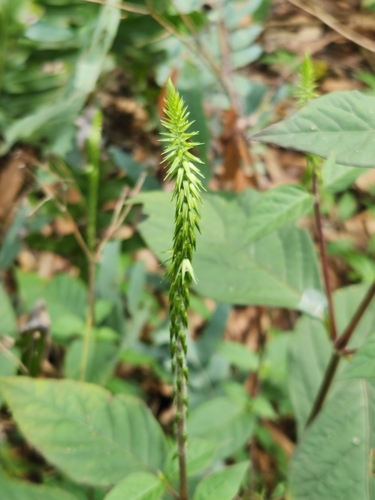
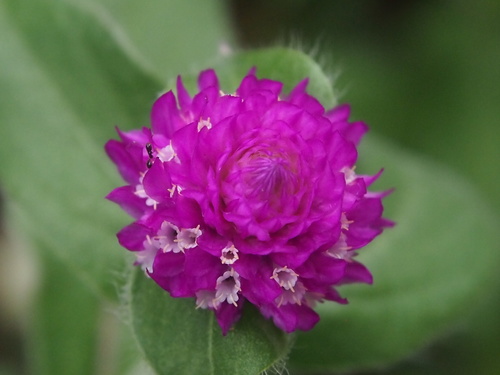
An upright bushy annual herb. Plants grow 30-60 cm high and spread to 30 cm across. Plants can lay over and root along the nodes. The leaves are oval and 15 cm long. They grow in pairs along the stem. They are covered with dense white hairs when young. The flower heads are oval and 3.5 cm long. They can be pink, red, purple or white flower bracts.
How to Grow
Plants can be grown from seed. The seedlings can be transplanted. Seed are sown 3-6 mm deep.
Medicinal Uses
In Hawaii, it is commonly used in long-lasting leis since it retains its shape and color after drying. In Nepal, the flower is known commonly as makhamali ful and is used to make a garland during Bhai Tika, last day of Tihar festival. The garland is put around the brother's neck by their sister for protection. The slow withering character of the flower symbolizes a long life for the brother. The flower was included in the gift sent to Britain by Jung Bahadur Rana in 1855. This flower is known as Rakta Mallika in Sanskrit. This plant is common in landscape design and cutting gardens for its vivid colors and color retention. The edible plant G. globosa has been used in herbal medicine. The flowers of G. globosa are rich in betacyanins which have a wide range of applications as additives and supplements in the food industry, cosmetics, and livestock feed. Stable between pH 3 and 7, the betacyanins in globe amaranth are well suited to be used as natural food dye and have a red-violet color.
Wikipedia
Source ↗Gomphrena globosa, commonly known as globe amaranth, is an edible plant from the family Amaranthaceae. The round-shaped flower inflorescences are a visually dominant feature and cultivars have been propagated to exhibit shades of magenta, purple, red, orange, white, pink, and lilac. Within the flowerheads, the true flowers are small and inconspicuous. Gomphrena globosa is native to Central America including regions Panama, and Guatemala, but is now grown globally. As a tropical annual plant, G. globosa blooms continuously throughout summer and early fall. It is very heat tolerant and fairly drought resistant, but grows best in full sun and regular moisture. The plant fixes carbon through the C4 pathway. At maturity, the flowerheads are approximately 4 centimetres (1.6 in) long and the plant grows up to 24 inches (61 cm) in height. Gomphrena globosa is an outcrossing species that is pollinated by butterflies, bees, and other insects. Floral volatiles likely play a significant role in the reproductive success of the plant by promoting the attraction of pollinators.
Other Information
It is grown as an ornamental in some coastal areas of Papua New Guinea.
Notes
There are about 90 Gomphrena species mostly in South America.
Names & Synonyms
Ablajtiin, Bachelor’s Buttons, Bachnhat, Didimangu, Idjoso, Idose, Lehua mau loa, Makhamali, Ma-nyo-lon-pan, Mseche, No-ngay, Oblocvetna gomfrena, Pahwis, Qian re hong, Staan vaste, Te motiti, Thousand Days red, Tocoroho
References (29)
- Ali, A. M. S., 2005, Homegardens in Smallholder Farming Systems: Examples from Bangladesh. Human Ecology, Vol. 33, No. 2 pp. 245-270
- Ambasta, S.P. (Ed.), 2000, The Useful Plants of India. CSIR India. p 242
- Bao Bojian; Steve Clemants, Thomas Borsch, Amaranthaceae [Draft], Flora of China
- Borrell, O.W., 1989, An Annotated Checklist of the Flora of Kairiru Island, New Guinea. Marcellin College, Victoria Australia. p 48
- Brickell, C. (Ed.), 1999, The Royal Horticultural Society A-Z Encyclopedia of Garden Plants. Convent Garden Books. p 479
- Burkill, H. M., 1985, The useful plants of west tropical Africa, Vol. 1. Kew.
- Burkill, I.H., 1966, A Dictionary of the Economic Products of the Malay Peninsula. Ministry of Agriculture and Cooperatives, Kuala Lumpur, Malaysia. Vol 1 (A-H) p 1115
- Burnie, G.(Ed.), 2003, Annuals and Bulbs. The Gardener's Handbooks. Fog City Press. p 165
- Codjia, J. T. C., et al, 2003, Diversity and local valorisation of vegetal edible products in Benin. Cahiers Agricultures 12:1-12
- Cundall, P., (ed.), 2004, Gardening Australia: flora: the gardener's bible. ABC Books. p 646
- Fowler, D. G., 2007, Zambian Plants: Their Vernacular Names and Uses. Kew. p 75
- Grubben, G. J. H. and Denton, O. A. (eds), 2004, Plant Resources of Tropical Africa 2. Vegetables. PROTA, Wageningen, Netherlands. p 562
- Kanis, A in Womersley, J.S., (Ed), 1978, Handbooks of the Flora of Papua New Guinea. Melbourne University Press. Vol 1. p 37
- Lazarides, M. & Hince, B., 1993, Handbook of Economic Plants of Australia, CSIRO. p 123
- Martin, F.W. & Ruberte, R.M., 1979, Edible Leaves of the Tropics. Antillian College Press, Mayaguez, Puerto Rico. p 174
- Parham, B. E. V., 1972, Plants of Samoa. New Zealand Department of Scientific and Industrial Research. Information Series. No. 85 p 71
- Peekel, P.G., 1984, (Translation E.E.Henty), Flora of the Bismarck Archipelago for Naturalists, Division of Botany, Lae, PNG. p 168, 169
- Pham-Hoang Ho, 1999, An Illustrated Flora of Vietnam. Nha Xuat Ban Tre. p 733
- Plants of Haiti Smithsonian Institute http://botany.si.edu
- Raponda-Walker, A & Sillans, R., 1961, Les Plantes Utiles du Gabon. Editions Paul Lechevalier, Paris. p 50
- Royal Botanic Gardens, Kew (1999). Survey of Economic Plants for Arid and Semi-Arid Lands (SEPASAL) database. Published on the Internet; http://www.rbgkew.org.uk/ceb/sepasal/internet [Accessed 25th March 2011]
- Smith, A.C., 1981, Flora Vitiensis Nova, Lawaii, Kuai, Hawaii, Volume 2 p 293
- Thaman, R. R., 1987, Plants of Kiribati: A listing and analysis of vernacular names. Atoll Research Bulletin No. 296
- Terra, G.J.A., 1973, Tropical Vegetables. Communication 54e Royal Tropical Institute, Amsterdam, p 49
- Thaman, R. R, 2016, The flora of Tuvalu. Atoll Research Bulletin No. 611. Smithsonian Institute p 62
- Thiselton-Dywer, W.T., (Ed.), 1913, Flora of Tropical Africa. Vol VI-section 1. Reeve, p 75
- Valder, P., 1999, The Garden Plants of China. Florilegium. p 358
- World Checklist of Useful Plant Species 2020. Royal Botanic Gardens, Kew
- Yuncker, T.G., 1959, Plants of Tonga, Bernice P. Bishop Museum, Hawaii, Bulletin 220. p 109