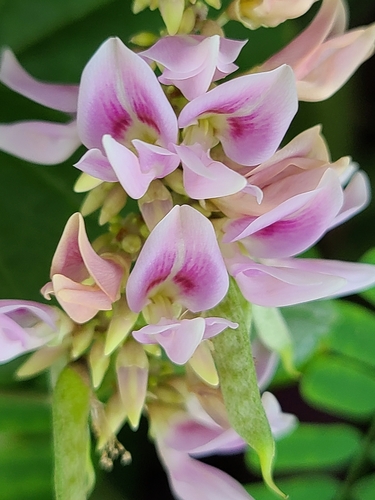
Acacia decora
Reichb. f.
Showy Wattle, Western Silver Wattle
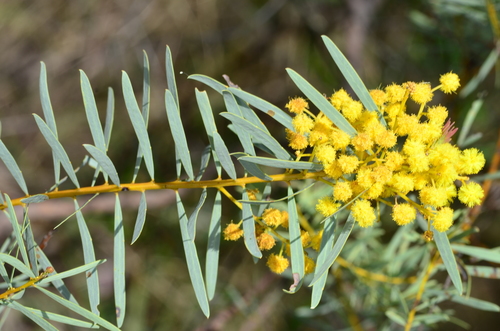
(c) Chris Lindorff, some rights reserved (CC BY-NC), uploaded by Chris Lindorff
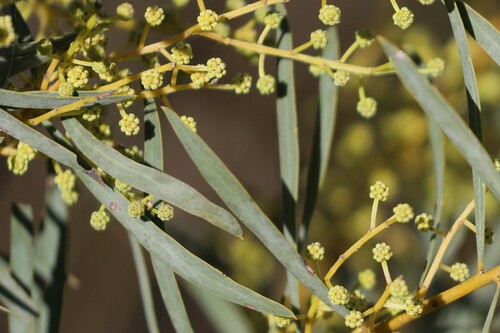
(c) Arthur Chapman, some rights reserved (CC BY-NC-SA), uploaded by Arthur Chapman

(c) discover_gondwana, some rights reserved (CC BY-NC), uploaded by discover_gondwana
What to Eat
Edible parts: Gum
The gum is eaten.
Where to Find It
It is a warm temperate and subtropical plant. It occurs naturally in New South Wales and Queensland in Australia. It prefers light to medium soils. It suits a sunny position but can grow in light shade. It is drought resistant but is probably damaged by frost. It suits hardiness zones 8-11.
Australia*,
How to Identify
A shrub or small tree. It grows 5 m tall. There are prickles along the stem. The leaves are twice divided and there are 8-18 pairs of pinnae. There are up to 50 pairs of pinnules on each pinnae. The flowers are yellow. They are in large clusters at the ends of branches. The pods are flattened.
How to Grow
It is grown from seed. The seed need treatment to break the hard seed coat. Normally this is by putting the seeds in very hot water and letting the water cool down overnight then planting the seeds immediately. It can be grown from cuttings. Trees can be pruned.
Wikipedia
Source ↗Acacia decora, commonly known as western silver wattle and showy wattle and other common names, is a species of flowering plant in the family Fabaceae and is endemic to eastern Australia. It is a shrub with lance-shaped, narrowly elliptic or more or less linear phyllodes, spherical heads of golden yellow flowers and papery to leathery pods.
Notes
There are about 1,350 Acacia species. Over 1,000 occur in Australia. Also as Mimosaceae.
Names & Synonyms
Pretty wattle, Western Golden Wattle
References (18)
- Bailey, F. M., 1913, Comprehensive Catalogue of Queensland Plants. Queensland Government. p 158
- Bircher, A. G. & Bircher, W. H., 2000, Encyclopedia of Fruit Trees and Edible Flowering Plants in Egypt and the Subtropics. AUC Press. p 4
- Bodkin, F., 1991, Encyclopedia Botanica. Cornstalk publishing, p 14
- Cundall, P., (ed.), 2004, Gardening Australia: flora: the gardener's bible. ABC Books. p 75
- Elliot, W.R., & Jones, D.L., 1982, Encyclopedia of Australian Plants suitable for cultivation. Vol 2. Lothian. p 40
- Etherington, K., & Imwold, D., (Eds), 2001, Botanica's Trees & Shrubs. The illustrated A-Z of over 8500 trees and shrubs. Random House, Australia. p 51
- Hedrick, U.P., 1919, (Ed.), Sturtevant's edible plants of the world. p 18
- Icon. bot. exot. 2:35, t. 199. 1829
- ILDIS Legumes of the World http:www;ildis.org/Legume/Web
- Irvine,
- Lazarides, M. & Hince, B., 1993, Handbook of Economic Plants of Australia, CSIRO. p 3
- Lord, E.E., & Willis, J.H., 1999, Shrubs and Trees for Australian gardens. Lothian. p 38
- Melzer, R. & Plumb, J., 2011, Plants of Capricornia. Belgamba, Rockhampton. p 185
- Molyneux, B. and Forrester, S., 1997, The Austraflora A-Z of Australian Plants. Reed. p 33
- Townsend, K., 1994, Across the Top. Gardening with Australian Plants in the tropics. Society for Growing Australian Plants, Townsville Branch Inc. p 52
- Townsend, K., 1999, Field Guide to Plants of the Dry Tropics. Society for Growing Australian Plants, Townsville Branch Inc. p 14
- Usher, G., 1974, A Dictionary of Plants Used by Man. Constable. p 12
- World Checklist of Useful Plant Species 2020. Royal Botanic Gardens, Kew