Gustavia superba
(Kunth) Berg
Membrillo

(c) Yeoh Thean Kheng, some rights reserved (CC BY-NC)

(c) Gabriela Rogers, some rights reserved (CC BY-NC), uploaded by Gabriela Rogers
(c) Jan Meerman, some rights reserved (CC BY-NC), uploaded by Jan Meerman
What to Eat
Edible parts: Fruit, Nuts
The fruit pulp is rich in vitamin A and is considered a delicacy in Colombia. The fruit is orange-coloured and globose, measuring up to 9 x 10cm.
Where to Find It
A tropical plant. It is native to Central and South America. It grows in rainforests and swampy woodlands. It can tolerate some drought. It grows up to 1,000 m altitude. It suits hardiness zones 10-12. In Townsville Anderson BG.
Asia, Australia, Central America*, Colombia, Costa Rica, Ecuador, Indonesia, Myanmar, Panama, SE Asia, Singapore, South America*,
How to Identify
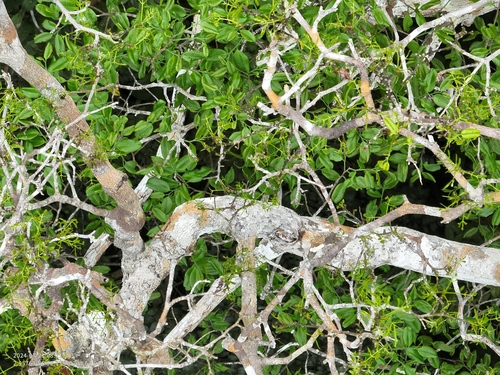
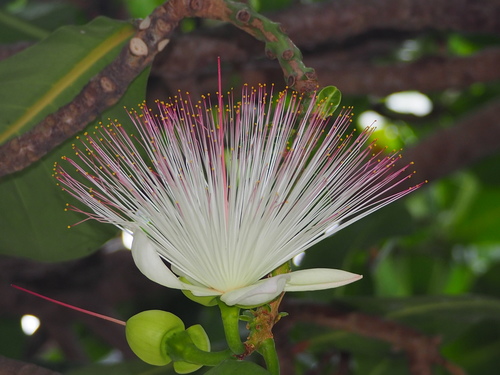
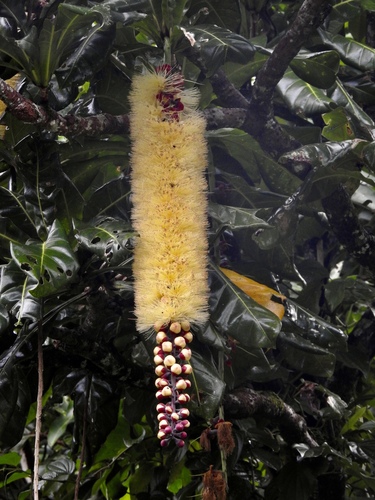
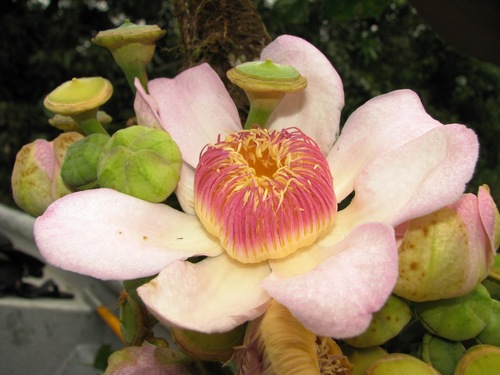
An evergreen tree. It grows 15 m high. The wood when cut produces a bad smell. The leaves are simple and deep green. They are 128 cm long and broadly sword shaped. They are deeply veined. The flowers are creamy-white to pale pink and 15 cm across. They have 7-9 wavy petals. They have a sweet smell. The fruit are like berries and 10 cm across. They are orange. The pulp is edible. It has seeds buried in it.
Nutrition Score: 26/100
| Part | Moisture | kJ | kcal | Protein | Vit A | Vit C | Iron | Zinc |
|---|---|---|---|---|---|---|---|---|
| Fruit | 0 | — | — | 15.2 | — | — | — | — |
How to Grow
It can be grown from seed or by layering.
Propagation: Seed; Layers
Medicinal Uses
None known
Other Uses
The heartwood is reddish brown, with thick sapwood that is nearly white with darker or nearly black streaks. The wood is straight and fine-grained, hard, heavy, strong, and tough. It splits and works fairly easily, takes an excellent polish, and is used to a limited extent for construction. The plant is also suited to use as a houseplant and in design applications including small flowering tree plantings, humid shade gardens, accents, large pots or planters, courtyards, and conservatories.
Wikipedia
Source ↗Gustavia superba is an understory tree in the family Lecythidaceae, that grows in Central and north-western South America. Common names include membrillo, sachamango, Stinkwood and heaven lotus. The trunk is around 5-10 m high with a rosette of very large leaves radiating from the top (like palms). These leaves can be up to 1.28 m (4 ft 2 in) long by less than 30 cm wide.
Production
It flowers year round.
Notes
There are 41 Gustavia species.
Names & Synonyms
Chope, Chupo, Manteco, Membrillo, Paco, Sachamango, Stinkwood, Tanchaape fintsumi, Tuba
References (19)
- Asprilla-Perea, J., & Diaz-Puente, J.M., 2018, Traditional use of wild edible food in rural territories within tropical forest zones: A case study from the northwestern Colombia. New Trends and Issues Proceedings on Humanities and Social Sciences [Online]. 5(1), 162–181.
- Barwick, M., 2004, Tropical and Subtropical Trees. A Worldwide Encyclopedic Guide. Thames and Hudson p 210
- Castaneda, H., & Stepp, J. R., 2007, Ecosystems as Sources of Useful Plants for the Guaymi People of Costa Rica. Ethnobotany Journal. 5:249-257
- Chizmar Fernandez, C., et al, 2009, Plantas comestibles de Centroamerica. Instituto de Biodiversidad, Costa Rica. p 221
- Condit, R., et al, 2011, Trees of Panama and Costa Rica. Princeton Field Guides. p 264
- Facciola, S., 1998, Cornucopia 2: a Source Book of Edible Plants. Kampong Publications, p 140
- Galeano, G., 2000, Forest Use at the Pacific Coast of Choco, Colombia: A Quantitative Approach. Economic Botany, Vol. 54, No. 3, pp. 358-376
- Grandtner, M. M. & Chevrette, J., 2013, Dictionary of Trees, Volume 2: South America: Nomenclature, Taxonomy and Ecology. Academic Press p 285
- Hermandez Bermejo, J.E., and Leon, J. (Eds.), 1994, Neglected Crops. 1492 from a different perspective. FAO Plant Production and Protection Series No 26. FAO, Rome. p15
- INFOODSUpdatedFGU-list.xls
- Llamas, K.A., 2003, Tropical Flowering Plants. Timber Press. p 245
- Kermath, B. M., et al, 2014, Food Plants in the Americas: A survey of the domesticated, cultivated and wild plants used for Human food in North, Central and South America and the Caribbean. On line draft. p 402
- Langlois, H. C., 2004, Ethnobotanical analysis of different successional stages as sources of wild edible plants for the Guaymi people in Costa Rica. M. Sc. thesis University of Florida.
- Lopez-Diago, D. & Garcia, N., 2021, Wild edible fruits of Colombia. Biota ColomBiana 22 (2) p 40
- Martin, F. W., et al, 1987, Perennial Edible Fruits of the Tropics. USDA Handbook 642 p 98
- Murilla, E., et al, 2010, Screening of vegetables and fruits from Panama for rich sources of lutein and zeaxanthin. Food Chemistry 122: 167-172
- Roa, J. A. G. & Boada, D. S. G., 2018, Fundación para el Fortalecimiento de la Fruticultura y Plantas Alimenticias no Convencionales en Colombia.
- Sukarya, D. G., (Ed.) 2013, 3,500 Plant Species of the Botanic Gardens of Indonesia. LIPI p 638
- Torre, de la, L., et al, 2008, Enciclopedia de las Plantas Útiles del Ecuador. Herbario QCA. Pontificia Universidad Católica del Ecuador. p 404